In the rapidly evolving landscape of personal audio, where multi-driver hybrids and massive dynamic-driver configurations often dominate the marketing narrative, the arrival of the MAKINAaudio T-100B is a refreshing exercise in restraint. Priced at $149.00, this single balanced armature (BA) universal in-ear monitor (IEM) arrives from a newcomer company with a veteran pedigree. South Korea-based MAKINAaudio, which debuted in late 2025, is staffed by industry professionals boasting over two decades of acoustic engineering experience. The T-100B serves as a definitive statement from this team: a commitment to coherent, monitoring-style audio performance over the "more is better" philosophy.
The Genesis of the T-100B: Company Background and Philosophy
The audio industry is often cyclical. While the market has shifted toward complex hybrid setups, there remains a dedicated cohort of audiophiles who prioritize the phase coherence and transient response that only a single-driver design can provide. By positioning the T-100B within the $150 segment, MAKINAaudio is challenging both established boutique brands and high-volume manufacturers.

The company’s philosophy is rooted in the belief that electronic signal management—rather than reliance on acoustic chambers alone—is the key to a refined frequency response. Their team, having spent twenty years refining their craft, brings a mature perspective to the T-100B, focusing on the "monitoring-like" sound signature that has become a staple of professional audio production.
Technical Architecture: Precision Engineering
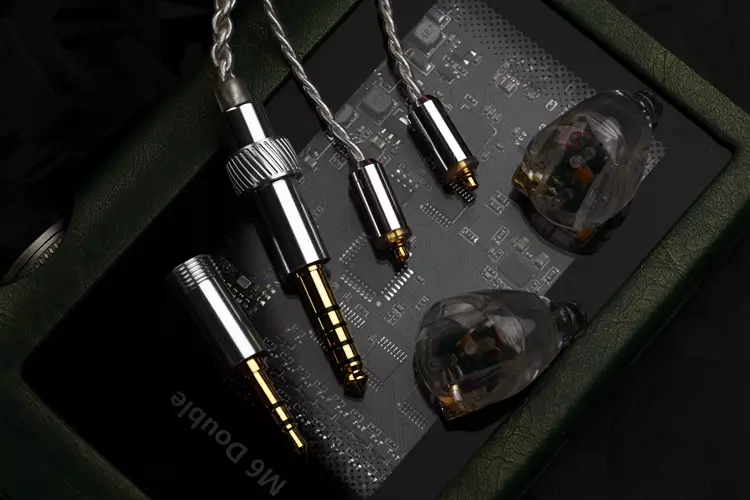
At the heart of the T-100B lies a custom-designed full-range balanced armature driver. Unlike entry-level IEMs that rely on basic acoustic damping, the T-100B utilizes a sophisticated network of electronic components—specifically resistors and capacitors mounted on an internal PCB—to shape the frequency response. This approach allows for a level of precision that mechanical chambers simply cannot match.

Key Specifications
- Driver: Custom-designed full-range single BA
- Impedance: 23Ω
- Sensitivity: 110 dB
- Connection: MMCX
- Cable: 1.2m 6N OCC high-purity copper
The visible nature of this internal circuitry, framed by a transparent shell, is more than an aesthetic choice; it serves as a testament to the engineering labor involved in the tuning process. Furthermore, the inclusion of a specialized tuning filter within the nozzle ensures that the output remains consistent and free of unwanted resonant artifacts.
Design and Ergonomics: Utilitarian Elegance
The T-100B does not strive for the flamboyant, jewelry-like aesthetic that defines much of the current IEM market. Instead, it embraces a utilitarian, "no-nonsense" design language. The shell is lightweight—weighing in at just 3 grams—and lacks complex geometry, favoring a shape that fits securely in the ear for extended periods.

Build and Connectivity
While the transparent shells provide a view of the high-quality PCB and driver assembly, some users may find the choice of MMCX connectors slightly restrictive. In an era where 2-pin connectors have become the industry standard for their durability and ease of replacement, the MMCX interface requires a bit more care. However, the stock cable is a standout component. Constructed from 6N OCC (Ohno Continuous Cast) copper, it offers a distinct upgrade in conductivity over standard OFC cables. It features a modular plug system, allowing the user to swap between 3.5mm single-ended and 4.4mm balanced connections without needing an aftermarket cable.
Sound Impressions: The Monitoring Standard
The T-100B is explicitly tuned for the listener who values accuracy over coloration. For those accustomed to the "V-shaped" sound signature—characterized by boosted bass and shimmering treble—the T-100B will require an adjustment period.

Frequency Response and Tonality
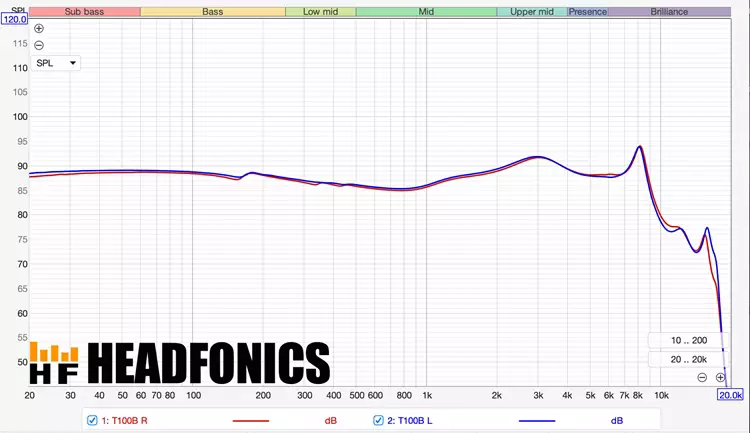
The bass response is characterized by speed and decay. It is neutral, flat, and articulate. While sub-bass enthusiasts may find the low-end "subdued," the lack of a bloated mid-bass shelf allows the midrange to shine with exceptional clarity. Vocals, in particular, are rendered with a natural weight that avoids the thinness often associated with single BA designs.
The midrange is undeniably the T-100B’s centerpiece. It is smooth, linear, and devoid of the "shoutiness" that plagues many mid-tier monitors. The treble is equally well-behaved; it follows a flat, monitoring-style trajectory that focuses on the fundamental harmonics of instruments rather than artificial airiness.
Soundstage and Imaging
The staging of the T-100B is compact but highly accurate. Rather than artificially stretching the soundstage at the cost of coherence, MAKINAaudio has opted for a presentation that prioritizes depth and layering. The imaging is sharp enough to place instruments within the mix with ease, providing a sense of space that is both intimate and accurate.
Performance Analysis: Strengths and Limitations
Our testing, conducted using the iBasso DC-Elite and the FiiO M15S, revealed a high degree of consistency across various sources. The T-100B does not require high-voltage amplification to perform optimally, though it benefits from the clean noise floor of high-end DAPs.

The Distortion Variable
During rigorous stress testing with bass-heavy tracks at high volumes, we observed a faint distortion. While this is likely a physical limitation of the single balanced armature driver being pushed to its mechanical limits, it is important to note that this only occurs at volumes far beyond what is considered "safe" or standard for critical listening. In everyday use, this is a non-factor.
Comparative Perspective
When compared to the Hidizs MP145 PRO or the ddHiFi Memory, the T-100B stands apart by refusing to chase the trends. Where others seek to impress with driver count or massive low-end impact, the T-100B aims to provide a neutral window into the music. It is, by all definitions, a reference-grade monitor for the entry-level enthusiast.

Implications for the Market
The emergence of the T-100B carries significant implications for the future of the sub-$200 IEM market. It proves that there is still a vital space for single-driver designs if the engineering is sound. By ignoring the "driver-war" and focusing on the implementation of high-quality internal components, MAKINAaudio has created a product that serves as a benchmark for clarity and coherence.
As the industry continues to push the boundaries of what is possible with hybrid configurations, the T-100B serves as a reminder that fundamental acoustic principles, when applied with twenty years of expertise, often yield the most rewarding musical experiences. For the listener who is tired of artificial tuning and desires a return to the source material, the MAKINAaudio T-100B is not just a purchase; it is a point of reference.
Conclusion
The MAKINAaudio T-100B is an honest, well-executed, and highly capable IEM. While it may not win awards for its minimalist design, it earns high marks for its commitment to a balanced, detailed, and fatigue-free listening experience. For those who prioritize vocal clarity, transient speed, and accurate instrument timbre, the T-100B represents a significant value proposition in a crowded marketplace. It is a bold debut from a company that clearly understands that the best sound is not necessarily the loudest, but the most accurate.