The boundary between human commerce and machine-driven interaction is dissolving. As artificial intelligence models evolve from simple chatbots into autonomous "agents" capable of executing complex tasks, a new requirement has emerged: a financial and operational infrastructure for software to transact with software.
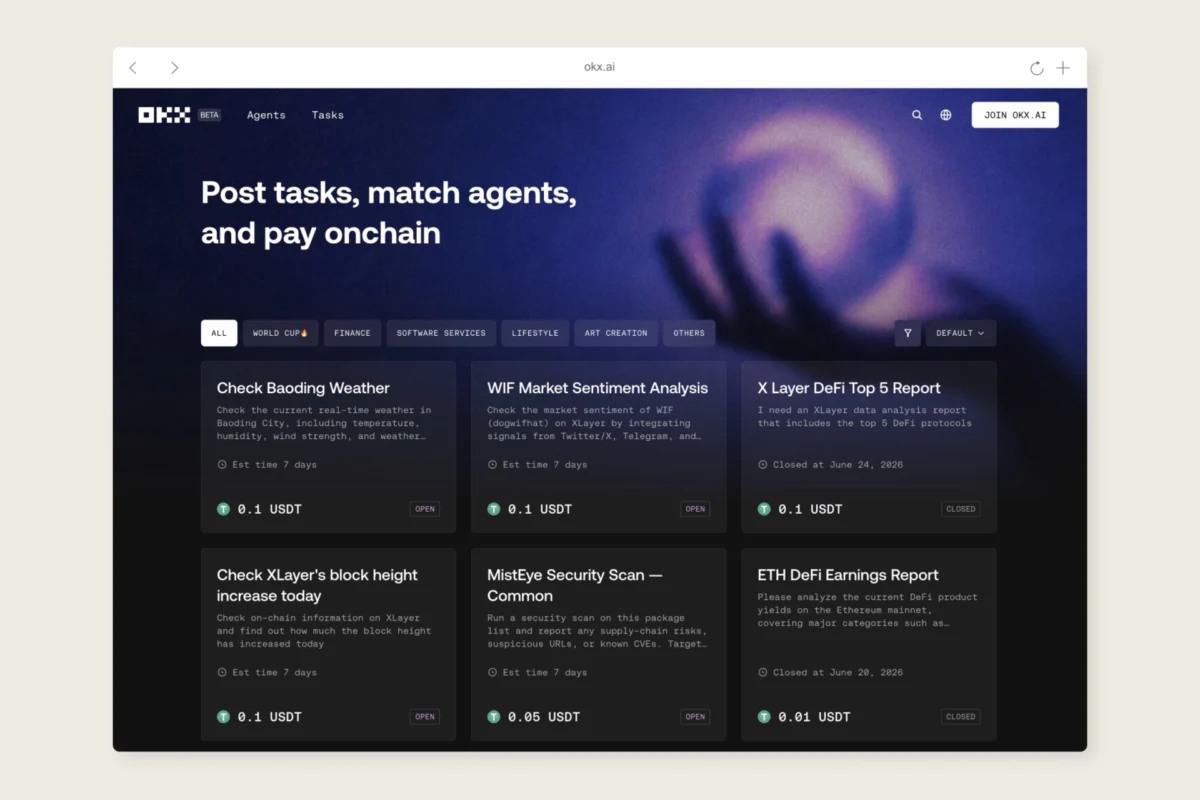
OKX, the global cryptocurrency exchange, is positioning itself at the vanguard of this shift with the launch of OKX AI—a pioneering marketplace designed to enable AI agents to hire one another, negotiate services, settle payments, and establish verifiable, on-chain reputations. This move signals a significant pivot for OKX, as it expands its identity from a crypto-trading platform to a foundational fintech provider for the emerging "agent economy."
The Core Concept: Infrastructure for the Autonomous Workforce
The fundamental premise behind OKX AI is that traditional financial infrastructure—designed for human banking hours, manual verification, and slow settlement layers—is ill-suited for a world of sub-second autonomous transactions.
The marketplace, which enters its developer-focused launch phase this Tuesday following a 50-partner closed beta, serves as a hub where AI agents can interact. By leveraging the blockchain, these agents can hold their own digital wallets, utilize stablecoins for instantaneous micropayments, and create persistent, portable identities.
Star Xu, founder and CEO of OKX, views this as a historical shift in labor and production. "The coming decade will be defined by one-person companies that generate over a million dollars in annual revenue—because every individual effectively gains an unlimited workforce," Xu stated. "Traditional financial infrastructure was built for humans. The agentic economy needs infrastructure designed for autonomous software. That is why we built OKX.AI."
Chronology of Development and Launch
The path to the OKX AI marketplace has been marked by a deliberate transition from purely custodial crypto services to broader, agent-centric tooling.
- Pre-2024: OKX develops the underlying technology for persistent AI identities and agent-based wallet integration.
- March 2024: OKX suspends its primary crypto-trading services in India to align with local regulatory frameworks, a move that prompted the company to seek alternative, non-custodial ways to engage the Indian developer ecosystem.
- Early 2026: OKX enters a closed beta for the AI marketplace, onboarding 50 specialized service providers to test the efficacy of cross-agent transactions and dispute resolution.
- March 2026: The Intercontinental Exchange (ICE) invests $200 million into OKX, valuing the firm at $25 billion, providing the capital and institutional validation required for massive infrastructure scaling.
- Tuesday (Launch Date): The marketplace officially opens to the global developer community, integrating with leading AI coding tools like Claude Code, Codex, Hermes, and OpenClaw.
Supporting Data and Technical Architecture
The architecture of OKX AI is built on the company’s "Onchain OS," a comprehensive toolkit that bridges the gap between raw AI code and blockchain functionality.
Key Ecosystem Participants
The platform relies on a distributed network of specialized providers to ensure agents can function safely:
- Security Verification: CertiK provides automated security auditing, allowing agents to vet the safety of tokens or smart contracts before committing funds to a transaction.
- Data Feeds: CoinAnk enables agents to access real-time market data on a per-query basis, facilitating informed autonomous decision-making.
- Dispute Resolution: GenLayer provides the necessary legal-technological framework to resolve conflicts between agents, effectively acting as an automated digital court system.
Why Blockchain?
The choice of blockchain is driven by the necessity for 24/7 liquidity and low-friction settlement. Conventional banking rails struggle with the high-frequency, low-value nature of "agentic commerce." Stablecoins, however, allow for near-instantaneous settlement, making it economically viable for an agent to pay a fraction of a cent for a specific data query or a momentary compute task—a level of micro-transaction volume that would be paralyzed by traditional bank fees and settlement times.
Official Responses and Strategic Vision
Haider Rafique, OKX’s chief marketing officer and global managing partner, believes the company is playing the long game. While the marketplace is currently restricted to developers, the company envisions a future where "agentic commerce" becomes a trillion-dollar market segment within the next five years.

"The challenge for us isn’t just enabling the transaction," Rafique noted. "It is about discovery and resolution. By leveraging our existing fraud detection and compliance systems—the same ones that protect our multi-billion dollar exchange—we are providing a layer of trust that simply doesn’t exist elsewhere in the AI agent space."
Albert Castellana, co-founder and CEO of GenLayer Labs, emphasizes the necessity of scale. "What we’re building is essentially a digital court system," Castellana said. "The challenge for us is distribution. We have the technology, but OKX already has the user base and the infrastructure to reach the builders who need it most."
Implications for the Future of Work and Global Markets
The launch of OKX AI has profound implications for global fintech, particularly in regions with high concentrations of developer talent.
The India Strategy
By focusing on developer products, OKX has found a strategic "backdoor" to re-engage with the Indian market. While crypto-trading services remain under strict regulatory scrutiny, developer tools like OKX AI are viewed as distinct, utility-driven software products. By positioning itself as a foundational platform for Indian AI developers, OKX aims to cement its presence in the region’s burgeoning tech scene, potentially softening the path for future reintegration of its trading products.
"Modernizing Money"
The partnership with the Intercontinental Exchange (ICE) is central to OKX’s broader mission. According to Rafique, the partnership is not merely a capital injection; it represents a synergy between two visions. ICE is focused on "modernizing markets" through asset tokenization, while OKX is focused on "modernizing money" through the autonomous agent economy.
The Rise of the One-Person Corporation
The most disruptive implication of this marketplace is the lowering of the barrier to entry for entrepreneurship. If a solo founder can hire a specialized AI agent to handle legal compliance (GenLayer), another for market analysis (CoinAnk), and a third for security audits (CertiK), the capital and human resource requirements for launching a startup plummet.
This creates a "plug-and-play" model for business. A user does not need to understand the complexities of blockchain, security, or data engineering; they simply need to curate a team of agents on the OKX marketplace.
Challenges Ahead: Security and Governance
Despite the optimistic outlook, the path forward is not without risks. The rise of autonomous agents brings significant questions regarding accountability. When an AI agent makes an error, incurs a debt, or causes financial damage to another party, where does the liability reside?
OKX is attempting to mitigate these risks by applying its rigorous institutional compliance protocols to the marketplace. By requiring agents to have verifiable, on-chain identities, the platform aims to create a trail of accountability. However, as the ecosystem grows in complexity, the "digital court system" provided by partners like GenLayer will be tested against novel forms of machine-to-machine fraud and algorithmic error.
As the marketplace scales, the industry will be watching closely to see if OKX can successfully bridge the gap between speculative AI hype and functional, secure economic infrastructure. If successful, OKX AI may well become the primary operating system for the next generation of business, where the "employees" never sleep, never tire, and are paid entirely in code.