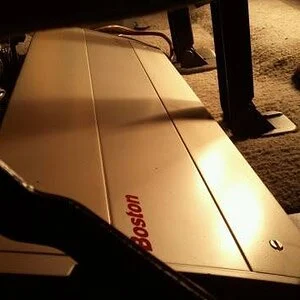
The pursuit of high-fidelity audio in classic automotive platforms presents a unique set of engineering challenges. Recently, enthusiasts have been exploring the efficacy of repurposing four-channel amplifiers to drive dedicated subwoofer units, a technique known as "bridging." This method allows car audio hobbyists to consolidate power, transforming a standard multi-channel setup into a high-output sound system. Using a 1979 Chevrolet Camaro—a vehicle noted for its iconic design but constrained internal acoustic geometry—as a case study, we explore the technical requirements and best practices for integrating a 10-inch subwoofer into a limited-space environment.
Main Facts: The Mechanics of Bridging Channels
At the heart of the inquiry is a 4-channel amplifier delivering 150 watts per channel. The current configuration utilizes two channels to drive a pair of 6×9-inch coaxial speakers. The remaining two channels are candidates for "bridging," a process that combines the output of two separate channels into a single mono output, effectively doubling the voltage swing and, theoretically, significantly increasing the power delivery to a single subwoofer.
Bridging is not a universal feature, and it requires careful consideration of the amplifier’s internal architecture. Most modern 4-channel amplifiers are designed to be bridgeable in pairs (Channels 1 & 2, and Channels 3 & 4). When bridged, the amplifier sees a different load impedance. If a single channel is designed for a 2-ohm load, the bridged pair typically requires a 4-ohm load to operate safely and efficiently. Failure to adhere to these impedance requirements can lead to thermal runaway, amplifier clipping, or catastrophic failure of the output stages.
Chronology of Audio System Evolution
The evolution of car audio, particularly in muscle cars like the 1979 Camaro, has shifted from simple "head unit and two speakers" setups to complex, integrated systems that prioritize frequency response and sound staging.
- The Early Era (1970s–1990s): Audio systems were primarily focused on basic playback. Factory speakers were often limited by shallow mounting depths and poor enclosure integration.
- The High-Fidelity Transition (2000s–2010s): The emergence of accessible Class-D amplification allowed for higher power density in smaller chassis, enabling enthusiasts to add subwoofers without sacrificing the entire trunk space.
- The Current Optimization Phase (2020s–Present): With the rise of digital signal processing (DSP) and high-efficiency subwoofers, the current focus is on "system synergy"—ensuring that every watt of amplifier power is utilized effectively through correct impedance matching and enclosure design.
In the case of the user’s 1979 Camaro, the project represents a classic optimization cycle: beginning with standard mid-range reinforcement (the 6x9s) and graduating to full-range sound reinforcement by adding the low-frequency foundation provided by a 10-inch subwoofer.
Supporting Data: Technical Considerations for Integration
When selecting a subwoofer to match a 300-watt RMS bridged output, the technical specifications must be treated with precision.
Power Handling vs. Amplifier Output
The relationship between an amplifier’s RMS (Root Mean Square) output and a subwoofer’s power handling is critical. A common misconception is that a subwoofer must have a higher power rating than the amplifier. In reality, matching the RMS ratings is the "sweet spot." Providing 300 watts to a 300-watt RMS subwoofer ensures that the amplifier can drive the sub to its mechanical limit without introducing "clipping"—a form of distortion that is the leading cause of voice coil failure.
Impedance Matching
Impedance is the resistance the subwoofer presents to the amplifier. As noted, most 4-channel amps bridge at 4 ohms. Therefore:
- Single Voice Coil (SVC) 4-ohm: Ideal for a direct connection to a bridged pair.
- Dual Voice Coil (DVC) 2-ohm: Can be wired in series to create a 4-ohm load, making it a highly versatile choice.
- DVC 4-ohm: Wired in parallel, this would create a 2-ohm load, which is often too low for bridged channels and could trigger the amplifier’s protection circuitry.
Enclosure Physics
The environment of a 1979 Camaro is unique. The trunk space is significant but often separated from the cabin by the rear deck.
- Sealed Enclosures: Provide a "tight" bass response with a gradual roll-off. These are generally smaller, making them ideal for vehicles where cargo space is at a premium.
- Ported (Vented) Enclosures: Use a tuned vent to increase output at specific frequencies. While they are more efficient, they require a larger volume of air and are physically bulkier, which may prove challenging to fit in the trunk of a vintage vehicle while maintaining aesthetic appeal.
Official Recommendations and Expert Guidance
Industry experts, including those within the professional audio community, consistently recommend the following models for users operating within the 300-watt RMS, 10-inch subwoofer category:
1. Rockford Fosgate P10D2
This unit is favored for its rugged construction and its ability to handle 300 watts RMS. Its Dual 2-ohm voice coil configuration provides the flexibility to achieve a 4-ohm load when wired in series, making it a perfect match for a bridged 4-channel amplifier.
2. JL Audio 10W0V3-4
JL Audio is renowned for its linearity and sound quality. The 10W0V3-4 is a staple in the entry-to-mid-level category. Being a single 4-ohm voice coil, it offers a "plug-and-play" simplicity for bridged setups, requiring no complex wiring configurations.
3. Kicker 43CWR104
The Kicker CompR series is designed for those who prioritize output. With a dual 4-ohm configuration, users must ensure their wiring topology matches their amplifier’s capabilities. It is a highly durable option for the high-vibration environment of a muscle car.
Implications for Future Upgrades
Integrating a subwoofer into a vintage vehicle like a ’79 Camaro has implications that extend beyond just the audio system.
Electrical Load
Classic cars typically feature electrical systems with lower amperage output compared to modern vehicles. A 300-watt amplifier is a relatively modest draw, but it is prudent to ensure the alternator is healthy and the battery ground is robust. Upgrading the "Big Three" (alternator positive to battery positive, battery negative to chassis, and engine block to chassis) is a recommended preventative measure to avoid voltage drops that can lead to flickering lights or amplifier distortion.
Acoustic Integration
In a 1979 Camaro, the rear deck is often constructed of thin metal or fiberboard. When mounting 6×9 speakers and introducing a subwoofer, the potential for panel resonance is high. Enthusiasts should consider applying sound-deadening materials (such as butyl-based mats) to the rear deck and trunk floor. This reduces unwanted vibrations, improves the "tightness" of the bass, and prevents the "rattling" often associated with older vehicles.
Safety and Wiring
Professional installation standards dictate that the positive power wire must be fused at the battery terminal within 18 inches of the connection. Furthermore, using oxygen-free copper (OFC) wiring is highly recommended over copper-clad aluminum (CCA), as OFC offers lower resistance and better current-carrying capacity, which is essential for maintaining consistent power delivery to the amplifier during high-demand bass transients.
Conclusion
The project of integrating a 10-inch subwoofer into a 1979 Camaro by bridging a 4-channel amplifier is a technically sound and rewarding endeavor. It requires a disciplined approach to impedance matching, enclosure volume calculations, and basic electrical maintenance. By selecting a subwoofer with a compatible RMS rating—such as the Rockford Fosgate P10D2 or the JL Audio 10W0V3-4—and ensuring the amplifier is bridged correctly, the enthusiast can achieve a substantial improvement in the vehicle’s acoustic performance.
While the mechanical constraints of a vintage Camaro require careful planning regarding space and panel resonance, the result is a balanced system that respects the car’s heritage while delivering the high-fidelity experience expected by modern standards. As the user moves forward with this installation, the key remains consistent: prioritize quality components, follow the amplifier’s technical manual to the letter, and do not overlook the importance of sound damping to ensure that the bass heard is the bass intended, free from the interference of the vehicle’s chassis.