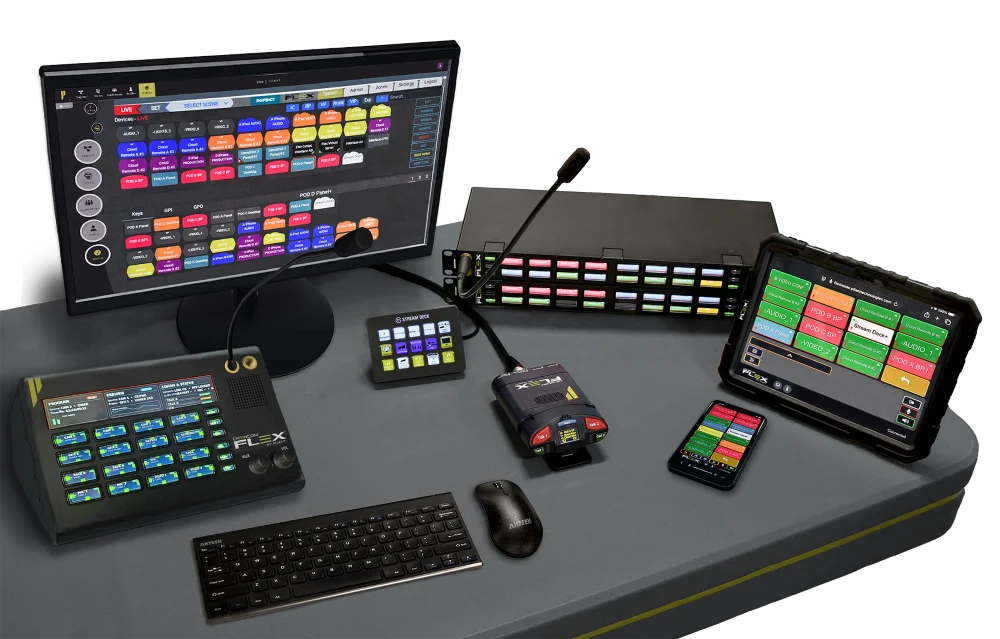
LAS VEGAS — The landscape of professional broadcast and live production communications is undergoing a paradigm shift. At the 2026 InfoComm Show in Las Vegas, Pliant Technologies officially pulled back the curtain on its most ambitious platform to date: CrewCom Flex. By moving away from the rigid, centralized hardware frames that have defined intercom architecture for decades, Pliant is introducing a fully distributed, IP-based ecosystem that promises to redefine how hybrid and remote teams collaborate.
The announcement represents a significant departure from traditional matrix-based intercom systems, opting instead for a standards-based AES67 and SMPTE ST 2110 backbone. This transition signals a broader industry move toward software-defined, virtualized infrastructures, offering users the ability to merge wired, wireless, and virtual communications into a single, unified workflow.
The Core Concept: Breaking the Matrix
For years, the "matrix frame" has been the heart and the bottleneck of professional intercom systems. These centralized hardware units—while reliable—have historically created limitations in scalability, physical footprint, and disaster recovery. If the frame failed, the entire communication network went dark.
CrewCom Flex eliminates the frame entirely. By utilizing a distributed processing architecture, every panel, desktop station, and beltpack within the CrewCom Flex ecosystem functions as an intelligent, autonomous node. This architecture ensures that there is no single point of failure, a critical requirement for high-stakes production environments like live sports, large-scale theater, and national news broadcasting.
"With our truly distributed architecture, there is finally an intercom system with no single point of failure," said Gary Rosen, vice president of Global Sales for Pliant Technologies. "CrewCom Flex delivers a lower total cost of ownership, reduced hardware inventory, simplified configuration, and effortless remote production workflows. It’s intercom with fewer limitations and far more possibilities."
Technical Specifications and Infrastructure
At the heart of the CrewCom Flex platform are the new CKP-16 Main Panel and CDP-16 Desktop Panel. These units bridge the gap between traditional tactile hardware and modern, IP-based distribution. Because each panel acts as its own intelligent matrix, the system can scale almost infinitely. Production teams can add expansion panels to create customizable user stations tailored to specific production roles, all without needing to upgrade a central rack-mounted processor.
Standards-Based Reliability
In an era where AoIP (Audio over IP) is the gold standard, CrewCom Flex is built upon a foundation of industry-standard protocols:
- AES67 and SMPTE ST 2110: These standards ensure seamless integration with existing professional audio and video routing infrastructures.
- ST 2022-7 Compliance: For critical applications where downtime is not an option, the system supports hitless merge redundancy, ensuring constant communication even if a network path is interrupted.
- Dante Integration: Through the CXD-32CF 32×32 Digital Audio Network Interface, the platform connects directly with existing CrewCom wireless systems, using robust EtherCon copper or dual LC fiber connectivity to bridge the gap between legacy wireless setups and the new Flex IP backbone.
The "Flex" Ecosystem: Wireless, Wired, and Virtual
The term "Flex" in the product name is not merely branding; it describes the versatility of the deployment options available to the end-user.
1. New Hardware: The BeltPack Evolution
Pliant is introducing two new models of the CrewCom Flex BeltPack: the CBP-22 (two-channel) and the CBP-24 (four-channel). Beyond their standard wireless capabilities, these packs feature integrated microphones and built-in loudspeakers. This is a game-changer for production crew members who may need to move between "headset-on" and "headset-off" states, such as floor managers or stage technicians who need to monitor communications while remaining spatially aware of their environment.
2. Virtual Intercom: The Cloud-Native Future
Perhaps the most notable addition to the ecosystem is the CrewCom Flex Virtual Intercom. This browser-based application allows users to deploy intercom functionality onto PCs, Macs, tablets, or mobile devices.
- Scalability: Available in 4-, 8-, 16-, and 36-key configurations.
- Deployment: It can function as a standalone system or integrate into a larger, multi-site hardware deployment.
- Remote Workflows: As remote production becomes the standard rather than the exception, the ability to grant a producer in London or a director in New York a fully functional intercom interface via a secure browser connection represents a massive leap forward in production efficiency.
Simplifying the Workflow: CrewWare 2.0
Hardware is only as effective as the software that manages it. Pliant has accompanied the launch of CrewCom Flex with the release of CrewWare 2.0. This updated software platform focuses on visual, drag-and-drop management.
"There are virtually no limits on size, geography, or project type with CrewCom Flex," Rosen noted. "Whether your workflow requires traditional panels, desktop panels, wireless users, virtual panels, site-to-site communications, or cloud-based deployments, every user experiences the same intuitive interface and streamlined communication workflow."
The software allows engineers to map complex routing paths, manage user permissions, and configure remote stations in minutes—a task that previously would have required extensive programming on legacy matrix hardware.
Chronology of Development
The development of CrewCom Flex follows a multi-year trend at Pliant Technologies toward IP-based wireless solutions.
- 2016-2020: Pliant established the CrewCom wireless brand, focusing on high-density RF performance.
- 2021-2024: The industry saw a surge in demand for hybrid workflows as global events shifted toward decentralized production. During this time, Pliant worked to integrate Dante and AES67 into their existing wireless frameworks.
- 2025: Beta testing of the distributed IP-matrix architecture took place in various live-event environments to ensure the "no single point of failure" mandate was met.
- June 2026 (InfoComm): Official public unveiling and market release of the CrewCom Flex platform.
Industry Implications
The release of CrewCom Flex arrives at a time when production houses are under immense pressure to reduce physical equipment footprints while simultaneously expanding the complexity of their shows.
Financial Impact
By moving to a distributed architecture, rental houses and broadcasters can see a significantly lower total cost of ownership (TCO). Because the system does not require massive, specialized matrix frames, the need for custom, high-cost cabling is reduced. Existing IP networks can often serve as the transport layer, utilizing fiber backbones already present in many production facilities.
Operational Agility
The ability to spin up virtual panels means that production teams can scale up for a major event—like a championship game or a global awards show—and then scale down instantly for smaller, daily productions. The modularity of the system means that a facility can grow its intercom capabilities one panel at a time, rather than investing in a massive central matrix that sits underutilized for 80% of the year.
Looking Ahead: The Future of Communication
As the industry continues to gravitate toward SMPTE ST 2110 for video and audio routing, the intercom has often been the "last holdout" of proprietary, closed-box hardware. Pliant Technologies is effectively ending that era.
With the CrewCom Flex, the intercom becomes just another high-performance node on the network. For technicians and engineers, this means a more manageable, flexible, and resilient communication strategy. For the performers and crew on the ground, it means a more reliable connection to the heart of the production.
As InfoComm 2026 concludes, the message from Pliant is clear: the future of intercoms is no longer defined by the frames they inhabit, but by the intelligence of the network they build. Whether in a local studio or a globally distributed cloud environment, CrewCom Flex is positioned to be the backbone of the next generation of professional production.
Pliant Technologies is currently showcasing the CrewCom Flex platform at booth N6151 at InfoComm 2026.