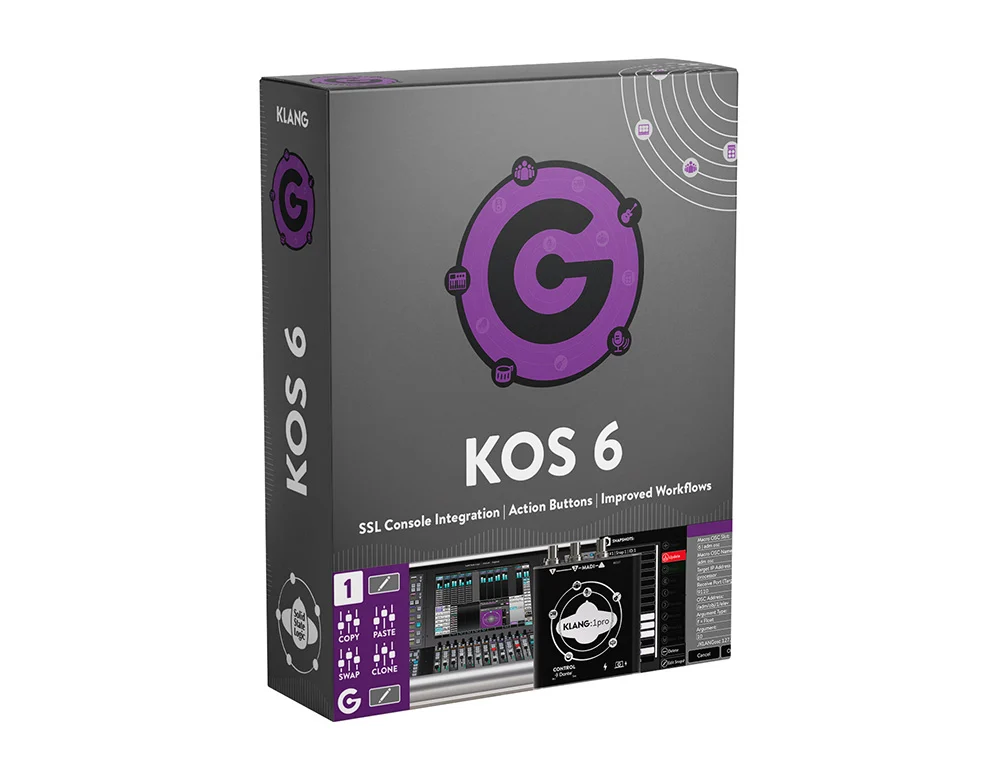
In a significant advancement for the world of live sound and professional monitoring, KLANG:technologies has officially released KOS 6, the latest iteration of its immersive in-ear mixing operating system. This comprehensive update, now available for free download, represents a major milestone in the evolution of KLANG’s product ecosystem, introducing deep-level console integration, refined workflow efficiencies, and a pioneering commitment to accessibility in professional audio.
Designed to serve the needs of touring engineers, studio professionals, and production houses, KOS 6 addresses the growing demand for more compact, flexible, and integrated immersive mixing solutions. With the introduction of support for the KLANG:1 and :1pro processors—both unveiled at the most recent NAMM Show—the company is positioning itself to provide high-end spatial audio capabilities across a wider spectrum of production scales.
Main Facts: The Core Pillars of KOS 6
KOS 6 is more than a simple firmware patch; it is a fundamental platform update that touches every aspect of the KLANG user experience. The release is defined by four core advancements:
1. Expanded Console Integration
The highlight of this release is the deepening of the relationship between KLANG processors and Solid State Logic (SSL) Live consoles. By enabling native control directly from the console surface, engineers can now manage immersive IEM processing without leaving their primary mixing environment. This includes per-channel and per-mix EQ shaping, routing configurations, and monitoring capabilities, all accessible via the familiar SSL interface.
2. Streamlined Connectivity and Networking
One of the most frequent pain points for live sound engineers is the complexity of IT networking. KOS 6 simplifies the setup process by allowing for easier separation of Dante audio and control networks. Furthermore, the system now supports a dedicated IP setup for KLANG:kontroller, eliminating the need for complex VLAN configurations and significantly reducing the time required for system deployment.
3. Workflow Acceleration
Efficiency is paramount in live production. The introduction of "Action Buttons" allows users to map critical functions—such as snapshot triggering, device preparation, and mix loading—directly onto the main menu. Additionally, the new Batch Snapshot Editing tool permits the simultaneous adjustment of parameters like panning, gain, and filter settings across multiple snapshots, effectively ending the tedious process of manual, scene-by-scene editing.
4. Broadened Compatibility
Beyond proprietary integrations, the update introduces ADM-OSC support, allowing for standardized real-time spatial control. This enables external immersive audio systems and consoles that lack native KLANG support to communicate with the processor, broadening the ecosystem’s interoperability.

Chronology: From Concept to Global Release
The development of KOS 6 follows a strategic trajectory designed to synchronize with the release of the company’s newest hardware line.
- January 2026 (NAMM Show): KLANG:technologies debuts the KLANG:1 and :1pro, hardware units aimed at bringing the immersive workflow to compact and mobile environments.
- Q1–Q2 2026: Following the NAMM debut, the engineering team shifts focus to finalizing the software backbone required to unify these new units with the existing KLANG:app ecosystem.
- Early June 2026: Beta testing concludes with select high-profile touring engineers, focusing on the stability of the SSL integration and the robustness of the new network protocols.
- June 15, 2026: KLANG:technologies officially announces the global availability of KOS 6. The software is released to the public, accompanied by the updated KLANG:app, ensuring seamless compatibility across all legacy and new-generation hardware.
Supporting Data: Technical Enhancements
To understand the impact of KOS 6, one must look at the technical architecture underlying these updates.
Bitfocus Companion and External Control
The integration of Bitfocus Companion compatibility for KLANG is a game-changer for production teams utilizing Elgato Stream Decks. By offloading complex macro operations to physical, programmable buttons, engineers can now trigger sophisticated immersive transitions with a single touch. This level of granular control is particularly useful for complex theatrical productions or multi-act music festivals where time-sensitive adjustments are constant.
Dante Patching Simplified
For users of the KLANG:1pro, the ability to manage Dante patching directly within the KLANG:app marks a significant departure from previous workflows. By removing the reliance on Dante Controller for routine patching, the system reduces the risk of human error and minimizes the number of software applications an engineer must keep open during a show.
System Robustness and Security
Dr. Pascal Dietrich, KLANG co-founder, has emphasized that KOS 6 includes critical "under-the-hood" improvements. These include:
- Enhanced Security Protocols: Fortifying the system against potential network vulnerabilities in high-profile, mission-critical environments.
- Latency Management: Optimized processing cycles that maintain the sub-millisecond latency requirements of professional IEM monitoring.
- Cross-Device Configuration: The ability to copy settings between disparate units, ensuring that a show file prepared in the studio can be deployed to a different processor on-site with absolute fidelity.
Official Responses: A Vision for the Future
The release of KOS 6 has been met with enthusiasm from the industry, particularly for its focus on inclusivity. Dr. Pascal Dietrich noted in his official statement that KOS 6 serves as a "future-ready system."
"Our customers will find much to be excited about in KOS 6, from new SSL Live console integration and expanded third-party compatibility to user-facing features like Action Buttons and Batch Snapshot Editing," says Dr. Dietrich.
Perhaps most notably, Dr. Dietrich highlighted the company’s recent focus on accessibility. "This major platform update… introduces KLANG’s first improvements toward more accessible workflows—including improved support for screen readers and making buttons and faders accessible via assistive technologies. This marks an important step toward making immersive mixing more inclusive and usable for a wider range of engineers."
This move is widely seen as a progressive step for the audio industry, which has historically been slow to adopt accessibility standards in its professional hardware and software interfaces.
Implications: The Future of Immersive Mixing
The rollout of KOS 6 signals a shift in how immersive audio is perceived and implemented. No longer a "boutique" feature for high-end stadium tours, KLANG’s ecosystem is becoming a scalable standard for professional audio.
Impact on Touring and Live Sound
For the average FOH or monitor engineer, the implications are profound. The reduction in setup time and the ability to control the mix from a centralized console surface means that immersive audio can now be integrated into tighter, faster-paced production schedules. With the ability to manage SSL consoles, Bitfocus control surfaces, and third-party ADM-OSC systems, KLANG is effectively becoming the "brain" of the monitor world.
The Standardization of Immersive Audio
The support for ADM-OSC is a critical piece of the puzzle. By adopting an industry-standard protocol for spatial audio, KLANG is ensuring that its technology remains relevant regardless of the console manufacturer or the specific immersive renderer being used. This "open-architecture" approach is likely to encourage further adoption among engineers who were previously hesitant to "lock themselves in" to a single brand’s ecosystem.
Closing Thoughts
As the industry continues to gravitate toward spatial audio, the ease of implementation becomes the primary barrier to entry. With KOS 6, KLANG:technologies has demonstrated that it is listening to the challenges of the modern engineer. By balancing complex, high-level integration with day-to-day usability and a newfound commitment to accessibility, KOS 6 establishes itself as a foundational update for the future of live sound monitoring.
Engineers and production managers looking to optimize their workflow can download the latest version of the operating system and the corresponding KLANG:app via the official company website. As the live event landscape continues to grow in complexity, tools like KOS 6 will remain vital in helping professionals deliver high-fidelity, immersive experiences to artists and audiences alike.