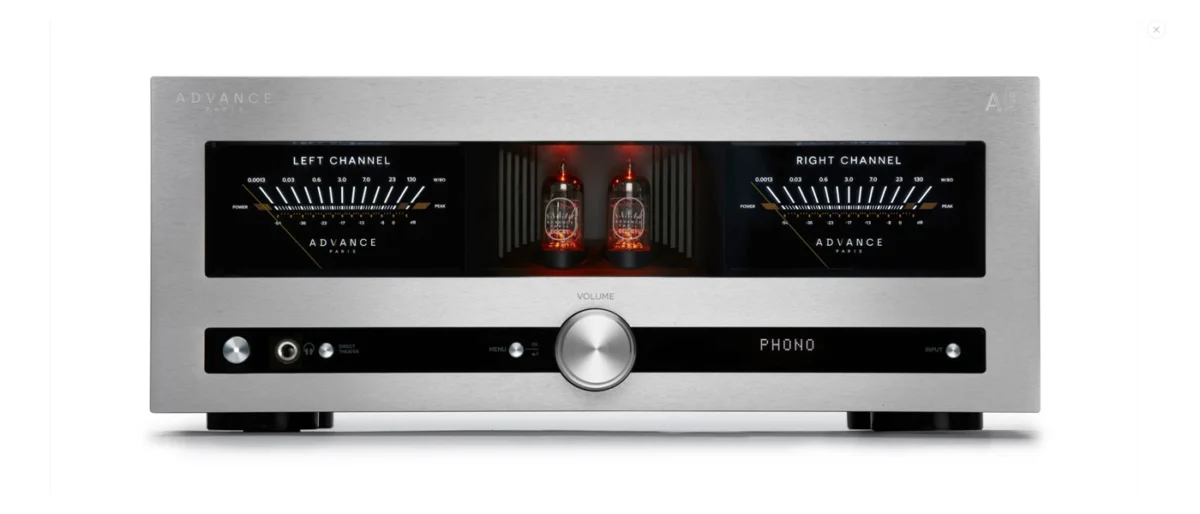
The high-fidelity audio market has long been polarized between the warmth of vintage tube-driven analog and the clinical, high-resolution efficiency of modern digital processing. With the launch of their new "Nova" integrated amplifier series, Advance Paris is attempting to dismantle this dichotomy. By introducing the A-i130 and A-i190 Nova, the French manufacturer is betting that audiophiles are no longer interested in choosing sides, but rather in demanding the best of both worlds.
Main Facts: The New Standard in Hybrid Amplification
Advance Paris has positioned the Nova series at the top of their current product hierarchy. The series debuts with two core models: the A-i130, delivering 130 watts per channel, and its more powerful sibling, the A-i190, which doubles down with 190 watts per channel.
At the heart of these units lies a sophisticated hybrid topology. The pre-amplification stage utilizes a pair of custom-made ECC81 vacuum tubes, a deliberate design choice aimed at injecting the "even-order harmonics" that characterize the quintessential analog sound. These tubes work in tandem with a robust Class A/B power amplifier section, supported by massive toroidal transformers—a 380 VA transformer in the A-i130 and a dual-transformer configuration in the A-i190.
Digital fidelity is maintained through an ESS9017S DAC running in Quad mode, which intelligently merges eight internal channels into four analog paths. This architectural choice is designed to minimize the noise floor while significantly expanding the dynamic range. Furthermore, the inclusion of a four-channel ADAU1452 DSP allows for precise room correction, enabling users to calibrate speaker output based on physical positioning to optimize the soundstage.
Chronology: From Concept to Listening Room
The development of the Nova series reflects a long-term evolution within Advance Paris’s engineering philosophy. For years, the brand has experimented with hybrid designs, but the Nova series represents their most ambitious integration of digital-first features with classic valve-driven amplification.
- Development Phase: Engineering teams focused on the "future-proofing" of the chassis, recognizing that the rapid turnover of streaming protocols often renders high-end amplifiers obsolete within a few years.
- Announcement: The series was unveiled to critical acclaim, highlighting the modular nature of the rear panel, which accepts proprietary cartridges for streaming and Bluetooth connectivity.
- Initial Arrival: The first review units, including the A-i130, began shipping to testing facilities recently.
- Current Status: We are currently in the early stages of a multi-week, real-world testing phase, evaluating the unit’s performance under daily use conditions, including pairing with high-end source components like the Oppo UPD-203 and the WiiM Ultra streamer.
Supporting Data and Technical Specifications
To understand why the Nova series is generating buzz, one must look at the granular technical specifications that define its performance. The A-i130 is not merely a pretty face; it is a dense, high-performance machine weighing in at just under 30 pounds.

Core Technical Metrics
- Power Output: 125 watts RMS into 8 ohms (both channels driven).
- Signal-to-Noise Ratio: 104 dB (measured at 1kHz, 90W into 8 ohms).
- Amplification Type: Hybrid Class A/B (Tube preamp/Solid-state power).
- Room Calibration: Integrated support for Room EQ Wizard (REW) via USB thumb drive upload.
- Input Array: HDMI-eARC, Phono (MM/MC potential), USB Audio (DSD 64/128 support), 3x Optical (24/192), 1x Coaxial (24/192).
- Connectivity: Modular expansion slots (A-NTC streaming module; A-BTC Bluetooth module).
The build quality extends to the tactile experience. The volume attenuation is controlled by a high-grade ALPS potentiometer, chosen for its linear consistency and lack of channel imbalance—a common point of failure in lower-tier integrated amplifiers.
Official Manufacturer Perspective
In discussions regarding the Nova series, representatives from Advance Paris emphasize the "Scalable Architecture" as their primary response to the frustration of modern consumer electronics. By moving away from fixed internal streaming boards, they have empowered the user to swap out hardware as Bluetooth standards evolve or as new high-resolution streaming services emerge.
"The Nova series is designed for the listener who wants the visceral, emotional impact of tube warmth, but who also demands the convenience of HDMI-eARC for home cinema integration and the precision of DSP-based room correction," a company spokesperson noted. This philosophy suggests that the manufacturer views the amplifier not as a disposable consumer product, but as the long-term anchor of a high-fidelity system.
Implications for the Audiophile Market
The arrival of the A-i130 and A-i190 has several implications for the high-end audio market.
The Death of Obsolescence
Perhaps the most significant implication is the modularity of the Nova series. The audio industry has long struggled with the "smart" aspect of modern amplifiers. When a DAC or a streamer becomes outdated, the entire amplifier usually ends up on the secondary market. By providing two dedicated slots for modular cartridges, Advance Paris is challenging the industry standard, essentially inviting users to treat the amplifier as a platform rather than a fixed component.
The Hybrid Renaissance
We are witnessing a resurgence of interest in hybrid designs. The "Nova" approach confirms that the market is rejecting the cold, sterile sound of purely digital amplification in favor of designs that prioritize harmonic richness. The use of ECC81 tubes is not just a marketing gimmick; it is an acknowledgment that digital audio, while mathematically perfect, often lacks the "air" and natural decay that analog enthusiasts cherish.

Room Correction as an Essential
By including DSP and REW (Room EQ Wizard) compatibility, Advance Paris is acknowledging that the listening room is the final, and often most flawed, component in the audio chain. Previously, advanced room correction was relegated to high-end home theater processors. Bringing this to a two-channel integrated amplifier suggests that manufacturers are finally addressing the acoustic realities of the modern living room.
Preliminary Findings and Future Outlook
In the initial days of testing, the A-i130 has demonstrated an impressive ability to manage difficult speaker loads while maintaining a refined, detailed presentation. The soundstage is notably expansive, likely a result of the DSP’s channel-specific calibration.
The aesthetic design—featuring dual VU meters that can be toggled between a classic white or a modern dark blue backlight—speaks to a consumer base that values the visual "theater" of hi-fi. When paired with a modern streamer like the WiiM Ultra, the A-i130 acts as a bridge between the convenience of digital streaming and the soulful performance of a tube-buffered preamp.
As we move into the next phase of our review, we will be testing the limits of the unit’s power reserves during complex orchestral passages and evaluating the efficacy of the modular upgrade paths. The Nova series is not just another integrated amplifier; it is a statement on how high-end audio must adapt to survive in a world of rapidly shifting digital standards.
Stay tuned for our comprehensive review, where we will dive into the nuances of the sonic character and provide a final verdict on whether the Nova A-i130 truly succeeds in its mission to bring analog heart to a digital world. For now, it is safe to say that for those looking for a centerpiece that promises longevity, beauty, and sonic excellence, the Advance Paris Nova series demands a serious audition.