Main Facts
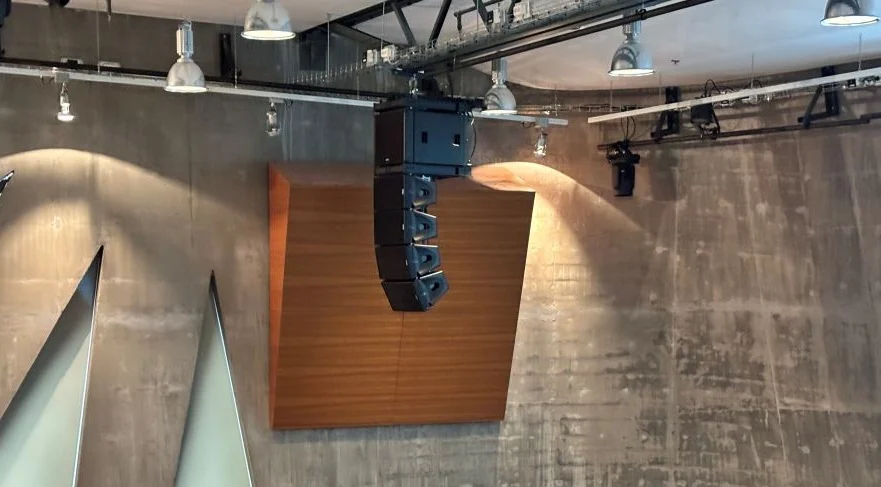
The Iceland University of the Arts in Reykjavik has successfully completed a high-profile audio infrastructure upgrade for its premier lecture and presentation facility, the Skriða room. Spearheaded by prominent Icelandic AV systems integrator Exton, the newly deployed sound reinforcement setup relies on NEXO GEO M10 line array technology paired with MSUB15 subwoofers.
The project addresses longstanding acoustic hurdles within the multi-purpose academic space, which regularly hosts lectures, multimedia presentations, and institutional events. Utilizing advanced predictive acoustic software and precision engineering, the Exton technical team delivered a high-performance, cost-effective audio ecosystem capable of meeting the rigorous demands of modern higher education. The installation features left and right flown arrays driven by state-of-the-art NEXO NXAMP amplification, ensuring uniform audio coverage across the venue’s steeply raked seating configuration despite tight scheduling constraints and structural limitations.
Chronology of the Project
The realization of the Skriða room upgrade is the culmination of a multi-year professional relationship between Exton and the Iceland University of the Arts, punctuated by careful planning and a remarkably accelerated deployment timeline.
Pre-Project Genesis and Initial Engagements
The operational partnership between the university and Exton was established years prior when Exton’s sound consultants designed a bespoke NEXO surround-sound system intended for the institution’s Film Department. Although that specific iteration of the project was ultimately deferred due to the department’s relocation to a new campus building, it laid a foundation of trust and technical familiarity between the two organizations.
Assessment and Software Simulation
When the Skriða lecture room project was officially greenlit, Exton sound consultant and technician Asaf Tzur and his team initiated the engineering phase. Initial on-site acoustic measurements were captured to understand the raw physical properties of the room. Armed with this data, the team utilized NEXO’s proprietary NS-1 system configuration and performance prediction software. This acoustic modeling allowed engineers to simulate various loudspeaker placements, dispersion angles, and coverage maps digitally before a single piece of hardware was mounted, ensuring the physical design met theoretical performance targets.
Installation and Tight Deadlines
Time management represented one of the most significant hurdles of the engagement. University leadership mandated that the new audio system be fully installed, calibrated, and operational in time for the commencement of the new academic academic year.
While compressed project timelines often introduce operational risks, Exton navigated the constraints efficiently. From the initial acoustic measurements and computer simulations to the final hardware commissioning, the entire lifecycle of the project was executed in less than three months. This rapid turnaround allowed the university to avoid costly scheduling delays and ensured students and faculty returned to a fully upgraded multimedia environment.
Supporting Data and Technical Architecture
Designing an audio system for a challenging architectural space requires a careful matching of hardware capabilities to physical room constraints. At the Iceland University of the Arts, the Skriða room presented a complex acoustic profile: while the room itself is not exceptionally long, its seating arrangement is exceptionally steeply raked. Furthermore, the venue functions as a highly reverberant space, which historically compromises speech intelligibility if direct-to-reverberant sound ratios are poorly managed.

Hardware Configuration
To combat these acoustic variables, Exton designed a distributed system centered around the NEXO GEO M10 line array family:
- Main Arrays: Left and right hangs, each comprising four GEO M10 cabinets flown directly beneath a single MSUB15 subwoofer.
- Cabinet Angling: To guarantee proper vertical coverage down the steep rake of the audience seating, each hang utilizes a precise mix of cabinet angles—specifically, three 12-degree angled cabinets for long-to-medium throw, paired with one steeply angled 25-degree box dedicated to down-fill coverage for the closer rows.
- Power and Processing: The entire speaker configuration is driven and managed by two NEXO NXAMP4X2Mk2 Powered TD Controllers. These four-channel amplifiers provide pristine digital signal processing (DSP), network control, and advanced protection algorithms. Notably, the team left a couple of spare channels within the amplification and processing infrastructure as a contingency measure, ensuring easy expandability should additional dedicated front-fill speakers be required down the road.
Performance and Coverage Outcomes
Despite initial concerns regarding physical rigging limitations—which restricted the exact placement of hanging points and raised questions about front-row coverage—the deployment exceeded expectations. The controlled dispersion characteristics of the GEO M10 line arrays proved remarkably effective at mitigating the room’s natural reverberation. Instead of bouncing excessive acoustic energy off untreated walls and ceilings, the system directed sound cleanly into the seated listening plane. The result is a high degree of speech clarity and musical articulation across every seat in the house, maintaining consistent tonal balance regardless of listener position.
Official Responses and Stakeholder Reactions
The success of the Skriða room audio upgrade was validated immediately upon its unveiling to university staff and academic leadership.
Reflecting on the physical constraints and the collaborative problem-solving required during the build, Exton sound consultant Asaf Tzur emphasized the importance of acoustic modeling:
"Initially we had some concerns about coverage in front rows, as there was a physical location limitation of the available hanging points. In fact, we left a couple of spare channels in the amplification and processing of two NEXO NXAMP4X2Mk2 Powered TD Controllers, in case additional front fills were required. Although the room is not particularly long, the seating is quite steeply raked and, ultimately, the coverage we achieved was very consistent. It’s also quite a reverberant space and while it would certainly benefit from some additional acoustic treatment down the line, the controlled dispersion of the GEO M10 delivered excellent clarity and intelligibility throughout."
Tzur also highlighted the intense pressure of the installation timeline:
"The university wanted the system to be installed in time for the new academic year and, while we never recommend rushing projects, we were able to meet the deadline on this occasion with the entire project from initial room measurements to system commissioning taking less than three months."
Perhaps the most telling endorsement came during a preliminary system walkthrough attended by a visiting delegation of professors from the university’s Music Department. Upon hearing the system in action for the first time, the faculty members broke into spontaneous applause. Moving deliberately from row to row to test audio consistency, the professors expressed profound appreciation for the system’s spatial uniformity—noting with satisfaction that every student and visitor experiences identical sonic performance from any seat in the venue.

Summing up the strategic value of the installation, Tzur noted:
"Ultimately NEXO GEO M10 gave us the tools we need to provide another dependable, high-performance and cost-effective solution to our clients’ requirements, and to continue to build Exton’s reputation and the trust of professional AV technology users in Iceland."
Implications for Higher Education and Future Projections
The successful deployment of the NEXO GEO M10 system at the Iceland University of the Arts carries broader implications for institutional AV design, particularly within higher education facilities throughout Northern Europe.
Elevating Academic Standards through Modern AV
As modern universities increasingly rely on blended learning models, multimedia lectures, visiting artist presentations, and digital screenings, the acoustic infrastructure of lecture halls is no longer secondary—it is central to the educational mission. Poor intelligibility leads to cognitive fatigue among students, reducing engagement and comprehension. By investing in professional-grade, line-array technology traditionally reserved for touring concert venues and high-end performing arts centers, the Iceland University of the Arts has established a new benchmark for campus audio standards.
The Value of Predictive Simulation in Retrofits
The Skriða room project serves as a textbook case study in the utility of advanced acoustic prediction software. In retrofit projects where physical architecture cannot easily be altered due to historical preservation, budget caps, or structural limitations, software tools like NEXO’s NS-1 allow systems integrators to engineer around physical shortcomings. By calculating precise splay angles and coverage trajectories virtually, integrators can minimize costly trial-and-error periods on-site.
Strengthening Regional Integration Networks
For Exton, the successful completion of this high-visibility academic project reinforces its standing as a premier AV solutions provider in Iceland. By successfully executing a complex installation under a compressed timeline and earning the vocal praise of the university’s rigorous Music Department faculty, Exton has solidified its market credibility. This project demonstrates that high-performance audio systems, when properly specified and calibrated, can tame difficult, reverberant spaces, ultimately paving the way for future institutional collaborations across the region.