Beyond the Datasheet: How Clock Jitter, Phase Noise, and Advanced Diagnostics Reveal the Hidden Truths of Digital Audio
016 mins
In the fast-evolving landscape of high-performance digital audio, a persistent engineering paradox continues to challenge both hardware designers and acoustical purists. A digital audio system can effortlessly roll off the manufacturing line, achieve pristine lab results, total harmonic distortion (THD) sitting safely well below audible thresholds, and pass conventional audio testing with flying colors. On paper, its noise performance looks immaculate. Yet, upon critical listening in a controlled studio or mastering environment, an underlying degradation of true clarity, spatial imaging, and transient bite remains perceptible.
This disconnect illustrates a broader, increasingly urgent challenge in modern audio evaluation: some of the most critical performance issues become apparent only when measurements move far beyond traditional headline specifications. As audio workflows push the boundaries of resolution, dynamic fidelity, and transparency, engineers are finding that standard aggregate metrics tell only part of the story. To truly understand how a digital ecosystem handles sound, the industry must look past conventional benchmarks and dive deep into the micro-domain of timing errors, clock precision, and high-resolution spectral analysis.
Main Facts: The Anatomy of Digital Timing Degradation
At the heart of every digital audio workstation, interface, converter, and playback device lies a master clock. Often treated merely as a supporting utility element within a digital signal chain, the clock signal functions as the foundational heartbeat of the entire system. Its primary role is to dictate the exact temporal intervals at which analog waveforms are sampled or digital streams are reconstructed into analog voltage.
Even when high-end analog-to-digital converters (ADCs), digital-to-analog converters (DACs), operational amplifiers, and discrete signal-chain components perform precisely as expected, clock precision can emerge as a severe, invisible limiting factor. When clock accuracy, stability, and precision falter—even by minuscule margins—the integrity of the entire audio path is compromised.
This introduces two critical variables into the engineering conversation: jitter and phase noise.
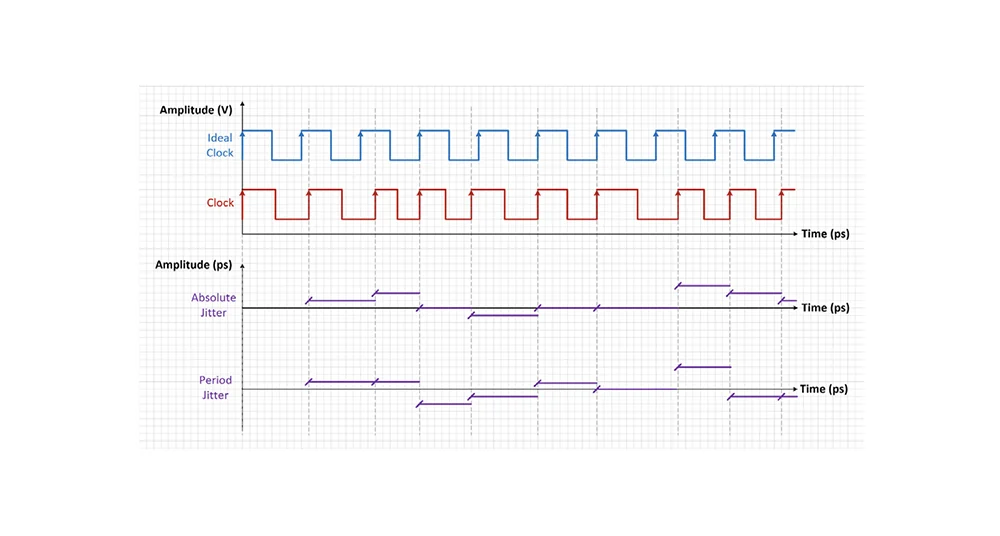
Jitter describes the temporal domain errors in a clock signal, representing fluctuations in the exact arrival time of clock edges relative to their ideal positions.
Phase noise characterizes those exact same timing errors, but viewed through the frequency domain, measuring the spectral purity of the clock oscillator.
Together, jitter and phase noise provide deep insight into how accurately a digital system samples, converts, and reconstructs complex audio signals. They serve as prime examples of why aggregate metrics like Total Harmonic Distortion Plus Noise (THD+N) and Dynamic Range (DNR) are no longer sufficient gauges of absolute fidelity.
Chronology: The Evolution of Audio Measurement Standards
To understand why jitter and phase noise have taken center stage in modern engineering discourse, it helps to examine how audio evaluation has evolved alongside digital technology over the past several decades.
1. The Era of Headline Specifications (1980s–1990s)
When Compact Discs and early digital audio workstations first disrupted the analog hegemony, the primary goal for manufacturers was to prove that digital audio was clean, quiet, and mathematically precise. During this era, engineers relied heavily on basic steady-state measurements: frequency response, signal-to-noise ratio (SNR), and Total Harmonic Distortion (THD). These metrics were vital for validating that digital systems could outperform older analog mediums in terms of baseline noise and channel separation.
2. The Rise of Dynamic Range and Multitone Analysis (2000s)
As digital resolution moved from 16-bit/44.1kHz to 24-bit/96kHz and beyond, hardware design matured. Manufacturers routinely achieved THD+N figures near the theoretical limits of analog-to-digital conversion. However, users began noticing that two converters with identical THD+N specs could sound strikingly different—one sounding harsh and fatiguing, the other open and natural. This realization spurred the adoption of dynamic range measurements and multitone intermodulation distortion (IMD) tests, though traditional time-domain jitter was still largely viewed as an academic curiosity rather than a primary bottleneck.
3. The High-Resolution Paradigm Shift (2010s–Present)
Today, modern semiconductor fabrication and advanced sigma-delta converter topologies have driven baseline distortion so low that standard sweep measurements rarely reveal anomalies. Concurrently, high-resolution audio formats, immersive mixing environments, and ultra-wide dynamic range requirements have exposed the limitations of traditional test methods. Engineers now recognize that microscopic phase anomalies, low-level spectral spreading, and clock jitter directly impact spatial depth, transient localization, and harmonic warmth. Consequently, advanced diagnostic methods—such as 1 Hz spectral analysis and high-resolution Fast Fourier Transform (FFT) testing—have become the new frontier in audio engineering evaluation.
Supporting Data: Why Timing Errors Matter and What Traditional Metrics Miss
To grasp the mechanical impact of clock degradation, one must examine how timing variations manifest in both the time and frequency domains.
In an ideal world, a clock signal is a flawless square wave with perfectly spaced edges. In reality, thermal noise, power supply ripple, and component aging introduce phase deviations. Figure 1 maps out these physical realities, illustrating how timing deviations appear as literal shifts in clock-edge position and cycle duration.
When these timing-imperfect clock signals are fed into audio converters, the deviations couple directly into the sampling process. Instead of sampling the analog input signal at mathematically precise, equidistant time intervals, the ADC samples it at jitter-modulated moments. This effectively modulates the phase of the input signal.
The mathematical consequence of this phase modulation is the creation of new, unwanted distortion products and fundamental shifts in the signal’s spectral behavior. As demonstrated in Figure 2, timing errors in the clock domain directly translate into phase modulation and visible spectral artifacts at the converter output.
Depending on the specific characteristics of the clock behavior, these anomalies manifest in several distinct ways:
Random Jitter: Tends to raise the overall noise floor uniformly across the frequency spectrum, reducing apparent dynamic clarity.
Deterministic Jitter: Creates discrete, periodic distortion spikes that are inextricably tied to both the signal frequency and the jitter frequency itself.
Low-Frequency Phase Noise: Spreads energy outward from a fundamental signal tone, creating what engineers refer to as "spectral skirts."
The Illusion of Clean Conventional Metrics
Crucially, Figure 3 and Figure 4 highlight a frustrating reality for audio designers: a system can exhibit pristine traditional Dynamic Range (DNR) and THD+N figures while simultaneously suffering from severe low-frequency phase noise. Standard Fast Fourier Transform (FFT) views, while offering a helpful high-level snapshot of system behavior, often lack the spectral resolution required to uncover faint tonal structures or low-level modulation artifacts.
When engineers employ higher-resolution FFT analysis combined with heavy signal averaging, previously invisible spectral features emerge. Skirt-shaped energy spreading around fundamental tones, elevated local noise floors, and hidden distortion components become starkly apparent. Without these deeper diagnostic techniques, these performance degradations remain entirely unmasked by headline specifications.
Official Responses and Industry Perspectives
The audio engineering community has responded to these diagnostic discoveries with a mixture of validation and a call for standardized testing reform.
The Component Manufacturers’ Viewpoint
Leading semiconductor and clock oscillator manufacturers point out that modern ultra-low jitter oscillators—such as oven-controlled crystal oscillators (OCXOs) and temperature-compensated crystal oscillators (TCXOs)—have brought picosecond- and femtosecond-level timing accuracy within reach of commercial audio gear. Representatives from major converter design firms emphasize that while ultra-clean clocks are technically achievable, the surrounding circuit board layout, power supply rejection ratio (PSRR), and grounding topologies play an equally vital role in preventing phase noise injection.
The Acoustical Engineering Perspective
Acoustical consultants and mastering engineers have long championed the philosophy that listening tests often outpace conventional testbench metrics. Many industry veterans argue that traditional test setups—which rely heavily on steady-state sine waves—fail to replicate the complex, transient-heavy nature of real-world music.
"We have reached a point in electronics design where measuring standard THD+N is like checking if a car has four wheels," notes a leading digital hardware architect. "It tells you the vehicle can move, but it tells you nothing about how it handles a hairpin turn at 100 miles per hour. Jitter and phase noise analysis give us the handling data we’ve been missing."
Implications: Bridging Objective Measurement and Human Perception
The disconnect between headline specifications and complex spectral behavior carries profound practical consequences for the future of audio product development.
1. Architectural Redesign in Digital Audio
For engineers designing next-generation digital audio systems, understanding the nuanced impacts of jitter and phase noise dictates critical architectural choices. Decisions surrounding asynchronous sample rate converters (ASRCs), local re-clocking stages, passive filtering topologies, and ultra-low-noise voltage regulators directly influence whether fine musical details survive the journey from production to playback.
2. The Rise of "Euphonic Testing"
Beyond rigid engineering benchmarks, the industry is increasingly embracing methodologies that connect objective analysis directly to human psychoacoustics. This is the domain of euphonic testing, where designers correlate high-resolution spectral data with how systems actually perform in real-world listening environments. Instead of stopping at the question, "Does this device meet its datasheet specifications?" modern development pipelines ask: "Does this device’s micro-behavior align with how the human ear processes spatial cues, transient snap, and timbral naturalness?"
3. Redefining Industry Standards
Ultimately, metrics like THD and DNR will remain foundational tools in the audio engineer’s toolkit—they provide the baseline context, but they no longer represent the finishing line. As professional audio workflows continue to evolve toward higher channel counts, immersive spatial formats, and uncompromised resolution, the criteria for equipment evaluation must evolve alongside them.
Jitter and phase noise serve as a definitive case study proving that true audio accuracy is not just a single, static number on a spec sheet. Rather, true fidelity exists at the exact intersection where rigorous, high-resolution measurement and real-world system behavior arrive at the exact same conclusion.