Main Facts
The high-end audio landscape has long operated under the assumption that superlative performance requires uncompromising complexity. To extract the ultimate sonic nuances from a vinyl groove, audiophiles have traditionally been expected to endure a ritual of minute adjustments: leveling massive multi-tier chassis, balancing heavy platter assemblies, dialing in precise azimuths, wrestling with delicate tonearm wiring, and spending hours optimizing VTA (vertical tracking angle). Enter the Rega Naia, a component that challenges this paradigm entirely.
Priced at approximately $19,000—or around $23,000 when bundled with its factory-matched Aphelion 2 moving coil (MC) cartridge—the Naia sits firmly in the ultra-premium tier of analog playback. Yet, according to early reviews and industry observers, evaluating it purely on a price-to-performance matrix misses the point. Instead of demanding a degree in mechanical engineering to operate, the Naia offers what reviewers describe as a "fiddliness factor of zero."
Out of the box, the turntable requires almost no calibration beyond setting the tracking force. It delivers the subterranean bass response, microscopic resolution, and breathtaking dynamic headroom typically associated with $50,000 reference systems, but with the plug-and-play simplicity of an entry-level deck.
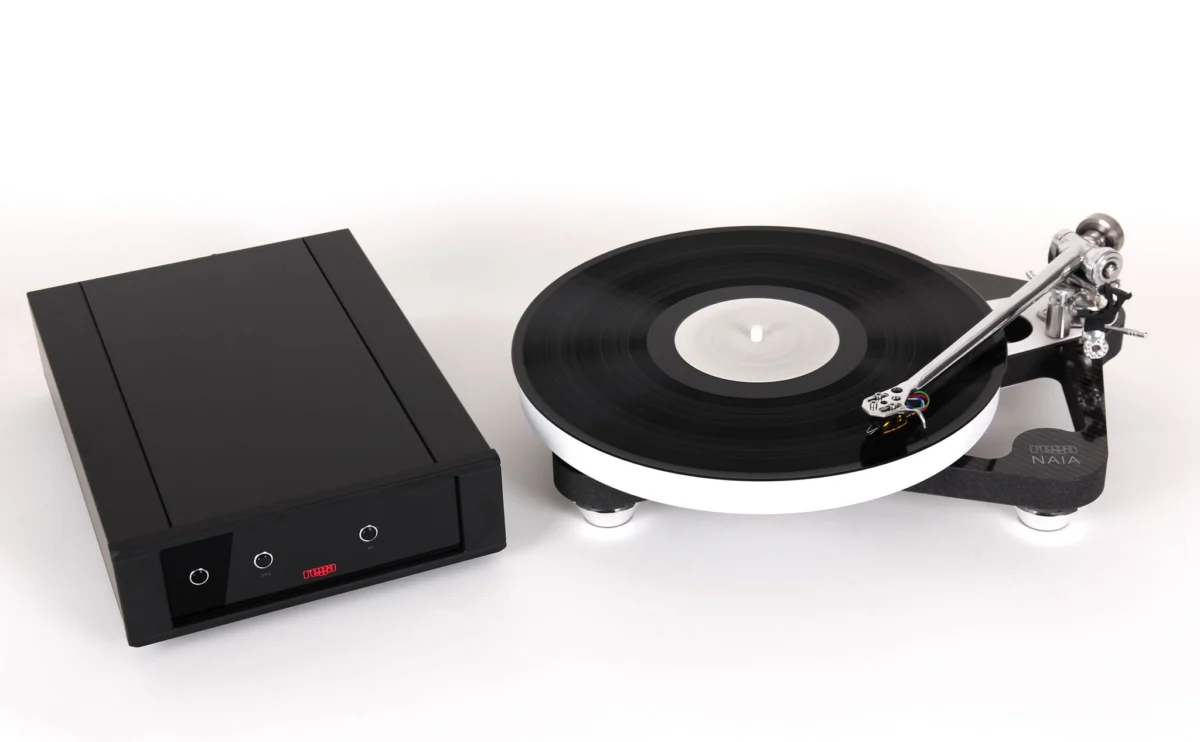
While its minimalist chassis visually echoes Rega’s popular Planar 8 and Planar 10 models, the Naia is an entirely different beast under the hood. Every molecule of its construction represents a relentless pursuit of material science and engineering refinement. Developed as the production successor to the ultra-exclusive, limited-edition Naiad prototype—a project two decades in the making—the Naia stands as the definitive culmination of founder Roy Gandy’s engineering philosophy. Distributed in North America by The Sound Organisation, the Naia has officially arrived in listening rooms, and its early impression on the high-end audio community has been nothing short of profound.
Chronology: A Two-Decade Journey from Prototype to Production
The story of the Rega Naia is not one of sudden inspiration; it is a two-decade masterclass in patience, metallurgical research, and iterative prototyping.
The Genesis: The Naiad Prototype (Early 2000s)
Roughly twenty years ago, long before the Naia was even a commercial consideration, key industry figures and audio journalists visited the home of Rega founder Roy Gandy. Hanging on the wall of his listening room was a skeletal, futuristic framework: the initial prototype of the Naiad. At the time, it was merely a conceptual exercise—a theoretical exploration of how much resonance could be eliminated from a turntable structure by stripping away mass and utilizing aerospace-grade materials. For years, the Naiad remained a mythical object, eventually culminating in a strictly limited, ultra-expensive production run that few mortals would ever get to touch, let alone own.
Trickle-Down Engineering (2010s–2020s)
Rega did not let the research done for the Naiad sit idle. Over the subsequent decade, the company systematically trickled down the exotic materials science and manufacturing techniques learned from the Naiad project into more accessible models. Innovations first pioneered for the ultra-flagship slowly made their way into the Planar 8 and later the Planar 10. These decks proved that Rega’s low-mass, high-rigidity philosophy could yield world-class sound without requiring a massive, multi-hundred-pound slate or granite plinth. However, a wide performance and price gap still remained between the Planar 10 and the unobtainable Naiad.
The Commercial Realization: The Launch of the Naia
The arrival of the Naia bridges that historical gap. Moving beyond the ultra-exclusive status of its predecessor, the Naia brings the apex of Rega’s engineering directly to the commercial market. Following its initial global rollout, review units began landing in the hands of major publications—such as ToneAudio—in late summer 2026. After spending initial weeks unboxing, configuring, and critically listening to the flagship system paired with the Aphelion 2 MC cartridge, reviewers quickly recognized that the Naia was not just an incremental update to the Planar 10, but a watershed moment for the British manufacturer.
Supporting Data: Engineering Excellence and Technical Specifications
To understand why a $19,000 Rega turntable commands such intense industry respect, one must look past its deceptively simple aesthetic and examine the underlying technology. Rega’s engineering ethos diametrically opposes the "heavier is better" school of thought dominant in high-end audio, favoring ultra-low-mass structures with exceptional rigidity instead.
The Plinth and Structural Integrity
Traditional turntables rely on sheer mass to absorb motor vibrations and external footfalls, often resulting in energy storage issues that muddy the sound. The Naia uses a skeletal plinth constructed from graphene-impregnated carbon fiber. This advanced composite material offers an extraordinary strength-to-weight ratio. To eliminate micro-vibrations further, the core of the plinth is filled with Tancast 8—a aerospace-grade polyurethane foam originally developed for the aerospace industry. The result is a chassis that weighs next to nothing yet resists resonance far more effectively than massive blocks of acrylic, wood, or metal.
Bearing Assembly and Ceramic Sub-Platter
At the heart of the Naia’s rotational stability is a custom-designed zirconia-toughened alumina (ZTA) ceramic spindle and central bearing assembly. ZTA is exceptionally hard, wear-resistant, and dimensionally stable. By utilizing ceramic materials for the platter and sub-platter assembly, Rega ensures minimal friction, exceptional speed stability, and efficient mechanical grounding of the vinyl record.
The Tonearm and Aphelion 2 MC Cartridge
The Naia features a hand-built RB330-derived carbon fiber tonearm—though calling it an RB330 vastly understates its sophistication. The arm utilizes a custom vertical bearing assembly constructed from aluminum and stainless steel, engineered to maintain absolute friction-free movement across both planes.
When paired with the factory-installed Aphelion 2 moving coil cartridge, the system reaches its sonic zenith. The Aphelion 2 represents a generational leap over Rega’s previous flagship, the Apheta 3. It incorporates a hand-wound micro-coil (utilizing iron cross assemblies that are 50% smaller than standard designs) housed within an aluminum body, topped with a vital-profile diamond stylus. The cartridge extracts significantly more harmonic richness, tonal body, and high-frequency air from the groove without inducing listening fatigue.
Official Responses and Industry Perspectives
The reception from the audio press and manufacturing partners highlights the unique positioning of the Naia in the ultra-luxury audio ecosystem.
"Disregarding the price tag as mere extravagance misses the core achievement," notes early assessment commentary from the audio publishing sector. "Think of it as a $50,000 reference table that you don’t need to fuss with—ever. You can unbox it, set the tracking force, and roll."
The distribution network has equally championed the product’s market viability. Representatives from The Sound Organisation, the North American importer and distributor for Rega, have emphasized that the Naia represents the ultimate expression of Roy Gandy’s 50-plus years in audio design.
"When you look at what Roy and his team have accomplished over the decades, the Naia is the holy grail," notes a representative close to the distribution channel. "It takes everything we’ve learned about resonance control, arm design, and motor precision and packages it into a component that respects the end user’s time. You buy a turntable to listen to music, not to spend your weekends adjusting suspension springs and alignment protractors."
Furthermore, industry insiders have pointed out the psychological advantage of the Naia’s form factor for domestic harmony—a frequent pain point among high-end audio enthusiasts. Because the Naia shares a silhouette similar to the more modest Planar 8 and Planar 10, it flies under the radar of unsuspecting spouses or housemates. As industry wags have joked, an upgrade from a P8 or P10 to a Naia can easily be executed under the radar, relying on "feigned ignorance" regarding the massive leap in internal engineering and cost.
Implications for the High-End Audio Market
The introduction and commercial success of the Rega Naia carry several profound implications for the high-end audio industry, particularly within the analog playback sector.
1. The Death of the "Fiddle Factor"
For decades, the ultra-high-end turntable market has been dominated by massive, industrial-looking decks that require professional installation and constant tuning. The Naia proves that elite performance does not need to be synonymous with user frustration. By delivering reference-grade resolution, slam, and soundstage dimensionality in a package that can be unpacked and running in under fifteen minutes, Rega has raised consumer expectations. Future buyers of high-end gear will increasingly ask manufacturers: Why should I spend $20k+ on a turntable if I need a mechanical engineering degree just to play a record?
2. The Maturation of Composite Materials
Rega’s successful commercialization of graphene-impregnated carbon fiber and Tancast 8 foam validates the shift away from traditional mass-loading philosophies. As more manufacturers observe the sonic benefits of ultra-low-mass, high-rigidity engineering, expect to see a broader industry-wide adoption of aerospace materials in chassis and tonearm design.
3. The Value Proposition at the Absolute Apex
At $19,000 (and upwards of $23,000 with the Aphelion 2 cartridge), the Naia is undeniably a luxury investment. However, when compared directly against competing analog setups that routinely cost $40,000 to $60,000—and still require outboard power supplies, complex suspension tuning, and separate arm matching—the Naia emerges as a disruptive value. It collapses the price-to-performance curve, offering 95% of the performance of unobtainable multi-tier mega-decks at a fraction of their footprint, complexity, and overall cost.
As full, long-term reviews continue to roll out across specialized audio publications, the Rega Naia is widely anticipated to sweep industry accolades for the year. More importantly, it secures Roy Gandy’s legacy not just as a brilliant innovator of accessible hi-fi, but as a master who successfully translated the wildest theoretical limits of analog audio into an effortless, breathtaking reality.