Modern high-fidelity audio systems have achieved a level of acoustic neutrality that would have seemed miraculous to the pioneers of the mid-20th century. We possess DACs with vanishingly low noise floors and amplifiers capable of near-perfect signal amplification. Yet, despite these technological leaps, a fundamental hurdle remains: the human ear. Our hearing is not a linear transducer; it is a complex, frequency-dependent biological system that shifts its sensitivity based on sound pressure level (SPL).
When we lower the volume on our high-end rigs, we aren’t just making the music quieter—we are fundamentally altering its tonal balance. By leveraging the latest ISO 226:2023 equal-loudness standards and modern digital signal processing (DSP), listeners can finally restore the intended mastering tonality at modest volumes, bridging the gap between clinical accuracy and domestic comfort.
The Nonlinearity of Human Hearing
Every hi-fi system lowers volume uniformly across the frequency spectrum. However, human hearing does not. Below the 83 dB SPL mastering reference—the industry standard for mixing and mastering—our perception of bass and treble recedes while the midrange frequencies remain relatively prominent. Consequently, a recording played at 72 dB is not the same sonic experience as the one the mastering engineer signed off on in the studio.

This phenomenon is the "noisy neighbor" of the audiophile world. It creates a situation where, during late-night or background listening, the foundation of the music—the bass—becomes distant and loses its tactility, while the "air" and "sparkle" of the upper registers are masked. Over time, the brain attempts to compensate for these tonal deficiencies, but this cognitive effort leads to fatigue. The auditory cortex must work overtime to reconstruct missing harmonics and track faint bass lines, turning a relaxing listening session into an exercise in concentration.
A Chronological Perspective: From Fletcher-Munson to ISO 226
The challenge of equal-loudness is not new; it is a legacy problem that has been addressed, discarded, and rediscovered over the last century.
The 1930s: The Telephone Industry’s Map
In 1933, Harvey Fletcher and Wilden A. Munson published their seminal research for Bell Labs. The telephone industry needed to know exactly how much bandwidth was required to make human speech intelligible over long-distance copper lines. They discovered that the human ear’s sensitivity drops off steeply below 300 Hz and peaks sharply between 2 kHz and 4 kHz—the core consonant band for speech. This map allowed Bell to build cost-effective, intelligible telephony networks. While it served their engineering needs, it simultaneously defined the limitations of human perception that audio enthusiasts grapple with today.

The 1970s: The Era of the "Loudness" Button
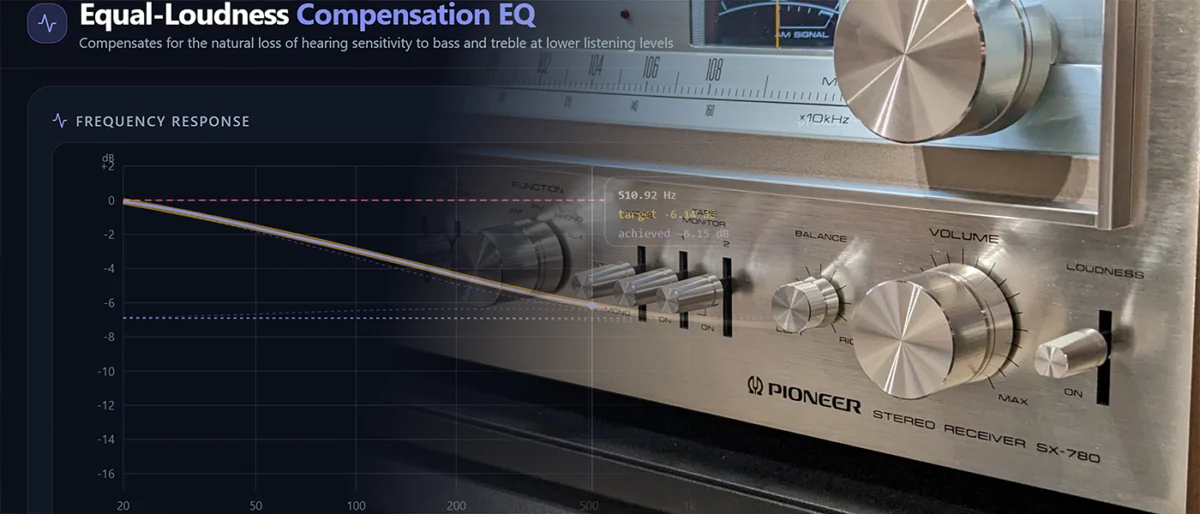
During the golden age of high-fidelity stereo in the 1960s and 70s, manufacturers like Pioneer, Sansui, and McIntosh recognized that consumers were losing bass and treble at lower volumes. They implemented "Loudness" switches on their receivers. These circuits used physical taps on potentiometers paired with RC (resistor-capacitor) filter networks to provide a passive boost to the frequency extremes as the volume was turned down.
While well-intentioned, these analog circuits were inherently flawed. They were "uncalibrated," meaning they had no knowledge of the source voltage or speaker efficiency. A sensitive horn speaker might produce high SPLs at a volume knob position where a low-sensitivity monitor would be barely audible. Furthermore, the circuits often produced a colored "V-shaped" caricature of the music rather than a scientifically accurate restoration, leading the audiophile press of the 1990s to reject these features in favor of "straight-wire-with-gain" purism.
The Modern Standard: ISO 226:2023
Research into auditory perception continued long after Fletcher and Munson. The ISO 226 standard, first released in 1987 and revised significantly in 2003, represents the modern consensus on equal-loudness contours. The latest edition, ISO 226:2023, refines these measurements to within 0.6 dB, providing a settled scientific foundation for digital correction. We no longer need to rely on the imprecise "guesswork" of a mechanical volume knob; we now have the data to apply surgical, mathematically precise corrections.

Supporting Data: Why DSP Changes Everything
The shift from analog circuits to digital signal processing (DSP) is the final piece of the puzzle. We now have the tools to implement 5-band parametric EQ (PEQ) filters that track the ISO 226:2023 standard with an accuracy of within 0.05 dB.
Unlike the blunt "Loudness" switches of the 1970s, modern DSP allows for:
- Calibration: Users can measure their specific listening level using smartphone-based SPL meters (C-weighted, slow integration).
- Headroom Management: By applying negative preamp gain before the PEQ filters, we can prevent digital clipping, ensuring that the boosted bass frequencies do not cause inter-sample overs.
- Precision: By using a 5-band PEQ, we can model the equal-loudness contour with extreme fidelity, avoiding the mid-bass "bloat" that plagued vintage equipment.
Measurement data from REW (Room EQ Wizard) confirms that the differences listeners experience at low volumes are not caused by the room or the speakers—which usually measure consistently across levels—but by the listener’s own auditory response. The data demonstrates that when we normalize the volume difference between 70 dB and 78 dB, the microphone sees a flat, linear shift. The "missing" bass and treble are purely a result of psychoacoustics.

Official Responses and Industry Implementations
The audio industry has taken note of these psychoacoustic realities, though with varying degrees of success.
- Dolby Volume: This solution is signal-adaptive and addresses the drift in tonal balance. However, its technical implementation is opaque; it does not explicitly reference the ISO 226 standard, making it difficult for enthusiasts to verify or tweak.
- Audyssey Dynamic EQ: Primarily designed for home theater, it is anchored to film-mixing standards. While excellent for movies, its rigid application can sometimes feel unnatural for music listening.
- Streaming Ecosystems: Platforms and hardware like WiiM, Roon, and JRiver now offer robust PEQ capabilities. The "Dynamic Bass" or "Loudness" presets found in many consumer apps are often still based on the same V-shaped caricatures of the 1970s. However, because these platforms allow for user-defined PEQ settings, they provide a "blank canvas" for the audiophile to apply scientifically accurate ISO 226 corrections.
Implications for the Audiophile Experience
The primary implication of this research is a shift in how we approach our listening environments. For decades, audiophiles have "voiced" their systems by moving speakers closer to walls or adjusting toe-in to compensate for perceived lack of bass at lower volumes. While these spatial tools work, they sacrifice soundstage, image focus, and the "disappearing" quality of high-end loudspeakers.
By moving the tonal correction into the digital domain via ISO 226-compliant PEQ filters, we free ourselves to place speakers for maximum imaging rather than tonal compensation.

A Path Forward
The implementation is straightforward:
- Measure: Use an SPL meter app to find your average listening level (C-weighted, slow).
- Calculate: Use an ISO 226-based calculator (such as those available on open-source repositories) to generate the five required PEQ filter values.
- Apply: Enter these values into your DSP-enabled streaming platform or DAC.
- Listen: Experience the intended balance of your recordings at any volume level.
This approach does not just "add bass." It restores the structural integrity of the music as the engineer intended it to be heard. It allows for a full-range, immersive experience during late-night listening sessions without the need to drive the system to levels that disturb the rest of the household.
In conclusion, the "Loudness" wars are over, and the data has won. By embracing the objective, scientific reality of human auditory perception, we can finally move past the subjective debates of the last century and enjoy the music exactly as the mastering engineer intended—at any volume we choose. The tools are free, the math is settled, and the result is a significant step toward the "absolute sound."