ATLANTA, Ga. — In an era where hybrid learning, multimodal collaboration, and seamless educational technology are no longer optional extras but central pillars of the academic experience, Emory University has taken a major leap forward. The prestigious institution, located in Atlanta, Georgia, has successfully integrated the Biamp Parlé Voice Lift platform across more than 120 teaching spaces within the Emory College of Arts and Sciences.
By cleverly leveraging existing audio infrastructure—specifically beamtracking ceiling microphones and advanced digital signal processors—Emory has solved one of the most persistent operational headaches in modern higher education: the management, maintenance, and distribution of wearable and handheld microphones.
This comprehensive deployment eliminates the need for bodypacks, disposable batteries, and clumsy charging docks. In doing so, it offers a glimpse into the future of classroom audio architecture: invisible, automated, and frictionless.
Main Facts
The deployment at Emory University centers on the integration of Biamp’s proprietary Parlé Voice Lift technology within the Emory College of Arts and Sciences.
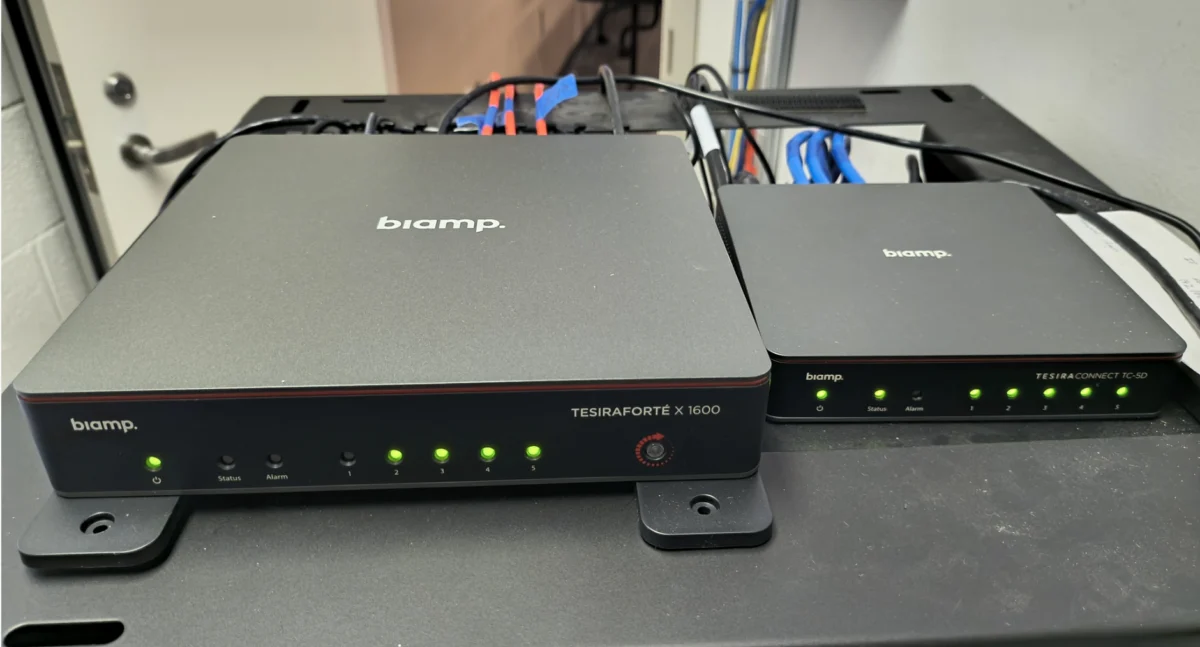
- The Technology: The system relies on Biamp’s Parlé TCM Beamtracking ceiling microphones paired with TesiraFORTE® X processors.
- The Scope: More than 120 teaching spaces across the campus have been integrated into this ecosystem.
- The Core Benefit: Instructors and students can lecture, debate, and present naturally without wearing lapel mics, clipping on bodypacks, or passing around handheld microphones. The system dynamically tracks speakers as they move around the room, automatically reinforcing their voices through the room’s loudspeakers at a comfortable, intelligible volume without causing acoustic feedback.
- The Operational Impact: By removing traditional wireless microphone hardware, Emory’s IT and classroom technology services team has entirely eliminated battery procurement, device charging routines, loss prevention, and frequent hardware troubleshooting.
- Versatility: Beyond simple voice lift for in-room amplification, the same hardware ecosystem seamlessly supports remote conferencing, lecture capture, and hybrid learning initiatives.
Chronology of the Project
The integration of advanced audio systems at Emory University did not happen overnight; it was the result of a strategic, methodical evaluation of classroom needs, faculty pain points, and emerging AV technologies.
Phase 1: The Status Quo and Existing Infrastructure
Long before the implementation of the Voice Lift platform, Emory had already invested in robust audio backbones. The university utilized Biamp’s Parlé TCM ceiling microphones and TesiraFORTE X processors across dozens of teaching spaces primarily for distance learning, conferencing, and lecture capture. However, like many universities, Emory faced a distinct dilemma when it came to voice reinforcement—commonly known as sound field amplification—inside the physical classroom.
Traditional voice lift systems required wireless bodypack transmitters, lavalier or headset microphones, and handheld units. While these systems helped students in the back of large lecture halls hear instructors clearly, they introduced heavy logistical burdens. Faculty members frequently forgot to turn them on, misplaced them, or struggled with dying batteries mid-lecture.
Phase 2: The Anthropology Room 303 Pilot
To test whether modern beamtracking technology could solve these traditional hurdles, Emory initiated a pilot program in Anthropology Room 303.
In this testbed, the existing ceiling-mounted beamtracking microphones and TesiraFORTE X processors were reconfigured to provide active voice lift. Instead of merely picking up audio for a remote Zoom call or lecture capture recording, the system was tuned to intelligently amplify the instructor’s voice locally through the room’s speakers in real time.
The pilot was designed to test several key metrics:
- Acoustic Clarity: Could ceiling microphones provide enough gain before feedback to make an instructor audible over the ambient noise of a busy classroom?
- Tracking Accuracy: Could the beamforming technology accurately follow an instructor pacing back and forth across the front of the room without cutting out or picking up excessive HVAC noise?
- User Acceptance: Would professors embrace a system that required zero physical interaction beyond simply walking into the room and speaking?
The pilot proved to be an overwhelming success. Instructors found that they could move naturally, project normally, and remain completely unburdened by hardware.
Phase 3: Scaling Across 120+ Teaching Spaces
Encouraged by the seamless performance in Anthropology Room 303, Emory’s Classroom Technology Services expanded the implementation across more than 120 teaching spaces within the College of Arts and Sciences. The rollout utilized the foundational hardware already present in those rooms, proving that advanced software and platform optimization can dramatically upgrade campus capabilities without requiring a total rip-and-replace equipment overhaul.
Phase 4: Current Evaluation and Future Expansion
Following the widespread adoption in classrooms, Biamp and Emory are actively evaluating secondary applications. This includes testing the ecosystem in high-profile administrative spaces, such as a major conference room utilized by the university’s executive leadership.
Supporting Data and Technical Architecture
To understand why Emory’s deployment represents a watershed moment in educational technology, it is necessary to examine the underlying engineering that makes "zero-touch" voice lift possible.
The Problem with Legacy Voice Lift Systems
In conventional AV design, voice lift requires a delicate balance between acoustic gain and feedback. If a microphone is too close to a loudspeaker, it causes a piercing feedback loop. To combat this, legacy systems rely heavily on close-mic techniques—forcing speakers to wear physical transmitters.
However, wearable mics introduce significant administrative friction:

- Power Management: Institutions must choose between disposable batteries (which create ongoing operational costs and environmental waste) and rechargeable batteries (which require dedicated charging infrastructure and degrade over time).
- Device Hygiene and Wear-and-Tear: Shared wearable microphones are subject to physical drops, sweat, cosmetic wear, and loss.
- User Compliance: Many faculty members simply dislike wearing clips, lanyards, or beltpacks, leading to low adoption rates for systems that could otherwise improve accessibility.
The Biamp Solution: Beamtracking Meets DSP
Biamp’s Parlé platform bypasses these physical limitations through sophisticated digital signal processing (DSP) and microphone array geometry.
- Beamtracking Technology: Unlike traditional static directional microphones, Parlé ceiling microphones feature dynamic beamforming algorithms that continuously track and lock onto a speaker’s voice anywhere in the room. As the instructor moves, the "beam" shifts instantly and invisibly.
- Acoustic Echo Cancellation (AEC) and Feedback Suppression: The TesiraFORTE X processor acts as the computational brain of the operation. It runs advanced algorithms that distinguish between the instructor’s direct voice, reflected sound waves (reverberation), ambient noise (like projector hums or HVAC units), and output from the room’s own loudspeakers. By precisely cancelling out feedback paths, the system can safely reinforce the instructor’s voice.
- Multipurpose Synergy: Perhaps the most compelling data point for university budget managers is hardware consolidation. In many modern campuses, institutions buy one set of mics for voice reinforcement, another set for lecture capture, and a third for Zoom conferencing. Emory’s architecture uses the same Biamp ecosystem to handle all three functions simultaneously.
Official Responses and Perspectives
Key stakeholders from both Emory University and Biamp have spoken out about the success of the project, highlighting how the technology aligns with institutional goals of accessibility, simplicity, and operational efficiency.
The View from Campus Technology Services
Griffin Fisher, manager of classroom technology services for the Emory College of Arts and Sciences, has been vocal about the persistent challenges that academic IT departments face when dealing with legacy audio hardware.
"Whether we go with rechargeable or disposable batteries, there are different issues we find," Fisher explains. "We have not introduced traditional voice lift in a lot of spaces because of those challenges."
For Fisher and his team, the ultimate benchmark of success is whether a technology can achieve its purpose without demanding constant intervention from support staff or end-users.
"There are no handhelds, no disposable batteries, no recharging docks. It’s like magic," Fisher continues. "We really do want solutions that just work. Whether it’s pushing the ‘ON’ button and everything comes on, or microphones that are simply part of that ‘just works’ equation, that’s something we’re hugely interested in."
The Industry Perspective from Biamp
From the manufacturer’s standpoint, the Emory deployment serves as a prime example of how audio engineering can directly improve the human experience in educational settings.
Joe Andrulis, executive vice president of corporate development at Biamp, emphasized the psychological and pedagogical benefits of removing hardware barriers for educators.
"The pilot delivers natural voice reinforcement that increases presenter confidence while remaining virtually invisible to faculty, students, and IT staff alike," Andrulis stated.
He also noted the broader strategic impact of the rollout, pointing out how the deployment is paving the way for further integration across the institution.
"Following its success, Biamp is helping Emory evaluate additional deployments, including a large administrative meeting room used by university leadership, extending the Biamp ecosystem that also supports conferencing, lecture capture, and hybrid learning across campus."
Implications for Higher Education and AV Design
The successful rollout of the Biamp Parlé Voice Lift platform at Emory University carries profound implications for colleges, universities, and corporate enterprises alike.
1. The Death of Friction in AV Engineering
For decades, the standard philosophy of AV design was to add more gear to solve emerging problems—adding wireless mics for voice lift, separate USB mics for web conferencing, and dedicated control processors for recording. Emory’s deployment flips this script. By proving that high-end ceiling arrays can intelligently serve multiple masters (in-room reinforcement, hybrid conferencing, and lecture capture), Emory and Biamp have established a blueprint for streamlined minimalism.
2. Elevating Accessibility and Inclusivity
Acoustic accessibility is a critical component of universal design in education. Students with mild hearing impairments, those sitting in the rear of crowded lecture halls, or individuals learning English as a second language benefit immensely from voice reinforcement. However, when voice lift systems depend on professors remembering to clip on a microphone, accessibility becomes inconsistent. A fully automated, zero-touch voice lift system ensures that every student, in every seat, enjoys equal access to the instructor’s voice from the moment class begins.
3. Mitigating IT Burnout
Higher education IT departments are frequently understaffed and overburdened. Troubleshooting dead wireless mic batteries, replacing lost bodypacks, and fielding emergency calls because a professor cannot figure out how to sync a transmitter drain valuable staff hours. By eliminating these failure points entirely, Emory has freed up its technical support personnel to focus on higher-value strategic initiatives rather than basic hardware babysitting.
4. A Template for the Future of Smart Campuses
As universities continue to refine their hybrid learning models post-pandemic, the lines between physical classrooms and virtual spaces are blurring. Technologies that perform multiple functions invisibly will inevitably become the gold standard. Emory University’s deployment demonstrates that the future of campus audio is not about teaching faculty how to use more gadgets; it is about building intelligent environments that anticipate human needs and fade entirely into the background.