By the Editorial Team
Published in High-Fidelity Audio Review
Main Facts
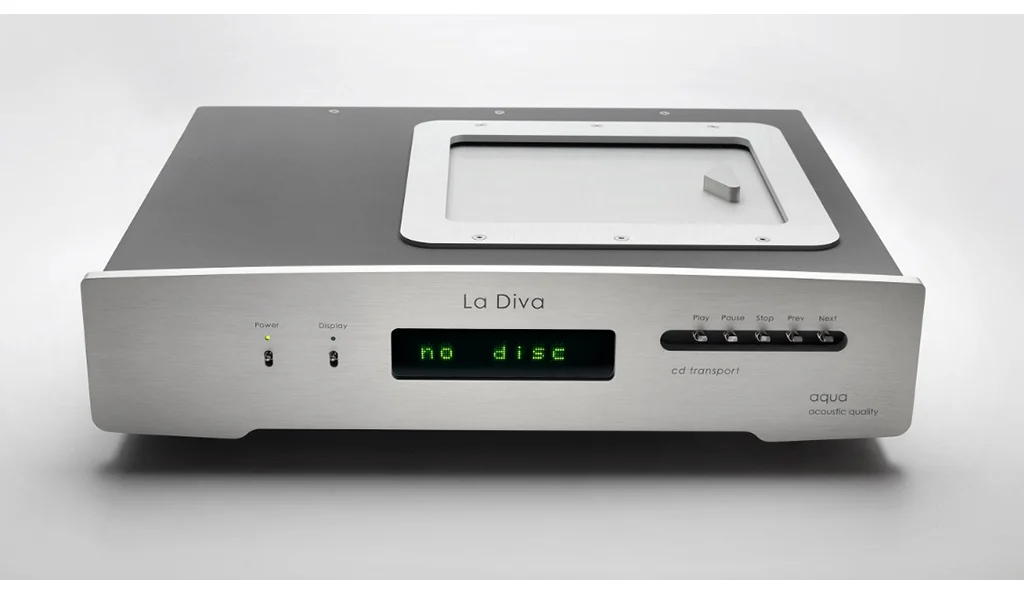
The pursuit of digital-to-analog conversion perfection has taken another significant leap forward. The high-end audio reviewing community has welcomed a formidable digital front-end pairing into its reference listening spaces: the newly announced LaScala Mk.III DAC and the companion LaDiva CD Transport, both meticulously engineered and manufactured by the esteemed Italian high-end audio specialist Aqua Acoustic Quality (officially known as aqua – acoustic quality).
Building upon a legacy of celebrated digital components, this latest generation system represents a comprehensive redesign of Aqua’s mid-to-high-tier digital architecture. The LaScala Mk.III is a pure R2R (Resistor-to-Resistor) ladder DAC that eschews conventional off-the-shelf delta-sigma chipsets in favor of a discrete, highly musical conversion topology. It is complemented by an integrated tube output stage and a brand-new proprietary analog board module: the Pilot Buffer.
Paired with the LaDiva CD transport—a dedicated mechanism engineered exclusively for uncompromised compact disc playback—the system is designed to extract the absolute maximum resolution, transient speed, and emotional resonance from silver discs and legacy digital files alike.
Key details of the system include:
- Aqua LaScala Mk.III DAC MSRP: $9,850 USD
- Aqua LaDiva CD Transport MSRP: $9,960 USD
- Core Technology (LaScala Mk.III): Pure R2R ladder DAC architecture, tube output stage, newly developed Pilot Buffer analog board module, and comprehensive internal circuit overhauls.
- Core Technology (LaDiva): High-precision CD transport mechanism designed to minimize jitter, mechanical resonance, and read errors, optimized for seamless digital handshake with Aqua conversion hardware.
Chronology: The Evolution of Aqua Acoustic Quality’s Digital Architecture
To understand the significance of the LaScala Mk.III and LaDiva pairing, one must examine the chronological progression of Aqua Acoustic Quality. Founded in Italy, the company carved out a distinct reputation in the ultra-competitive high-end audio market by swimming against the tide of mainstream, measurement-obsessed delta-sigma DAC designs. Instead, Aqua focused heavily on proprietary digital-to-analog conversion topologies, modular upgrades, and discrete resistor ladders that prioritize natural timbre, time coherence, and listener fatigue reduction.
The Genesis of the LaScala Line
Years ago, the original LaScala DAC established Aqua as a serious contender in the reference digital category. It introduced the audio world to the company’s philosophy of combining discrete R2R conversion with tube-buffered analog outputs. This hybrid approach aimed to marry the pinpoint imaging and micro-dynamic retrieval of ladder DACs with the organic warmth, liquidity, and harmonic richness characteristic of vacuum tube topologies.
The Mk.II Iteration and Modular Philosophy
Recognizing the rapid pace of digital audio evolution—spanning high-resolution PCM, native DSD, and advanced USB interface protocols—Aqua engineered its components with a modular upgrade path in mind. The Mk.II iteration refined the power supply filtering, reduced noise floors, and updated the digital receiver board. Crucially, Aqua’s design philosophy ensured that owners of earlier hardware could often upgrade their units, protecting consumer investments in high-end gear.
The Arrival of the LaDiva Transport
While computer audio and streaming networks dominated the 2010s, a dedicated faction of audiophiles clung fiercely to the compact disc format, recognizing that well-mastered Redbook CDs often outperform compressed or poorly handled streaming files. To serve this market, Aqua developed the LaDiva CD transport. Built with the same uncompromising mechanical and electrical rigor as their conversion units, the LaDiva was designed to eliminate the jitter and mechanical noise that plague standard transport mechanisms.
The Launch of the Mk.III Generation
The arrival of the LaScala Mk.III marks the culmination of years of R&D following the Mk.II. Rather than a minor cosmetic refresh, the Mk.III represents a ground-up overhaul of nearly every circuit board inside the chassis. The introduction of the Pilot Buffer module on the analog board and the comprehensive redesign of the DAC ladder circuitry signify a generational leap for Aqua, positioning the brand firmly at the bleeding edge of modern digital reproduction.
Supporting Data: Technical Analysis of the LaScala Mk.III and LaDiva
In the realm of ultra-high-end audio, specifications tell only part of the story, but they establish the engineering baseline from which sonic performance is derived. A closer look at the technical architecture of both units reveals why this pairing has generated significant anticipation within the audiophile community.
Inside the LaScala Mk.III R2R DAC
-
Discrete R2R Ladder Topology:
Unlike delta-sigma chips that modulate high-frequency data streams, an R2R ladder DAC uses a precision network of discrete resistors to translate digital words directly into analog voltages. This approach avoids the digital filtering artifacts and high-frequency noise typical of chip-based designs, resulting in a more natural, analog-like presentation of music. -
The New Pilot Buffer Module:
A critical advancement in the Mk.III is the integration of the proprietary Pilot Buffer on the analog board. This module acts as an impedance-matching bridge between the delicate R2R ladder network and the tube output stage. By optimizing signal transfer and isolating the conversion stage from downstream preamplifier loads, the Pilot Buffer preserves micro-dynamic nuances and expands soundstage dimensionality. -
Tube Output Stage Integration:
Audio purists often debate solid-state versus tube topologies. Aqua bypasses this dichotomy by employing a carefully chosen tube output stage that operates without negative feedback in critical areas. This preserves phase integrity and transient speed while infusing the upper registers with natural air, bloom, and dimensional body.
-
Power Supply and Isolation:
Clean power is the lifeblood of any high-end DAC. The LaScala Mk.III features multiple independent power transformers and regulated power supply rails dedicated strictly to digital processing, conversion, and analog amplification. This compartmentalization prevents cross-contamination of high-frequency digital noise into the analog audio path.
Inside the LaDiva CD Transport
-
Precision Mechanical Transport:
The LaDiva utilizes a specialized, heavy-duty CD mechanism isolated from external vibrations and internal chassis resonances. By maintaining precise rotational speed and laser tracking accuracy, the transport ensures that data is read accurately on the first pass, drastically reducing error-correction overhead. -
Proprietary Digital Interfacing:
To maximize the synergy between the transport and the DAC, the LaDiva features high-grade digital output options—including I2S, which transmits clock and data signals on separate lines to eliminate jitter at the DAC interface. When paired with an Aqua DAC like the LaScala, the LaDiva forms a closed-loop digital ecosystem designed for optimal timing precision.
Official Responses and Industry Perspectives
The announcement and subsequent arrival of the LaScala Mk.III and LaDiva units have prompted commentary from industry analysts, reviewers, and representatives within the high-end audio manufacturing sector.
According to preliminary briefings provided by Aqua Acoustic Quality’s engineering team, the development of the Mk.III was driven by a desire to push the limits of what R2R architecture could achieve without sacrificing long-term reliability.
"We did not rush the LaScala Mk.III to market," noted an Aqua product development spokesperson during a technical overview. "Every single component on the analog and digital boards was re-evaluated. The introduction of the Pilot Buffer required dozens of prototype iterations to ensure it met our standards for harmonic transparency and dynamic freedom. When paired with a reference transport like the LaDiva, the system achieves a level of musical realism that bridges the gap between digital convenience and master-tape authenticity."
Reviewers who have spent time with previous iterations of Aqua equipment have also weighed in on the significance of the new release. Long-term listening panels note that while earlier versions of the LaScala were already celebrated for their lush midranges and exceptional soundstage depth, critics occasionally pointed to minor limitations in extreme bass control and micro-detail retrieval compared to ultra-costly solid-state flagships.
Industry insiders suggest that the Mk.III’s comprehensive circuit redesign—particularly the new analog board topology—directly addresses these critiques, promising tighter low-frequency grip without compromising the signature organic warmth that defines the Aqua brand.
Implications for the High-End Audio Market
The introduction of the LaScala Mk.III ($9,850) and LaDiva ($9,960) arrives at a fascinating crossroads in the high-end audio industry. As streaming services push toward ultra-high-resolution files and master-quality authenticated formats, the physical media market—specifically the compact disc—has experienced a resilient boutique resurgence. Audiophiles are increasingly recognizing the sonic benefits of locally hosted, uncompressed digital playback, free from the network congestion, packet loss, and software instability that can plague computer-based streaming setups.
1. The Validation of Redbook CD Playback
By offering a flagship transport like the LaDiva at nearly $10,000, Aqua is making a bold statement: the compact disc is far from obsolete. For collectors with extensive CD libraries, high-end transports demonstrate that the Redbook standard (16-bit/44.1 kHz) was never pushed to its absolute limits by mass-market players of the 1990s and 2000s. When fed into a state-of-the-art R2R ladder DAC like the LaScala Mk.III, standard CDs can rival, and in some cases surpass, high-resolution digital streams in terms of musical engagement, tonal saturation, and spatial coherence.
2. R2R Ladder DACs vs. Delta-Sigma Hegemony
The commercial success and critical acclaim of Aqua’s offerings highlight a broader consumer shift away from generic silicon conversion chips. While major semiconductor manufacturers continue to refine delta-sigma chips for mass-market consumer electronics, high-end audiophiles are increasingly gravitating toward bespoke, discrete ladder architectures. The LaScala Mk.III reinforces the viability and superiority of R2R topologies for listeners who prioritize timbre, tone, and musical flow over sterile, measurement-driven clinicality.
3. Investment Protection and Modular Longevity
At a combined price point approaching $20,000 USD for the full digital stack, consumers rightfully expect a future-proof investment. Aqua’s long-standing commitment to modular architecture means that owners of the LaScala series are not easily left behind by shifting digital standards. This philosophy of upgradability sets a benchmark for the industry, countering the planned obsolescence often seen in consumer tech.
Conclusion and Future Outlook
As the LaScala Mk.III DAC and LaDiva CD transport settle into their long-term evaluation environment, anticipation is high for the published listening impressions. Early setup notes indicate a hardware pairing that commands immediate respect through its industrial build quality, aesthetic elegance, and uncompromising sonic ambition.
Over the coming months, exhaustive review protocols will test the limits of the new Pilot Buffer module, evaluate the synergy of the tube output stage across various musical genres, and determine whether this Italian digital duo lives up to the lofty financial and auditory expectations set by their predecessors. For high-end audio enthusiasts, the journey into the outer limits of digital playback continues—and Aqua Acoustic Quality remains firmly at the vanguard.