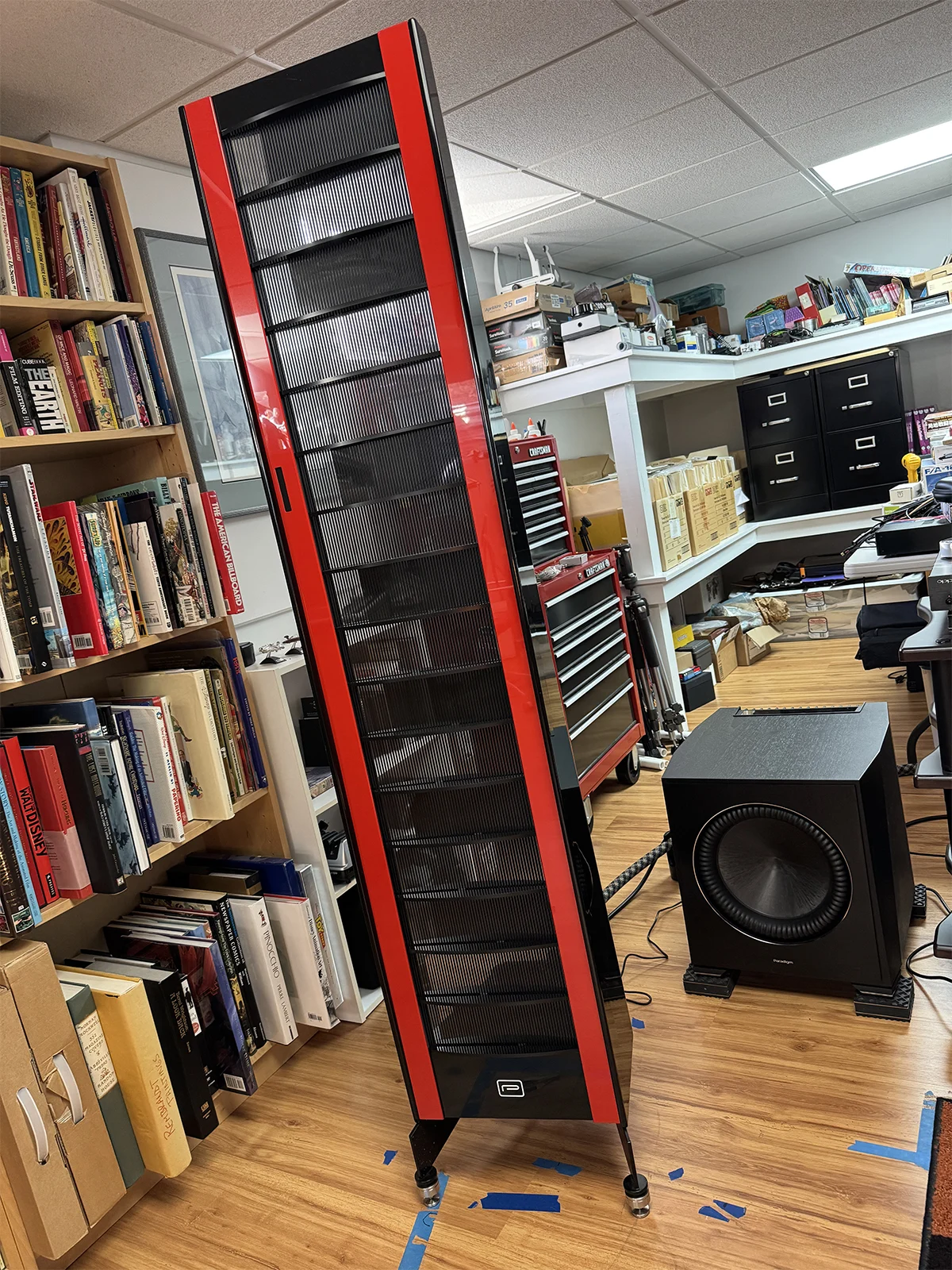
In the high-fidelity world of audiophile equipment, few transducer technologies command as much respect—and pose as many engineering challenges—as the electrostatic loudspeaker. Known for their lightning-fast transient response and unparalleled clarity, these speakers have historically struggled with the "missing bottom end," often requiring complex hybrid designs to achieve a full-frequency spectrum. However, a Hungarian manufacturer, formerly known as Popori Acoustics and now operating under the banner of Prodigio Audio, is challenging these conventions. Their latest creation, the WR2 Arrabona, stands as a testament to the fact that electrostatic purity and robust bass performance need not be mutually exclusive.
Main Facts: The Prodigio Philosophy
The Prodigio Audio WR2 Arrabona is not a hybrid system. Unlike many market competitors that pair a thin electrostatic panel with a traditional cone-based dynamic woofer, the Arrabona is a true full-range electrostatic design. Standing at a commanding 1,848 mm in height, the speaker utilizes a massive electrostatic panel to cover the entirety of the frequency spectrum, from the delicate shimmer of a high-hat to the resonant punch of a kick drum.
The Arrabona is the "step-up" model in Prodigio’s six-model lineup. At an MSRP of $38,000 per pair, it occupies a premium space in the market, targeting listeners who demand the "disappearing act" that only a dipole electrostatic radiator can provide. The core design ethos focuses on artisanal, hand-crafted production, ensuring that each unit is built to a standard that justifies its position as a flagship-tier offering.
Chronology: From Popori to Prodigio
The evolution of this specific design is rooted in the heritage of the company’s previous identity, Popori Acoustics. Over the years, the engineering team behind the project has been meticulously refining the stator and membrane tensioning processes.
For years, the industry watched as the team experimented with various frame materials and conductive coatings to improve efficiency. The transition from the Popori branding to Prodigio Audio signaled a shift toward a more global, performance-oriented market strategy. The Arrabona model represents the culmination of this R&D cycle—a period characterized by a move away from the compromises often found in smaller electrostatic panels. The development of the Arrabona was driven by a single, audacious goal: to maintain the sheer speed of an electrostatic transducer while coaxing 35 Hz extension out of a panel that doesn’t rely on "cheating" with a moving-coil woofer.
Supporting Data and Engineering Specifications
To understand why the WR2 Arrabona manages to defy the "bass-shy" stigma of the past, one must look closely at its technical architecture.

Technical Performance Matrix
- Design: Full-range electrostatic loudspeaker (dipole).
- Frequency Response: 35 Hz – 22 kHz.
- Impedance: 2.5 Ohms (nominal minimum).
- Dimensions: 1848 mm (H) x 415 mm (W) x 330 mm (D).
- Included Hardware: 2 external power supplies, 6 aluminum spikes, 6 floor disks, 4 jumper cables, and 16 proprietary foam damping panels.
The inclusion of external power supplies is a critical design choice. By separating the high-voltage bias circuitry from the audio path and the main frame, Prodigio minimizes electromagnetic interference and allows for a cleaner signal path. Furthermore, the impedance curve, which dips to a challenging 2.5 Ohms, suggests that the Arrabona requires a high-current, stable amplifier to truly sing. This is not a speaker for the faint-hearted; it demands an amplification chain that can handle low-impedance loads with authority.
The inclusion of 16 foam panels is a unique touch, allowing the end-user to fine-tune the room-loading characteristics of the dipole radiation. This level of granular control is rarely seen in floor-standing speakers, indicating that Prodigio views the speaker and the room as a singular, symbiotic system.
The "Hybrid" Myth: Why the Arrabona Changes the Conversation
For decades, companies like MartinLogan have utilized hybrid designs—electrostatic panels for the mids and highs, paired with dynamic woofers for the low end. While effective, these designs often face a "crossover problem." The speed of the electrostatic panel is so much faster than the inertia of a traditional paper or plastic cone that the sonic signature can feel disjointed.
Prodigio’s commitment to a full-range electrostatic design eliminates this transition point entirely. When listening to the Arrabona, there is a seamlessness to the presentation that is simply unattainable in hybrid designs. The "healthy dose of bass" mentioned in early show reports is not a byproduct of a subwoofer; it is the result of a larger, more sophisticated diaphragm surface area and a highly tuned tensioning system that allows the panel to move enough air to create genuine low-frequency tactile impact.
Official Perspectives: The Listener’s Experience
Those who have witnessed the Arrabona in action—whether at international audio shows or private demonstrations—consistently highlight its transient speed. In high-end audio, "transients" refer to the ability of a speaker to start and stop a sound instantly. Electrostatic speakers are the gold standard for this, as the membrane is virtually massless compared to a dynamic driver.
The official perspective from Prodigio Audio suggests that the Arrabona is designed for the "purist listener." The company’s design notes emphasize that by removing the mechanical distortion of voice coils and magnets, the listener is left with nothing but the signal. The "robust" bass, often a point of surprise for show-goers, is achieved through an optimized panel excursion that pushes the limits of electrostatic physics without introducing the audible breakup common in lesser designs.

Implications for the High-End Market
The release of the WR2 Arrabona has significant implications for the future of the electrostatic market.
1. The Death of the "Small Panel"
The industry has long favored smaller panels for their ease of placement. Prodigio is proving that if you want a full-frequency range, you need scale. The Arrabona’s nearly two-meter height is not just for aesthetics; it is a prerequisite for achieving the necessary displacement to hit 35 Hz.
2. The Return of the Purist
There is currently a trend toward "all-in-one" wireless speakers and simplified systems. Prodigio Audio is swimming against the tide, catering to a demographic that still values the ritual of high-end amplification and precise speaker placement. By offering a product that requires dedicated power and careful room interaction, they are reaffirming the hobbyist nature of high-end audio.
3. Economic Positioning
At $38,000, the Arrabona enters a crowded field of ultra-high-end speakers. However, its value proposition is distinct. Unlike dynamic speakers that rely on exotic cabinet materials and complex crossover networks to achieve neutrality, the Arrabona relies on the simplicity of physics. For the consumer, this represents a trade-off: they are paying for the mastery of the electrostatic process and the artisanal build quality rather than for thousands of dollars worth of internal components in a crossover.
Conclusion: A New Standard for Electrostatics
The Prodigio Audio WR2 Arrabona is more than just a speaker; it is an engineering challenge issued to the rest of the high-end industry. It asks a simple question: why accept the "hybrid" compromise when the full-range ideal can be perfected?
With its tall, elegant stature and a sound that manages to combine the airy, holographic soundstage of an electrostatic panel with a low-end weight that feels genuinely physical, the Arrabona is likely to become a benchmark for enthusiasts. It is a reminder that in the world of high-fidelity audio, the most profound innovations often come from those who stay true to the foundational principles of sound reproduction. For those seeking the ultimate in transparency, the Hungarian-made Arrabona is not just an option—it is a destination.