Modern high-fidelity audio systems have reached a pinnacle of acoustic neutrality. Today’s amplifiers, DACs, and speakers possess the technical capability to reproduce sound with near-perfect transparency. Yet, despite these engineering marvels, many listeners find that their home audio systems fail to capture the "magic" of a recording when played at moderate or quiet volumes. The reason for this discrepancy is not found in the equipment, but in the biological reality of human hearing: our ears are fundamentally non-linear devices.
At lower sound pressure levels (SPL), the human auditory system loses sensitivity to the frequency extremes—the deep bass and the shimmering highs—while maintaining a sharp focus on the midrange. Consequently, a recording played at 72 dB sounds fundamentally different than it did in the mastering studio at 83 dB. By leveraging modern digital signal processing (DSP) and the rigorous standards of ISO 226:2023, listeners can finally bridge this gap, restoring the intended tonal balance of their favorite music at any volume.
The Psychoacoustic Reality: Why Volume Matters
In online audio forums, the question "What is your typical listening level?" appears with monthly regularity. While often treated as a trivial conversation starter, this number is actually a critical parameter for sound reproduction.

Most professional music is mastered at a reference level, typically 83 dB SPL. This is the volume at which the mastering engineer—using highly calibrated, flat-response monitors—makes the final decisions on tonal balance, bass impact, and high-frequency "air." However, most domestic listening occurs at lower levels—often between 65 dB and 75 dB—due to household constraints, neighbor considerations, or personal preference.
When the playback level drops below the mastering reference, the listener experiences a psychoacoustic phenomenon where the perceived bass and treble recede. This is not a failure of the amplifier or the room acoustics; it is a feature of human biology, evolved to prioritize midrange sounds (such as speech) while filtering out environmental noise. Because our brain is "mid-forward," the music played at lower levels lacks the foundation of the bass and the sparkle of the harmonics, leading to a thin, clinical, or dull presentation. Over time, the auditory cortex works overtime to reconstruct these missing frequencies, resulting in subtle but persistent cognitive fatigue.
A Chronological Perspective: From Fletcher-Munson to ISO 226:2023
The history of addressing this issue dates back nearly a century. In 1933, researchers Harvey Fletcher and Wilden Munson of Bell Labs published the first comprehensive study on how human hearing perceives loudness across the frequency spectrum. Their research was born of necessity; the telephone industry needed to understand how to deliver intelligible speech across long-distance copper wires without wasting bandwidth on frequencies the human ear couldn’t effectively perceive at low volumes.

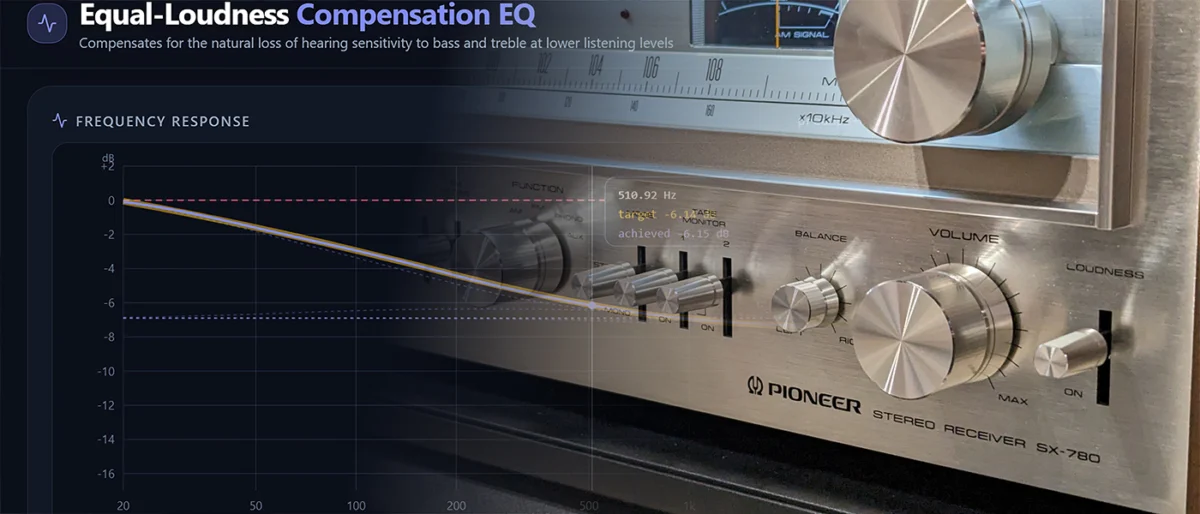
The "Fletcher-Munson curves" became the foundation for the "Loudness" buttons found on virtually every stereo receiver of the 1970s. Brands like Pioneer, Sansui, and Kenwood implemented passive circuits—often using tapped potentiometers—that boosted bass and treble when the volume knob was turned down.
However, these analog solutions were often crude. They were "fixed" curves that didn’t account for the sensitivity of the speakers, the room size, or the actual SPL at the listener’s ear. By the 1980s, the "straight wire with gain" philosophy of high-end audio pushed these controls into obsolescence, viewing them as unwanted coloration. The baby was effectively thrown out with the bathwater.
The science, however, continued to evolve. The 1956 Robinson-Dadson curves refined the data, and eventually, the International Organization for Standardization (ISO) established the ISO 226 standard. The current iteration, ISO 226:2023, represents the global consensus on human hearing sensitivity. It provides a precise mathematical map of how our ears perceive sound, allowing engineers to calculate exactly how much compensation is required to maintain tonal fidelity at any volume level.

Supporting Data: Validating the Need for Correction
To understand the necessity of this correction, one need only perform a simple in-room measurement. Using Room EQ Wizard (REW), if you measure the frequency response of a system at 70 dB and 78 dB, you will notice that the microphone reports a nearly identical, flat tonal balance. The system is performing perfectly. Yet, the human ear perceives the 70 dB measurement as significantly deficient in bass and treble compared to the 78 dB measurement.
The red curve on the ISO 226 contour map confirms this: the difference in perceived loudness is not in the equipment; it is entirely in the listener. To counteract this, a Five-Band Parametric EQ (PEQ) can be implemented to mirror the inverse of the ISO 226 curve. When this digital filter is applied, the listener experiences a "loudness-compensated" signal that restores the tonal balance of the 83 dB mastering reference at a 70 dB actual playback level.
Verification studies show that this method is remarkably accurate, often tracking the ISO target to within a few hundredths of a decibel. Unlike the "V-shaped" caricature of vintage loudness buttons, which were often implemented incorrectly, modern DSP-based correction is surgical, precise, and entirely transparent.

Implications for Modern Audio Systems
The rise of lossless streaming and digital playback has made this correction easier than ever to implement. Modern platforms such as Roon, Audirvāna Studio, and JRiver Media Center, as well as hardware streamers from brands like WiiM, Eversolo, and miniDSP, allow for the application of precise PEQ filters.
The Practical Implementation Strategy
To implement this, a listener should follow a structured three-step process:
- Calibration: Use a simple SPL meter app (set to C-weighting and slow integration) to determine your average listening level. Do this from your actual seating position over a 30-second window.
- Calculation: Use an ISO 226-compliant calculator (such as the one developed by David Snyder) to generate the required filter values. These filters act as an intelligent, level-dependent EQ.
- Application: Apply the calculated negative preamp gain (to prevent digital clipping) and enter the five PEQ bands into your system’s DSP settings.
The implication of this approach is profound. It allows audiophiles to decouple speaker placement from tonal balancing. Often, speakers are shoved into corners or toed-in aggressively to "force" more bass or treble into a room. With proper loudness compensation, the speaker can be placed where it images best, and the digital filter handles the tonal balance according to the actual volume of the session.

Addressing the Skeptics: Is This "Coloration"?
Purists may argue that any EQ is "coloration" that interferes with the original recording. However, the true "coloration" occurs in the ear of the listener when the playback volume deviates from the reference level. By refusing to apply compensation, the listener is effectively hearing a distorted, thin version of the music.
Dolby Volume and other proprietary adaptive systems have attempted to solve this for years, but they often function as "black boxes"—applying algorithms without disclosing the underlying target curves. The ISO 226:2023 approach is superior because it is transparent, verifiable, and standardized. It does not guess what the listener wants; it applies the exact mathematical correction required to align the listener’s perception with the mastering engineer’s intent.
Conclusion: A New Standard for Home Listening
The ability to enjoy music at lower volumes without sacrificing the emotional impact of the bass or the clarity of the highs is a significant development for the home audio enthusiast. It transforms the listening experience, allowing for late-night sessions that feel as full-bodied and satisfying as those held at high noon.

By acknowledging the limitations of human biology and embracing the precision of ISO standards, we can finally stop fighting our rooms and our volume knobs. The goal of high-end audio has always been to bring the listener closer to the artist’s intent. Today, the most effective way to do that is not by upgrading a cable or an amplifier, but by using the tools of modern DSP to give our ears exactly what they need, at the volume we choose to live with.
As we continue to integrate digital tools into our analog setups, the "Loudness" conversation should move from a nostalgic debate about 1970s hardware to a sophisticated implementation of psychoacoustic science. The next time you find yourself turning the music down, remember: you don’t have to accept the loss of the music’s foundation. With a thirty-second measurement and a five-band filter, the reference-level experience is always at your fingertips.