By James for Headfonics
Disclaimer: This evaluation sample was provided in exchange for an honest, independent review. Headfonics operates entirely independently with no affiliate links or brand partnerships. Special thanks to Sony for their ongoing support.

Introduction: Sony Returns to the Professional Stage
For years, the pro-audio community has waited for Sony to refresh its dedicated stage-monitoring portfolio. While the Japanese electronics giant has maintained a strong foothold in consumer audiophile spaces—and continues to dominate studio environments with legendary over-ear staples like the MDR-7506—true stage-ready in-ear monitors (IEMs) have seen more selective releases.
Enter the Sony IER-M500, an accessible yet rugged stage monitor priced at $119.99. Built around a single, compact 5mm dynamic driver, the M500 makes no secret of its primary target audience: live performers, gigging musicians, and studio tracking professionals who demand physical reliability, fatigue-free highs, and immediate low-end feedback over sterile, analytical studio tuning.

In this deep-dive review, we examine how Sony’s latest live-sound workhorse handles the rigors of the stage, benchmark it against industry contemporaries like the Westone Audio AM Pro X20 and the Earsonics SWITCH 300 PRO, and evaluate whether it deserves a spot in your DAW toolkit or gig bag.
Chronology and Engineering Evolution
The genesis of the IER-M500 stems from a shift in design philosophy away from pure consumer audiophile sound profiles toward functional reliability. Traditional consumer IEMs prioritize expansive soundstages, sparkling treble air, and deep sub-bass drops optimized for sedentary listening rooms. Conversely, live stage monitors must survive harsh physical environments, resist sweat ingress, and deliver consistent performance under high SPL (Sound Pressure Level) stage conditions.

Sony’s development cycle for the M500 zeroed in on three core parameters:
- Mechanical Security: Mitigating the notorious issue of IEMs slipping out during energetic performances or vigorous movement.
- Driver Efficiency: Employing a diminutive 5mm dynamic driver (16Ω impedance, 103 dB/mW sensitivity) capable of being driven effortlessly by entry-level wireless bodypacks, mixing consoles, or mobile dongles without requiring dedicated amplification.
- Fatigue Mitigation: Smoothing out high-frequency transients to eliminate harsh sibilance during multi-hour sets.
Supporting Data and Hardware Analysis
Build Quality, Shell Design, and Aesthetics
Out of the box, the IER-M500 presents an understated, highly functional aesthetic. The injection-molded plastic housing is remarkably rigid, boasting seamless shell transparency entirely free of glue marks or cosmetic blemishes.

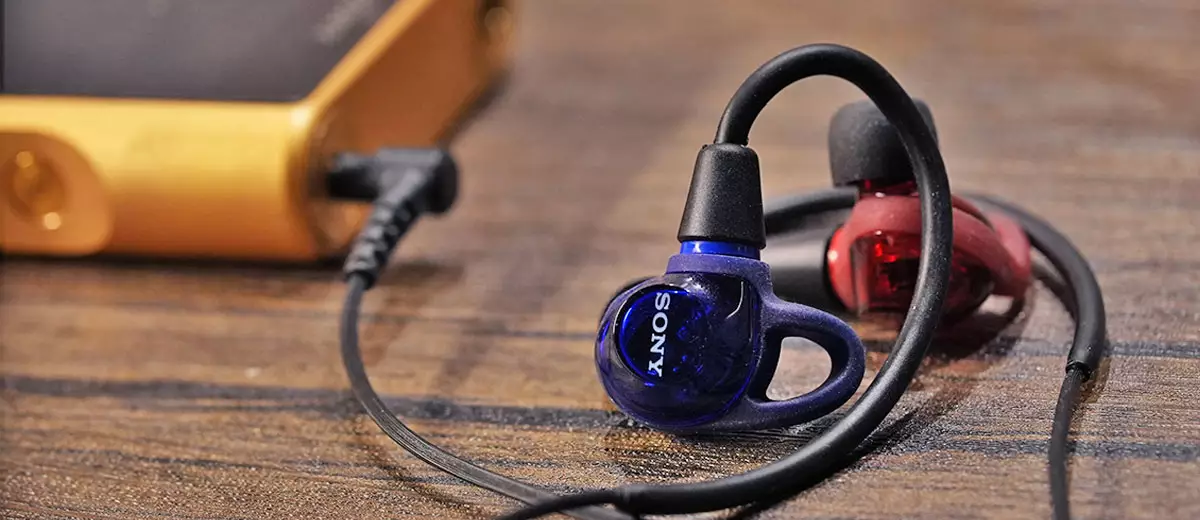
Sony employs a classic pro-audio color-coding scheme on our review unit: transparent red for the right channel and transparent blue for the left, ensuring rapid visual identification under dim stage lighting. For users desiring a more discreet footprint, clear and transparent black variants are also available.
Measuring in with a sleek, low-profile footprint, the shells sit flush within the outer ear, preventing snagging on clothing, mic cables, or instrument straps.

The Innovation of Swappable Ear Fins
The standout mechanical feature of the IER-M500 is its proprietary swappable ear fin system. Borrowed conceptually from sports-oriented True Wireless Stereo (TWS) earphones, these flexible fins grip the concha of the outer ear.
Sony includes five different sizes of fins in the box. The larger sizes feature pronounced hooks that mechanically lock the IEMs into place. Whether a drummer is headbanging or a vocalist is sprinting across a stage, the M500 remains firmly anchored.

Connectivity and Cable Specifications
The MMCX sockets on the M500 are deeply recessed into the shell housing. This architectural choice serves a dual purpose: it significantly reinforces the connection against physical strain while forming a sweat- and moisture-resistant barrier.
The stock cable is a generous 1.6 meters in length, terminated with a standard 3.5mm single-ended plug. It features a rugged, slightly stiff jacket designed to resist tangling. The extra length is particularly advantageous for stage use, easily reaching bodypack receivers worn on a performer’s lower back or plugging straight into an audio interface on a deep studio desk without needing an extension.

Comfort, Isolation, and Accessories
Comfort & Fit Dynamics
Because live performers routinely wear monitors for hours at a time, ergonomics are paramount. Sony leverages its deep anthropometric research database to craft a nozzle depth that achieves a shallow yet exceptionally secure seal. The ear fins distribute pressure evenly, preventing localized hotspots or fatigue over extended sessions.
Triple-Comfort Ear Tips
Sony equips the IER-M500 with its acclaimed Triple-Comfort ear tips—accessories that retail separately for over $30. These utilize a hybrid design combining a rigid silicone inner core with a soft, rinsible polyurethane foam exterior layer.

Unlike traditional memory foam tips, users do not need to compress them prior to insertion. They offer immediate grip, maintain passive noise attenuation without absolute isolation (allowing performers to retain a natural sense of stage ambient sound), and preserve high-frequency energy better than standard foam alternatives. In addition to four pairs of Triple-Comfort tips, Sony supplies four pairs of standard silicone tips (SS, S, M, L) and a cable clip.
Critique: While the included soft carrying pouch is well-constructed, the absence of a hard-shelled protective case feels like a missed opportunity for professional-grade gear destined to take a beating on the road.

Sound Impressions
Testing Methodology: Sound evaluations were conducted across multiple reference sources, including the Sony WM1Z, FiiO BTR15, Lotoo PAW Gold Touch, and the RME ADI-2 Pro interface.
Summary Signature
The IER-M500 presents an M-shaped, bass-tilted frequency response. Rated at 16 ohms and 103 dB/mW, its miniature 5mm dynamic driver defies expectations, offering high agility, immediate transient response, and effortless drivability straight out of modest laptop jacks or mobile dongles.

Timbre and Frequency Breakdown
- Low-End: The bass is full, punchy, fast, and authoritative. There is a noticeable low-end lift designed to give bassists and drummers the physical rhythm cues they need to anchor themselves against loud stage floors. Transients are clean, avoiding muddy bleed into the lower midrange.
- Midrange: Vocals possess a natural body and solid projection. Rather than being artificially pushed forward to steal the spotlight, they sit harmoniously in line with backing instrumentation. While complex, layered tracks require a bit of active focus to separate individual vocal nuances, pairing the M500 with a high-resolution DAC instantly tightens instrument definition.
- Treble: Designed for fatigue-free performance, the high frequencies feature a deliberate, steep roll-off. This tames harsh sibilance, piercing cymbals, and overly bright high-pitched vocals. While it sacrifices the extreme air and micro-detail required for classical strings or woodwinds, it provides a wonderfully smooth, forgiving presentation—particularly when paired with bright or sterile live-mixing boards.
Staging and Dynamics
The soundstage dimensions are intimate and controlled, evoking a small performance venue or studio live room with generous width and slightly closer depth. Dynamic punch is exceptional, handling heavy equalization adjustments in the midrange without introducing audible distortion.
Selected Comparisons
Sony IER-M500 vs. Westone Audio AM Pro X20
- Technicalities: The Westone Audio AM Pro X20 utilizes a dual Balanced Armature (BA) architecture with a 2-way crossover (27Ω, 119 dB sensitivity). Crucially, it incorporates Westone’s StageSense passive acoustic filter, which deliberately lets in ambient stage noise so performers can interact with audiences.
- Performance: The X20 leans brighter, offering superior resolution, vocal clarity, and air at the expense of isolation. Conversely, the IER-M500 delivers a far more coherent, punchy, and authoritative low-end response. If bass weight and isolation are your priorities, the M500 wins; if ambient awareness and analytical clarity are paramount, the X20 takes the lead.
Sony IER-M500 vs. Earsonics SWITCH 300 PRO
- Technicalities: Coming from France, the Earsonics SWITCH 300 PRO houses a triple-BA layout with an adjustable impedance corrector allowing users to toggle between three distinct tonal profiles ("Tight," "Standard," and "Warm") using a miniature screwdriver.
- Performance: The SWITCH 300 PRO leverages its multi-BA design to extract superior midrange micro-detail and positional precision on percussion. However, the IER-M500 renders low-end texture far more effortlessly and organically via its dynamic driver. The Earsonics monitor scales more aggressively with high-end desktop hardware, whereas the Sony remains forgiving and consistent across utilitarian stage gear.
Implications and Verdict
The Sony IER-M500 represents a welcome pivot back to professional live audio engineering from a brand traditionally celebrated for consumer-facing gear.

For bass players, drummers, and vocalists who need reliable rhythm cues, a secure physical fit, and a forgiving treble response that combats ear fatigue over grueling sets, the M500 is a formidable tool. General listeners who enjoy rock, guitar-driven tracks, and bass-heavy genres will find plenty to love, provided they do not require ultra-airy treble extension.
Pros:

- Powerful, responsive, and articulate bass performance.
- Rugged, sweat-resistant physical build with ingenious ear fins.
- Exceptional drivability across modest portable sources.
- Smooth, sibilance-free treble presentation.
Cons:
- Lacks a hard protective carrying case in the accessory bundle.
- High frequencies are rolled off, limiting air and sparkle for acoustic or orchestral music.
- Limited scalability with ultra-high-end desktop chains.
Ultimately, the Sony IER-M500 punches well above its $119.99 price point, serving double duty as a bulletproof stage monitor and an enjoyable, fatigue-free everyday companion for workouts and live practice sessions.