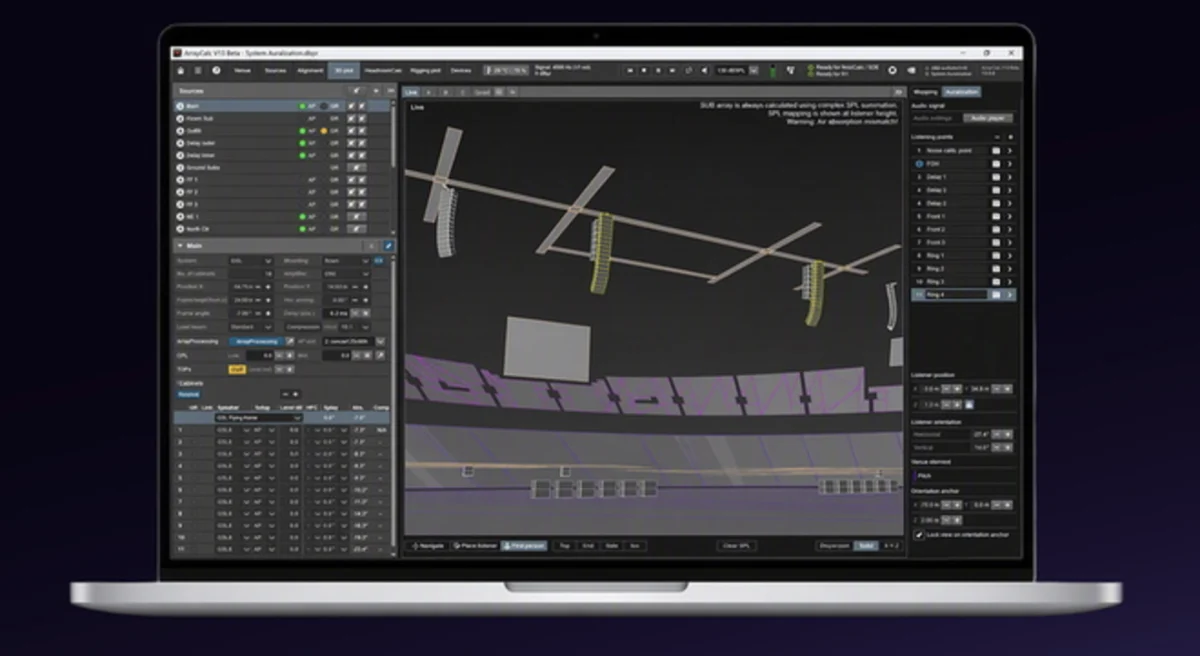
MUNICH, GERMANY — In an announcement poised to change the workflow of live sound engineers and system designers worldwide, d&b audiotechnik has officially introduced System Auralization. This groundbreaking software feature brings real-time binaural audio simulation directly to the industry-standard ArrayCalc platform, allowing audio professionals to literally hear their loudspeaker system designs within a virtual venue long before a single cable is run or a speaker is flown on-site.
For decades, acoustic prediction software has relied heavily on visual data—heat maps, coverage plots, SPL calculations, and frequency response graphs. While invaluable, these traditional metrics require engineers to mentally translate visual data into auditory expectations. System Auralization bridges this gap entirely, introducing a sensory-rich, interactive simulation layer that promises greater precision, faster deployments, and deeper confidence for live sound, touring, and fixed-installation professionals.
Main Facts: What is System Auralization?
System Auralization is an advanced real-time audio simulation tool integrated into d&b audiotechnik’s ArrayCalc ecosystem. Rather than substituting traditional prediction tools, it builds upon them, merging acoustic physics calculations with real-time binaural rendering.
Key features of the new software module include:
- First-Person Virtual Walkthroughs: Users can navigate a 3D virtual venue model, assessing acoustic coverage, high-frequency roll-off, imaging, and tonal balance from virtually any seat in the house.
- Real-Time Parameter Updates: Any adjustments made to loudspeaker positioning, array splay angles, flown heights, amplifier parameters, equalization filters, or complex ArrayProcessing configurations are reflected instantly in the audio playback.
- Playback Integration: Engineers can load custom audio tracks or standard reference material into the software to evaluate how music or speech translates through the proposed system design.
- A/B Snapshot Comparison: Combined with ArrayCalc’s snapshot recall functionality, users can seamlessly switch between multiple system configurations on the fly without interrupting audio playback, allowing for immediate comparative analysis.
Currently launched as an open beta version, the feature is available for public testing and feedback via the official d&b audiotechnik website, setting the stage for a comprehensive commercial rollout later in the product lifecycle.
Chronology: The Evolution of Acoustic Prediction
To understand the magnitude of d&b audiotechnik’s latest development, it is helpful to look back at how acoustic prediction software has evolved over the past thirty years.
The Era of 2D Calculations and Math
In the early days of professional sound reinforcement, system design was largely empirical, relying on basic inverse-square law math, manufacturer-provided polar plots, and decades of field experience. As computers became more powerful in the 1990s, basic prediction software emerged, allowing technicians to plot basic coverage angles in two dimensions. However, these early tools could not account for complex line array interactions, phase anomalies, or architectural reflections.
The Rise of 3D Modeling (The ArrayCalc Era)
The turn of the millennium saw the introduction of sophisticated 3D acoustic modeling software, with d&b’s ArrayCalc becoming an industry benchmark. These programs allowed engineers to map complex multi-cabinet line arrays inside detailed 3D venue computer-aided design (CAD) models. Engineers could accurately predict maximum SPL distribution, tonal consistency, and mechanical safety limits.

Despite these massive leaps forward, a fundamental disconnect remained: the software could show what a system was doing visually, but it could not reproduce how it sounded. Engineers still had to rely on their imagination and past experience to predict the subjective sonic impact of a crossover filter, a FIR filter adjustment, or a physical array tweak.
The Auralization Breakthrough (2026)
With the launch of System Auralization, d&b audiotechnik has closed the loop between sight and sound in acoustic design. By leveraging modern processing power and advanced binaural rendering algorithms, the company has transitioned prediction software from a purely analytical tool into an immersive, experiential environment. This milestone marks the next logical step in the evolution of audio engineering workflows.
Supporting Data and Technical Architecture
Underneath the user-friendly interface of System Auralization lies a complex web of acoustic mathematics and real-time digital signal processing (DSP).
How Binaural Rendering Works in Virtual Venues
Binaural audio relies on Head-Related Transfer Functions (HRTFs) to simulate how human ears perceive sound in a three-dimensional space, accounting for the acoustic filtering effects of the torso, shoulders, head, and pinnae. In System Auralization, the software calculates the direct sound path from every individual loudspeaker element in a virtual array to the virtual listener’s coordinates, factoring in:
- Distance Attenuation: Natural drop-off in level according to the inverse-square law.
- Air Absorption: High-frequency attenuation caused by temperature, humidity, and distance.
- Directivity Indices: The specific off-axis frequency response and dispersion patterns of individual d&b loudspeaker cabinets.
- Boundary Reflections: Interaction with virtual architectural surfaces (walls, ceilings, floors) mapped within the venue model.
Efficiency Gains in the Field
According to internal preliminary metrics shared by early testing groups, the integration of System Auralization is expected to drastically reduce tuning and optimization times during load-in. Traditionally, a significant portion of a system engineer’s day is spent chasing anomalies—such as uneven front-fill coverage or excessive slap-back echoes—once the physical PA is already flown. By ironing out these discrepancies in the virtual domain, teams can arrive at festival sites, arenas, and theaters with a pre-optimized baseline, leaving more time for creative fine-tuning and system validation.
Official Responses and Industry Perspectives
The professional audio community has responded with immense enthusiasm to the introduction of System Auralization. Executives and product developers at d&b audiotechnik emphasize that the tool was built to solve real-world pressures faced by modern touring crews.
"With System Auralization, engineers can build confidence in their decisions and address many important design considerations beforehand," explains Florian Hahn, Product Manager of Applied Software at d&b audiotechnik. "It’s a huge time saver, which is especially valuable before a show. While built to support professionals, it also makes system behavior easier to explore and understand, offering a useful tool for the next generation of system engineers."
Industry veterans have echoed Hahn’s sentiments, noting that live production timelines are increasingly compressed. As load-in windows shrink and festival changeover times grow tighter, any tool that minimizes uncertainty on-site provides an invaluable competitive advantage.

Furthermore, educational institutions and training academies have praised the software’s intuitive nature. By allowing students and junior audio engineers to audibly experience the consequences of poor splay angles, improper coverage alignment, or incorrect processing choices, System Auralization serves as an exceptionally powerful pedagogical tool.
Implications for the Live Sound and Installation Markets
The release of d&b audiotechnik’s System Auralization has wide-ranging implications for multiple sectors of the professional audio industry.
1. Touring and Festival Production
For large-scale touring productions, where speaker configurations change from venue to venue on a daily basis, predictive accuracy is paramount. System Auralization allows touring system engineers to pre-configure their designs for every stop on a routing schedule ahead of time. By virtually walking through acoustically challenging arenas or unusual amphitheaters before the trucks even arrive, engineers can anticipate problematic balconies, blind spots, or coverage gaps, devising targeted ArrayProcessing solutions before hitting the road.
2. Fixed Installations and Architectural Integration
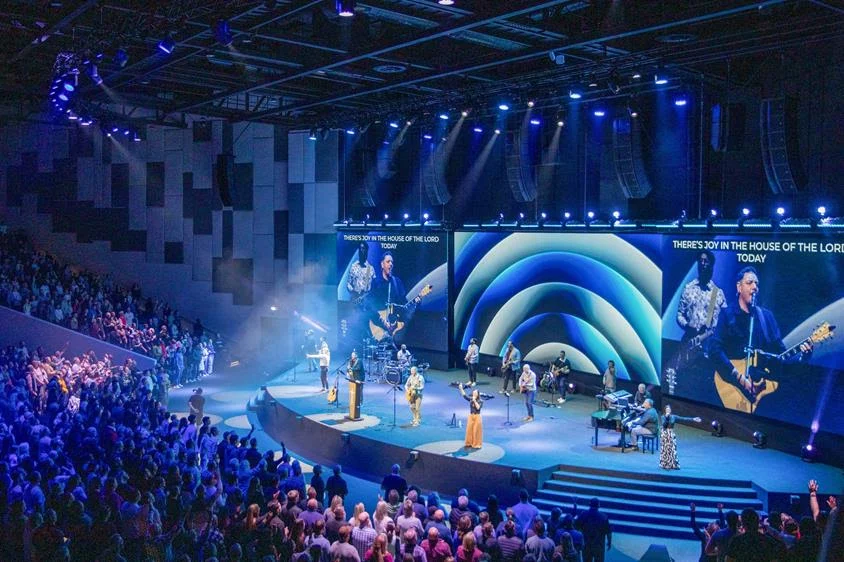
In fixed installation projects—such as houses of worship, performing arts centers, sports stadiums, and corporate auditoriums—stakeholders and consultants often struggle to understand acoustic design proposals presented merely as numbers and charts. System Auralization bridges the communication gap between technical designers and non-technical clients. Consultants can now play a simulated audio sample of how a sermon, musical performance, or public announcement will sound in the finished room, giving architects and venue owners unprecedented clarity and peace of mind.
3. The Future Standard of Acoustic Software
As competitors observe the market reaction to d&b’s new feature, a broader industry shift is likely to follow. Just as 3D acoustic modeling became an uncompromised standard for loudspeaker manufacturers over the last two decades, real-time auralization threatens to become the new benchmark for professional sound system design. Clients and engineers will increasingly expect to hear a virtual space before committing to capital expenditures or deployment strategies.
Conclusion and Next Steps
d&b audiotechnik has once again demonstrated its commitment to pushing the boundaries of audio technology and engineering workflow efficiency. By translating complex acoustic equations into an intuitive, real-time auditory experience, System Auralization removes much of the guesswork from professional sound reinforcement.
The beta version of ArrayCalc featuring System Auralization is currently accessible for download via the d&b audiotechnik website. The company is actively encouraging the global engineering community to put the software through its paces, utilizing user feedback gathered during the beta testing phase to refine performance and stability ahead of the official, general commercial release.
As live sound production continues to demand higher fidelity, tighter tolerances, and faster execution, innovations like System Auralization ensure that engineers are better equipped than ever to deliver exceptional sonic experiences to audiences worldwide.