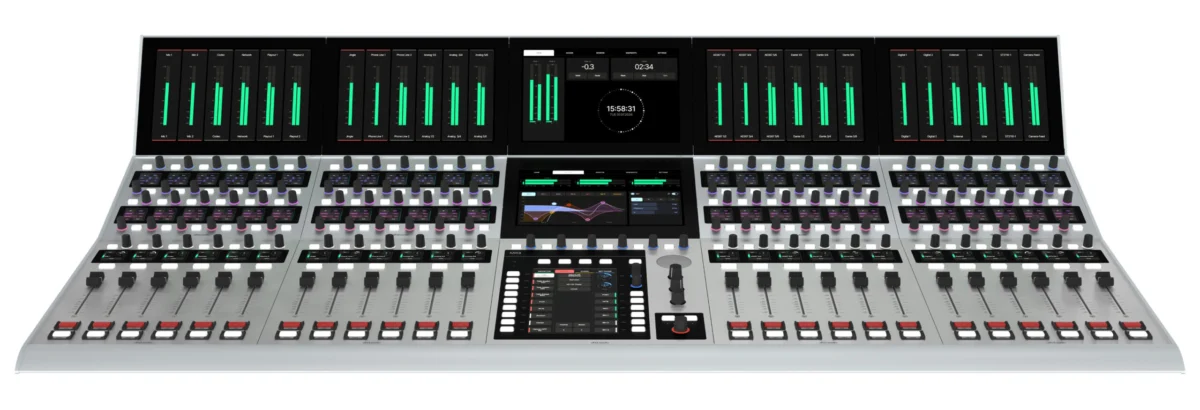
AMSTERDAM — Marking a significant milestone as the company celebrates its 30th anniversary, audio technology innovator DHD has officially launched its highly anticipated MX3 modular audio mixing console range. Unveiled at the IBC 2026 Show at RAI Amsterdam (Stand 8.B46), the MX3 series represents the third generation of DHD’s renowned Series 52 control surfaces.
Designed to address the rapidly shifting demands of modern broadcast and media production environments, the MX3 retains the core modularity, operational flexibility, and expandability that defined its predecessors, while introducing advanced capabilities tailored for the "Dynamic Media Facility"—a framework coined by the European Broadcasting Union (EBU) to describe modern, adaptable, and IP-centric production infrastructures.
Main Facts
The DHD MX3 console range introduces a profound technological leap for the company’s hardware ecosystem, bridging legacy investment protection with cutting-edge network flexibility.
At its technical core, the MX3 transitions away from DHD’s proprietary Audio/Power/Control (APC) protocol—a staple of current Series 52 systems—in favor of standard IP networking. Each MX3 module now operates as a fully self-contained network device connected via standard Ethernet utilizing Power over Ethernet Plus (PoE+). This architecture requires just a single cable per console column, drastically streamlining physical installation and studio cabling.
Key features of the MX3 console range include:
- True Modularity: Consoles are constructed using individual modules, typically featuring a central module paired with six-fader expansion modules housed within a robust physical frame, complemented by optional over-bridge modules and high-resolution displays.
- Hot-Swappable Infrastructure: Modules can be seamlessly added, exchanged, or repaired while the system remains fully operational, minimizing downtime in high-stakes broadcast environments.
- Flexible Core Assignment: The assignment between physical control surfaces and external digital processing cores is no longer rigidly fixed, allowing dynamic reconfiguration of studio resources.
- Comprehensive AoIP Integration: Building on DHD’s extensive history with Audio-over-IP (AoIP), the MX3 range natively supports industry-standard protocols including AES67, Dante, Ravenna, and SMPTE 2110 for high-capacity channel routing.
- Contextual Surface Displays: Intelligent displays embedded across the surface dynamically update to reflect the functions assigned to adjacent controls based on the engineer’s currently selected view.
Chronology: Three Decades of Modular Innovation
To understand the significance of the MX3 release, it is essential to trace DHD’s evolutionary trajectory over the last thirty years, a timeline defined by a consistent commitment to modularity and hardware longevity.
1996–2005: The Foundation and Early Digital Adoption
DHD was founded in the mid-1990s with a clear vision: to build modular audio systems that could adapt to the shifting technological tides of radio and television broadcasting. During its first decade, the company established itself as a reliable European manufacturer, transitioning analog studios into the digital age with modular control surfaces and pioneering digital signal processing (DSP) routing matrices.
2006–2020: The Series 52 Era and the Rise of AoIP
The introduction of the Series 52 range marked a turning point for DHD, cementing its reputation globally. The Series 52 platform revolutionized control surface design by separating physical mixing surfaces from external digital processing cores. Over the years, DHD continually updated the Series 52 platform to incorporate emerging Audio-over-IP (AoIP) standards, ensuring that broadcasters could migrate from traditional MADI and baseband audio to networked environments without discarding their underlying hardware investments.

2021–2025: Preparing for the Dynamic Media Facility
As post-pandemic production workflows necessitated greater remote collaboration, virtualization, and IP-native flexibility, DHD began engineering its next-generation platform. Recognizing that broadcasters required workflows capable of shifting dynamically between automated playout, live talk radio, and multi-camera television production, the engineering team focused on standardizing control surface communication over conventional Ethernet protocols.
September 2026: The IBC Global Debut
Culminating three decades of research and development, DHD chose the IBC 2026 Show in Amsterdam to debut the MX3. Positioned prominently at Stand 8.B46, the console range immediately drew attention from audio engineers, system integrators, and broadcast network managers looking for future-proof mixing solutions.
Supporting Data & Architectural Overview
The engineering philosophy behind the MX3 centers on the concept of capital preservation and technical adaptability. In traditional broadcast engineering cycles, upgrading a mixing console often meant a "rip-and-replace" scenario—tearing out legacy cabling, replacing processing racks, and retraining staff on an entirely new software paradigm.
DHD’s modular ecosystem mitigates this financial friction by allowing facilities to invest incrementally in individual modules rather than whole systems.
| Feature Category | Series 52 Legacy Systems | New DHD MX3 Range |
|---|---|---|
| Inter-Panel Communication | Proprietary DHD APC Protocol | Standard IP Networking / Ethernet |
| Power Delivery | Dedicated power distribution cabling | Power over Ethernet Plus (PoE+) |
| Cabling Requirements | Multi-conductor proprietary looms | Single Ethernet cable per console column |
| Core Integration | Fixed control-to-core mapping | Dynamic, flexible core assignment |
| AoIP Compatibility | AES67, Dante, Ravenna (select models) | AES67, Dante, Ravenna, SMPTE 2110 (Full Native) |
| Module Maintenance | Requires partial system power-down | Fully hot-swappable during operation |
The integration of PoE+ across the MX3 platform represents a major leap forward for system integrators. By eliminating heavy power supply units embedded within the console chassis, the physical weight and thermal output of the mixing surface are substantially reduced. Furthermore, the reliance on standard Ethernet infrastructure allows MX3 control surfaces to interface seamlessly with existing enterprise IT switches, bypassing the need for specialized proprietary network cabling topologies.
Official Responses and Industry Perspectives
Speaking at the launch event in Amsterdam, DHD Managing Director Marc Herrmann emphasized the company’s long-standing philosophy of protecting customer investments while embracing technological progress.
"DHD this year celebrates the 30th anniversary of its foundation and has been building modular systems right from the start," stated Herrmann. "Control surfaces, processing cores, analog and digital connectivity, software, and APIs all unite into a single system which can be upgraded or expanded to any desired extent at any time as new standards are adopted or studios are repurposed. What remains are the system and the existing investment."
Industry analysts attending IBC 2026 noted that the MX3’s architectural shift toward standard IP networking directly addresses the frustrations voiced by broadcast IT directors. For years, proprietary control surface protocols created isolated "islands" within facility networks, requiring dedicated gateways to translate control data into routable IP streams. By adopting native IP communication between the desktop panels and the processing cores, DHD has aligned its hardware architecture with modern IT security and network management practices.

Early reactions from system integrators on the convention floor highlighted the utility of the hot-swappable module design. In 24/7 broadcast facilities where a single hardware failure can threaten on-air continuity, the ability to hot-swap a faulty fader module or expand an existing surface mid-broadcast without rebooting the core processing engine is regarded as a massive operational advantage.
Implications for the Broadcast and Media Industry
The launch of the DHD MX3 console range arrives at a crucial juncture for the broadcast industry. As stations transition toward virtualized control rooms, software-defined workflows, and centralized remote production hubs, the role of physical hardware is rapidly evolving. Rather than becoming obsolete, physical control surfaces are being re-engineered to act as highly versatile, ergonomic control portals for complex, distributed software environments.
1. Streamlining IT and Broadcast Convergence
By discarding the proprietary APC protocol in favor of standard Ethernet and PoE+, DHD has removed a traditional barrier between broadcast engineering departments and corporate IT teams. MX3 consoles can now ride on converged enterprise network infrastructures, simplifying VLAN partitioning, security auditing, and remote diagnostic management.
2. Future-Proofing via the EBU Dynamic Media Facility Framework
The EBU’s vision of the Dynamic Media Facility relies on asset agility—the ability to spin up, modify, or tear down production environments on demand. The MX3’s dynamic core assignment supports this philosophy. A single physical control surface located in a central control room can theoretically be reassigned to process audio from different remote studios, mobile production units, or cloud-based processing instances depending on daily operational needs.
3. Economic Resilience for Regional and National Broadcasters
With media budgets under continuous pressure globally, capital expenditure (CapEx) must be carefully justified. DHD’s modular approach—allowing stations to purchase a small-footprint console today and expand it with additional fader modules, over-bridges, or display units tomorrow—provides a financially sustainable pathway to technological migration. Furthermore, because the external digital processing cores are backwards-compatible and forward-scalable, broadcasters can upgrade their physical control surfaces to the MX3 standard while leveraging their existing core processing investments.
Conclusion
As DHD marks three decades of continuous innovation in audio mixing technology, the MX3 console range serves as a clear statement of the company’s strategic direction. By successfully merging the trusted modularity and operational familiarity of the Series 52 lineage with state-of-the-art IP networking, PoE+ architecture, and dynamic workflow capabilities, DHD has positioned the MX3 as a powerful contender in the modern broadcast landscape.
As demonstrations continue throughout the IBC 2026 exhibition at RAI Amsterdam, industry professionals are afforded a firsthand look at a mixing platform built not just for the demands of today, but for the flexible, IP-driven media facilities of tomorrow.