The landscape of high-end audio has long been defined by a tension between uncompromising analog performance and the rapid, often volatile evolution of digital technology. For the modern audiophile, the challenge has been finding a single chassis that can bridge these worlds without sacrificing the soul of the music. With the announcement of the NAD M33 V2, the legendary Canadian manufacturer aims to settle this debate, offering a refined, powerhouse solution that marries cutting-edge amplification with the convenience of a sophisticated, future-proof streaming hub.
Main Facts: The New Standard in Integrated Power
The NAD M33 V2 is not merely an incremental update; it is a comprehensive refinement of the company’s flagship Masters Series. At its core, the V2 iteration introduces a more robust signal processor and a sophisticated digital-to-analog conversion architecture that elevates it beyond the capabilities of the original M33.
The unit serves as an "all-in-one" solution, integrating a high-performance streaming engine, a reference-grade DAC, and a formidable amplifier into a sleek, aluminum-chassis package. The centerpiece of its performance is the second-generation Eigentakt Class D amplification, developed in collaboration with Purifi Audio. This technology has been lauded in industry circles for its ability to eliminate hysteresis distortion—a common plague of Class D designs—resulting in a sound signature that is both transparent and surgically precise.
Key specifications include 200 watts per channel into 8 ohms, with dynamic power reaching up to 550 watts into 4 ohms. This raw power is matched by the new ESS ES9039PRO SABRE DAC, which serves as the heart of the digital domain. By integrating MQA (Master Quality Authenticated) processing alongside proprietary FOQUS and QRONO timing technologies, NAD has successfully reduced jitter to near-imperceptible levels, promising a nuanced and emotionally resonant listening experience.
Chronology: From the Original M33 to the V2 Revolution
The journey to the M33 V2 began with the runaway success of the original M33. When it launched, the M33 was heralded for bringing Dirac Live room correction to a high-end streaming integrated amplifier, a move that essentially democratized acoustic optimization. However, as digital standards shifted and component technology matured, NAD recognized an opportunity to push the performance envelope further.
The development phase for the V2 focused on three primary pillars:
- Digital Precision: Implementing the ESS ES9039PRO to improve detail retrieval and noise floor management.
- Thermal and Mechanical Efficiency: Optimizing the internal layout to ensure that the massive power reserves of the Eigentakt modules remain stable during long-duration, high-volume listening sessions.
- Expandability: Strengthening the Modular Design Construction (MDC) platform to ensure that the V2 remains relevant as streaming protocols and high-resolution formats continue to evolve over the next decade.
Following the initial development phase, the M33 V2 underwent extensive beta testing in diverse acoustic environments, ranging from treated professional studios to "real-world" living rooms—the latter of which NAD identifies as the primary battleground for high-end audio.
Supporting Data: Engineering Excellence
The technical specifications of the M33 V2 underscore its ambition to serve as the ultimate system centerpiece. Beyond the impressive 200W-per-channel output, the unit boasts a signal-to-noise ratio exceeding 120 dB, ensuring that the background remains "black" even at high gain levels.
Acoustic Correction and Bass Management
Perhaps the most significant value-add is the inclusion of Dirac Live Limited Bandwidth. By utilizing the provided calibrated microphone, users can correct for room anomalies in the critical 20–500 Hz range. This is where most domestic listening spaces suffer from standing waves and muddy bass response. For those seeking even greater control, the V2 is fully "Dirac Live Bass Control" ready, allowing for the integration of multiple subwoofers with seamless crossover management.

Connectivity and Multi-room Versatility
The M33 V2 is built on the BluOS platform, which remains the industry benchmark for high-resolution, multi-room streaming. Its connectivity suite is exhaustive:
- Wireless/Network: Dual-band Wi-Fi and Ethernet.
- Bluetooth: Two-way aptX HD Bluetooth, allowing the unit to act as a receiver or a transmitter for wireless headphones.
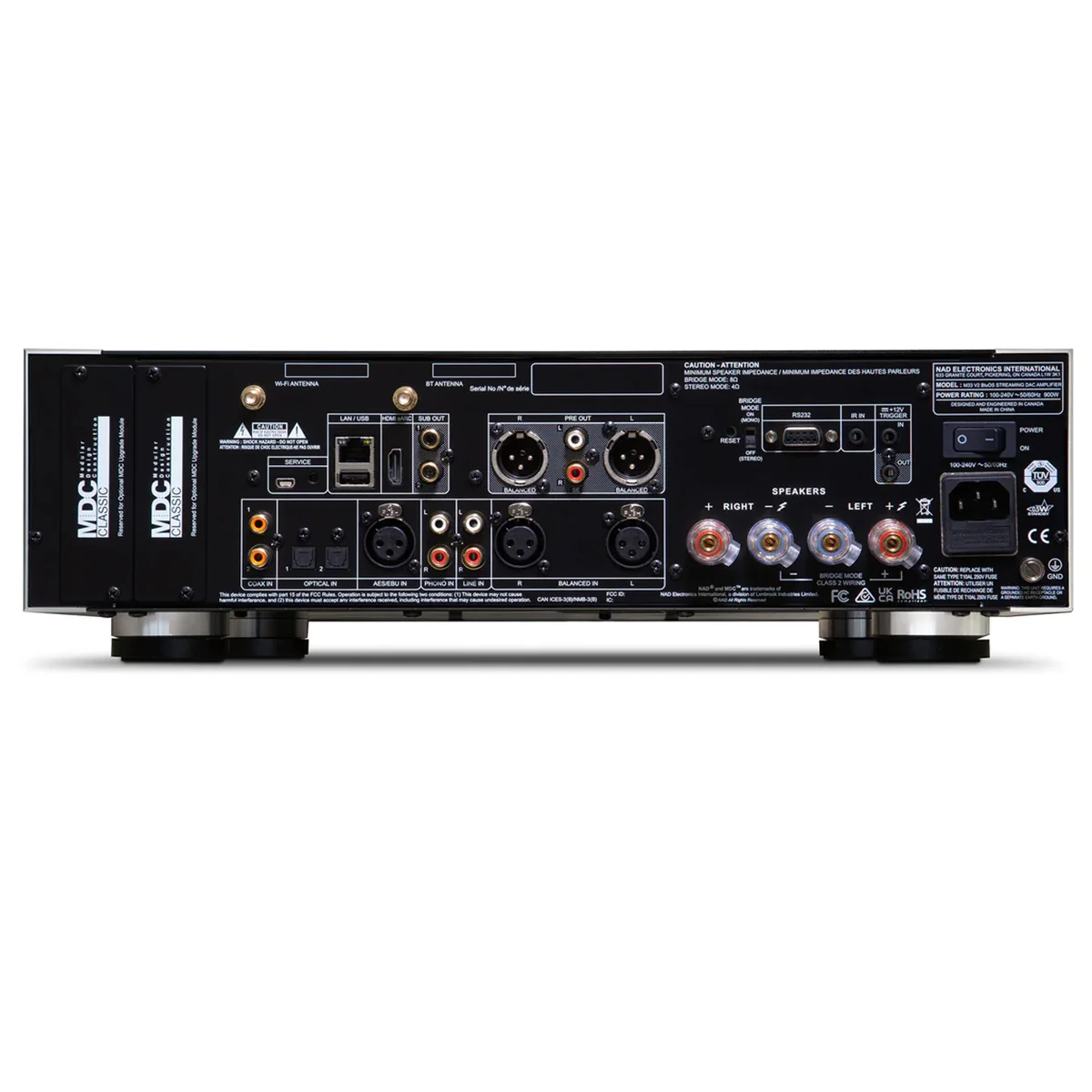
- Physical Inputs: HDMI eARC for television integration, balanced XLR inputs for professional-grade sources, and a reference-grade MM/MC phono stage that pays homage to the vinyl revival.
- Future-Proofing: Two MDC expansion slots on the rear panel allow owners to add future modules—such as HDMI video switching or updated streaming hardware—without replacing the entire unit.
Official Perspectives: The Philosophy of "Room-First" Audio
In discussions regarding the release, NAD’s engineering team has consistently emphasized that no amplifier is better than the room it resides in. "Who has a perfect room?" remains the company’s rhetorical challenge to the audiophile community. By centering the M33 V2’s identity around room correction, NAD is signaling a shift away from the "purist" philosophy of raw, uncolored amplification toward a "pragmatic" philosophy: the belief that the best sound is achieved when the hardware intelligently adapts to its environment.
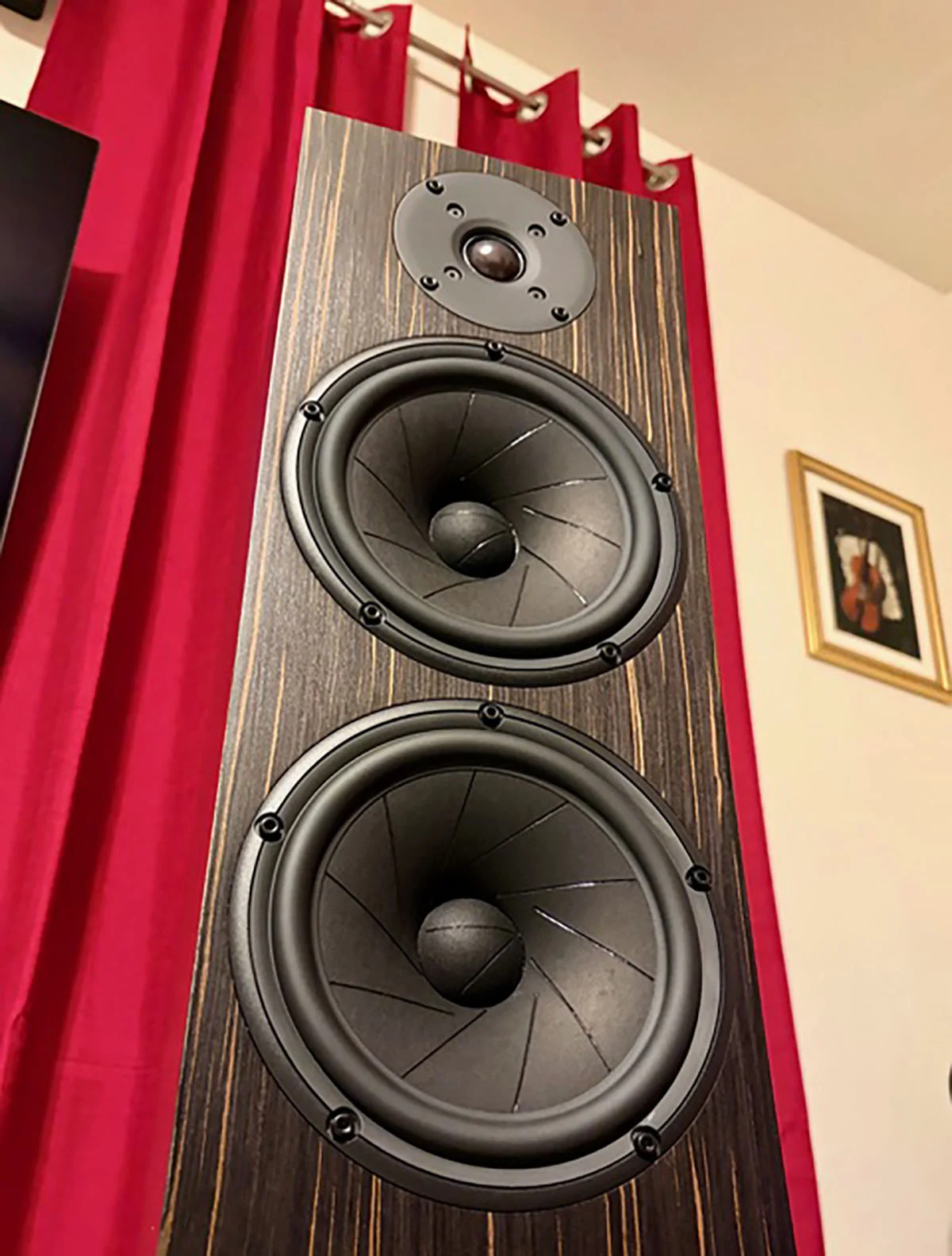
Early testing by industry reviewers has corroborated this. The M33 V2 has shown exceptional control over high-end floor-standing speakers, demonstrating that even with difficult loads, the Eigentakt modules maintain a tight grip on the woofer excursion. The unit’s ability to remain cool under pressure—a rarity for amplifiers of this power class—is being cited as a testament to the efficiency of the updated Class D design.
Implications: A New Centerpiece for the Modern Home
The arrival of the NAD M33 V2 has significant implications for the hi-fi market. It effectively bridges the gap between the "lifestyle" audio category (which prioritizes convenience) and the "ultra-high-end" category (which prioritizes sonic purity).
The End of the "Rack-Full" Era
For the consumer, the M33 V2 represents a consolidation of assets. It replaces the need for a separate DAC, a separate pre-amplifier, a separate power amplifier, and a separate streamer. By reducing the signal path and eliminating the need for interconnect cables between these components, the M33 V2 reduces the potential for noise and electromagnetic interference, leading to a cleaner sound.
The Rise of Modular Longevity
The modular nature of the M33 V2 addresses the "obsolescence anxiety" that plagues digital audio buyers. By allowing users to swap out expansion cards as technology advances, NAD has positioned this amplifier as a long-term investment. This is a departure from the traditional "replace every five years" cycle that many digital streamers face.
Final Impressions and Outlook
While the BluOS app remains a feature-rich ecosystem, early feedback suggests minor software quirks, though these are typically addressed via over-the-air firmware updates—a core strength of the BluOS platform. The physical build, characterized by an aluminum chassis and a high-resolution touchscreen, confirms that the M33 V2 is designed to be the visual and acoustic focal point of a listening room.
As we look toward the future of audio, the M33 V2 stands as a compelling proof-of-concept. It asserts that high-end audio does not need to be intimidating or stagnant. By embracing digital room correction, modular hardware, and high-efficiency amplification, NAD has created a device that is as comfortable playing a high-resolution FLAC file from a local NAS as it is driving a pair of reference-grade floor-standing speakers. For those who view their music system as the heartbeat of their home, the M33 V2 is a formidable, forward-thinking contender that demands a place at the top of the audition list.