
In the specialized world of professional audio and DIY speaker design, the tapped horn (TH) occupies a revered, if controversial, position. Known for delivering immense acoustic output from relatively compact enclosures, these designs have historically been the domain of expert engineers. Recently, a new project has sent ripples through the enthusiast community: the "Lonely.TH21-30." Spearheaded by Viktor, a prominent figure in the DIY audio scene, this 21-inch tapped horn project aims to redefine the accessibility and performance benchmarks for massive sub-bass reinforcement.
Main Facts: The Anatomy of a Titan
The Lonely.TH21-30 is a high-performance subwoofer enclosure engineered specifically for 21-inch drivers. Its core objective is to achieve a tuning frequency of 30Hz, bridging the gap between high-efficiency PA sound and the deep, visceral extension required for modern electronic music and cinema applications.
![Lonely.TH21-30 [21" 30Hz_Tapped Horn + B&C 21DS115-8]](https://files.diyaudio.com/forums/images/smilies/worship.gif)
Unlike commercial offerings that often shroud their design parameters in proprietary mystery, the Lonely.TH21-30 is an "open-source" theoretical project. It relies on the B&C 21DS115-8 driver as its benchmark, selected for its balance of performance and cost. With an Xmax of +/- 16.5mm and a high Bl (force factor) of nearly 40 T.m., this driver provides the mechanical foundation necessary to move massive amounts of air without reaching the breaking point prematurely. The design philosophy centers on a balanced compromise: it aims for maximum possible compactness while avoiding the extreme compression ratios that often plague other designs, which can lead to premature driver fatigue.
A Chronological Perspective: From Niche Hobbyist to Market Disruptor
The journey toward the TH21-30 did not happen in a vacuum. It began with a long-standing fascination with the untapped potential of 21-inch drivers, which have become a hot topic in global PA forums.
![Lonely.TH21-30 [21" 30Hz_Tapped Horn + B&C 21DS115-8]](https://www.diyaudio.com/community/data/attachments/1507/1507204-f02136ff1e2a78f20ed2c3504a8632c0.jpg?hash=dmOSwOV0aM)
The Influence of Predecessors
For years, the DIY sector has been dominated by a few key projects. Josh Ricci’s "Othorn" set the standard for compactness but required a compression ratio of 4.19:1—a design choice that many purists argue puts undue stress on the driver. Simultaneously, the "TH1821" by Sound Agency gained traction, though its lack of transparent data and public Hornresp parameters left many DIYers frustrated.
The catalyst for the current project arrived in December 2025, when industry legend Tom Danley unveiled the TH121, dubbed "The Beast." The marketing surrounding the product promised a new era of power. However, critics like Viktor noted that such announcements are often accompanied by "utopian" efficiency claims that are difficult to replicate in real-world, DIY scenarios. The skepticism surrounding these commercial releases acted as the final push for the development of the TH21-30, with the community asking: Could a more transparent, user-accessible alternative be built?
![Lonely.TH21-30 [21" 30Hz_Tapped Horn + B&C 21DS115-8]](https://www.diyaudio.com/community/data/attachments/1507/1507205-5f1f3ef721dcdb56a16c9baf69791898.jpg?hash=-ZvrodHnQo)
Supporting Data: Engineering Through Simulation
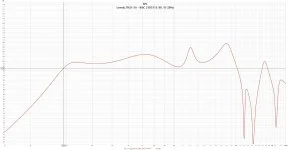
The development of the TH21-30 is rooted in rigorous simulation data using the Hornresp software suite. Unlike proprietary manufacturers who withhold data to protect market share, the Lonely.TH21-30 provides a complete suite of parameters, allowing users to verify frequency response, impedance, and displacement curves themselves.
Key Performance Indicators
- Tuning Frequency: 30.48Hz, with the expectation that actual real-world measurements will settle slightly lower.
- Driver Compatibility: Designed primarily for the B&C 21DS115-8, but with support for a wide range of 21-inch alternatives, including models from 18Sound, Faital Pro, LaVoce, and Celestion.
- Output Potential: Simulations indicate a maximum output of approximately 134.86dB at 2160 watts, assuming the driver remains within its 16.5mm Xmax limit.
- Construction Versatility: The plans cater to varying levels of skill and budget, offering build variations for 15mm, 16mm, and 18mm wood thicknesses.
The project also addresses the logistical reality of touring and sound reinforcement. A primary design goal was "pallet compatibility." While many competing designs are too wide or too deep to fit efficiently on a Euro-pallet, the TH21-30 was dimensioned so that two units could be transported in a standard professional configuration, minimizing wasted space during transit.
![Lonely.TH21-30 [21" 30Hz_Tapped Horn + B&C 21DS115-8]](https://www.diyaudio.com/community/data/attachments/1507/1507206-dd4e9d55971a7076b4d8d4389c00515d.jpg?hash=WrIYF-CpU2)
Official Responses and the "Open-Source" Ethos
The philosophy behind the Lonely.TH21-30 stands in stark contrast to the closed-loop business models of larger audio firms. By providing comprehensive documentation—including simulation files compatible with Room EQ Wizard (REW)—the project encourages an educational dialogue.
When asked about the necessity of such large-scale cabinets, the lead developer remains pragmatic: "You could build two bass reflex subwoofers for the enclosure volume of one tapped horn." This admission highlights a crucial industry insight: the tapped horn is not for everyone. It is a specialized tool for those who prioritize the specific transient response and efficiency of horn-loaded bass over simple volume-to-enclosure-size ratios.
![Lonely.TH21-30 [21" 30Hz_Tapped Horn + B&C 21DS115-8]](https://www.diyaudio.com/community/data/attachments/1507/1507207-64311b7855843bd9c19e2ceb748181f7.jpg?hash=ELpZLg1Rv3)
The community reaction has been overwhelmingly positive, particularly from the American DIY market, where imperial unit conversions were released alongside the metric plans to ensure global accessibility.
Implications for the Future of DIY Audio
The release of the Lonely.TH21-30 signals a shift in how audio enthusiasts interact with professional-grade hardware. By democratizing access to high-performance design parameters, the project challenges the traditional "black box" approach of commercial audio manufacturers.
![Lonely.TH21-30 [21" 30Hz_Tapped Horn + B&C 21DS115-8]](https://www.diyaudio.com/community/data/attachments/1507/1507209-658adaf2d0331beb1e39b1e44932f303.jpg?hash=DYhYqajP7e)
Impact on the PA Market
- Transparency as a Standard: As more DIYers demand access to Hornresp parameters and honest, non-embellished measurements, commercial manufacturers may find it harder to justify premium pricing based on marketing fluff alone.
- Standardization of DIY Projects: The success of the TH21-30 suggests that the DIY community is moving toward a more professional standard, where simulation, measurement, and peer-reviewed documentation are expected, not optional.
- The "Efficiency vs. Size" Debate: By providing a detailed, deep-reaching 30Hz design, the project forces a re-evaluation of what is considered "compact." It proves that high performance doesn’t necessarily require sacrificing driver longevity or user-serviceability.
Conclusion: Is the Beast Worth the Build?
The Lonely.TH21-30 is more than just a subwoofer design; it is a manifestation of the DIY spirit. It represents a middle ground between the inaccessible, ultra-expensive "Beast" units found in high-end venues and the amateur-grade projects that lack technical depth.
For those considering the build, the message is clear: do not undertake this project simply to save money. The complexity of constructing a folded horn, the cost of high-excursion 21-inch drivers, and the sheer physical size of the cabinet make it a significant commitment. However, for the enthusiast who demands a specific, horn-loaded character and the ability to tune their system with surgical precision, the TH21-30 offers a rare opportunity to own a piece of engineering that rivals professional-grade concert hardware.
![Lonely.TH21-30 [21" 30Hz_Tapped Horn + B&C 21DS115-8]](https://files.diyaudio.com/forums/images/smilies/smash.gif)
As the audio world continues to trend toward massive, low-frequency reinforcement, projects like the Lonely.TH21-30 ensure that the knowledge required to build such systems remains in the hands of the people, rather than locked behind the doors of corporate research labs. Whether this project truly "blows people away" remains to be seen in the field, but if the simulation data is any indication, the world of DIY audio is about to get a whole lot louder.
For those interested in exploring the technical specifications, simulation files, and build guides, the complete construction folder for the Lonely.TH21-30 is available for public review through the developer’s official channels and the DIYAudio community forums.


