The Historic Moment
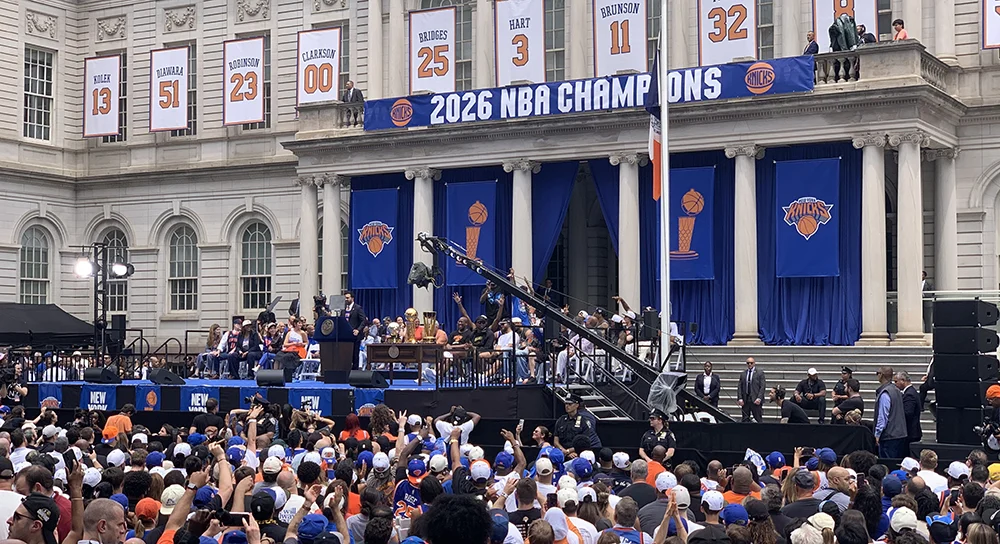
In a spectacle that will be etched into the annals of New York City sports history, an estimated two million jubilant fans flooded the streets to celebrate the New York Knicks’ first NBA championship in 53 years. The culmination of this monumental triumph took place at City Hall, where the city gathered to honor the team’s perseverance and historic run. While the players and coaching staff were the stars of the show, the massive logistical challenge of delivering pristine audio to such an immense crowd fell upon the shoulders of Eastern Stage Productions (ESP) of New York.
The event, which featured high-profile speeches from city officials and a show-stopping performance by musical icon Alicia Keys, required a sound reinforcement system capable of extreme clarity, immense output, and impeccable coverage. To meet these rigorous demands, ESP opted for a comprehensive solution centered on CODA Audio’s cutting-edge loudspeaker technology.
The Engineering Challenge: A City-Scale Audio Project
Managing audio for a crowd of two million people is a feat of acoustic engineering. The geography of the City Hall area presents significant hurdles, including wide viewing angles, reflective urban surfaces, and the need for high-fidelity sound that can carry over the ambient roar of a city in celebration.
Bill Danilczyk, owner of ESP, recognized early on that a conventional approach would not suffice. "I chose the CODA Audio system for the Knicks celebration because of its clean and clear coherency, phase alignment, high output, and a remarkably small footprint," Danilczyk explained. "In a high-stakes environment like this, where every word of a speech and every note of a performance must reach the back rows with equal intensity, those features made it the perfect system."
The project required a hybrid deployment of ground-stacked and flown elements to ensure the sound remained phase-coherent across the entire expanse of the plaza.

System Breakdown: Precision in Every Component
The complexity of the system deployed by ESP highlights the versatility of CODA Audio’s current product lineup. The configuration was built around the flagship AiRAY compact line array, a system known for delivering massive output from a lightweight chassis.
Main System Configuration
The primary audio reinforcement was handled by two main arrays, each consisting of four AiRAY and six CiRAY units. These were bolstered by two SCP-F sensor-controlled dual 18-inch subwoofers per side to provide the low-end punch required for musical performances.
Distributed Fill and Coverage
To ensure even coverage across the wide stage and the peripheral seating areas, the team implemented a strategic layout:
- Ground Stacks: Seven individual stacks, each comprising three AiRAY units and single SC2-F sensor-controlled bass extensions.
- Fills: Four HOPS8T (high output point source) speakers were positioned as dais fills to capture the nuances of the speeches.
- Backstage and Center: Two HOPS8 units managed backstage fill, while two HOPS12 loudspeakers provided center-fill support.
- Side Coverage: Eight compact N-RAY line array units were deployed to ensure the side seating areas experienced the same level of audio fidelity as the front-of-house.
- Low-End Reinforcement: An additional 10 SCP-F subwoofers were distributed throughout the area to maintain consistent, deep, and tight low-end frequencies.
Power and Monitoring
The entire system was driven by 12 LINUS14D 4-channel DSP amplifiers, which provided the necessary power density and networking capabilities to manage the complex array. Onstage, performers like Alicia Keys relied on CUE FOUR stage monitors, ensuring that the artists could hear their performance with the same clarity as the audience.
The Sonic Signature: Why CODA Audio Stood Out
According to Danilczyk, the choice of CODA Audio was driven as much by the "musicality" of the system as it was by its raw power. The integration of the sensor-controlled subwoofers is a critical differentiator for the brand.

"The AiRAY loudspeakers, when combined with the SC2 low-end extensions, keep the PA warm, allowing the articulation of the mid-high drivers to sparkle," Danilczyk noted. "The SCP-F sensor-controlled subs are truly amazing. They are tight and deep, allowing the whole system to lock in. Sonically, they are very smooth to the ear, avoiding the muddiness that can sometimes plague large-scale outdoor events."
This "lock-in" effect is achieved through CODA’s proprietary sensor-controlled technology, which monitors the cone movement of the subwoofers in real-time, correcting for distortion and ensuring the air movement is a perfect replica of the electrical signal. For a performance as dynamic as one delivered by Alicia Keys, this level of precision is non-negotiable.
Chronology of the Event
- Preparation Phase: ESP began the logistical planning weeks in advance, conducting acoustic modeling to determine the optimal placement of the 17+ arrays and stacks required to cover the City Hall footprint.
- Installation: Load-in occurred under tight security protocols, given the high-profile nature of the celebration. The compact nature of the CODA hardware allowed for a faster-than-usual rigging process, which is essential when working in high-traffic urban areas.
- Soundcheck: Extensive phase alignment and tuning were performed to ensure that the transition between the main hangs and the ground-stacked delays was imperceptible to the audience.
- The Celebration: As the Knicks took the stage, the system was pushed to its limit, maintaining constant clarity throughout the speeches and the live musical segments.
- Load-Out: Following the conclusion of the event, the modular nature of the system allowed for a swift teardown, returning the City Hall area to normal operation within a record timeframe.
Supporting Data and Technical Implications
The success of this deployment underscores a shifting trend in the live sound industry: the move toward high-output, compact systems that do not require massive crane infrastructure to install.
In the past, covering a crowd of two million would have necessitated significantly larger and heavier line array systems. By using AiRAY and N-RAY, ESP was able to achieve a higher SPL (Sound Pressure Level) per square foot of gear, reducing the aesthetic impact on the historic architecture of City Hall while maximizing sonic performance.
Furthermore, the LINUS14D amplifiers provided a unified digital ecosystem. With remote monitoring and DSP control, the ESP engineers could adjust the system’s EQ and delay timings in real-time as the crowd density shifted and the ambient temperature changed throughout the day.

Implications for Future High-Profile Events
The New York Knicks victory celebration serves as a case study for future municipal events. As cities continue to host massive outdoor gatherings, the demand for "low-impact, high-performance" audio systems will only grow.
The ability of a single audio company—CODA Audio—to provide the entire frequency spectrum for a world-class performance in a challenging urban acoustic environment highlights the brand’s maturation into the large-scale touring and event sector. For ESP, the project was a testament to the reliability of the hardware; for the city, it was the backdrop to a historic memory.
As Bill Danilczyk concluded, "CODA Audio continues to exceed my expectations time and time again for these large-scale, high-profile events." As the industry looks toward the next generation of outdoor concerts and celebrations, the lessons learned at City Hall—namely, that coherence and clarity are the ultimate keys to success—will undoubtedly influence the design of future large-scale sound reinforcement systems.
This report was produced in collaboration with industry partners. Allen & Heath, a leader in the design and manufacture of mixing desks for live sound, broadcast, and recording studios, continues to support the advancement of professional audio technology.