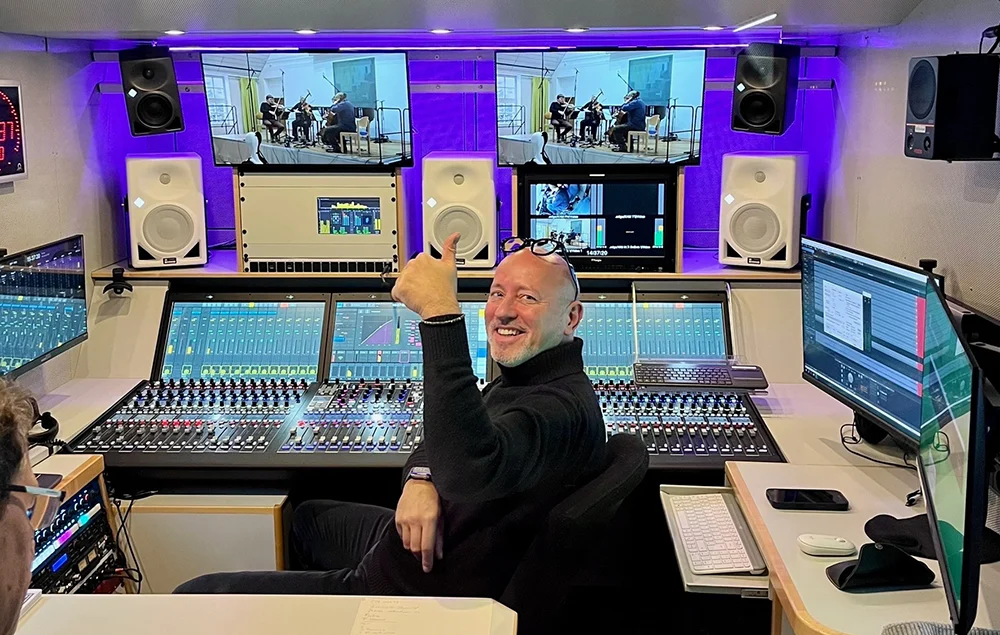
In a landmark shift for European broadcast engineering, Munich-based public broadcaster Bayerischer Rundfunk (BR) has completed a radical modernization of its legendary “Ü5” radio outside broadcast (OB) vehicle. By abandoning traditional, hardware-heavy infrastructure in favor of a fully software-defined, SMPTE ST 2110-compliant architecture, BR has transformed a 2007-vintage truck into one of the most sophisticated mobile production environments in the world.
This project marks a significant milestone in the industry’s transition toward virtualization. By integrating Lawo’s cutting-edge HOME ecosystem and mc² audio technology, BR has successfully bridged the gap between legacy broadcast reliability and the infinite scalability of IP-based software.
The Genesis: Rethinking the Mobile Studio
The Ü5 vehicle has long been a staple of German cultural production, facilitating everything from high-stakes sports broadcasts to intimate chamber music recitals. However, as the industry moved toward IP-based networking, the limitations of the truck’s original 2007 infrastructure became impossible to ignore.
“This was not a conventional retrofit project but rather a complete technical redesign within the existing vehicle,” explains Nicolas Anselm-Rasor, the lead media engineer at Bayerischer Rundfunk. The goal was not merely to update the equipment, but to rethink the workflow entirely. The team decided to retain the vehicle’s original chassis and body, focusing their resources on a “blank slate” approach to the interior technical layout.
The conceptual phase, which began in 2022, was driven by the necessity for a more agile, format-agnostic system. As production demands grew more complex—requiring higher channel counts, integrated video workflows, and remote connectivity—the engineering team sought a platform that could evolve through software updates rather than hardware replacements.

Technical Architecture: A Software-Defined Paradigm
At the heart of the modernized Ü5 is a fully SMPTE ST 2110-compliant IP infrastructure. This network carries audio, video, monitoring, and control data over a unified, high-speed backbone. By moving away from dedicated copper cabling and proprietary point-to-point connections, BR has achieved unprecedented signal flexibility.
The Power of HOME and DSP
The audio backbone of the vehicle is anchored by a 48-fader Lawo mc²56 MkIII production console. While the console provides the tactile interface that sound engineers demand, the true processing heavy lifting is performed by a HOME mc² DSP app. This application runs on a standard, high-performance CPU server, representing a departure from traditional dedicated hardware racks.
This system is licensed to handle up to 384 processing channels, with an I/O capacity of 1,280 inputs and outputs. This level of headroom ensures that even the most complex multi-mic orchestral recordings can be managed without the risk of hardware saturation.
Video Integration and Connectivity
Connectivity is handled via Lawo’s .edge interface, which provides SDI video connectivity and advanced audio embedding/de-embedding capabilities. The system is further bolstered by:
- Power Core Gateways: Used for onboard I/O and as stagebox interfaces.
- Dedicated Comms Power Core: Ensuring that mission-critical production communications remain separate from the primary signal path.
- HOME Multiviewer and Stream Transcoder Apps: These software modules allow the team to manage various video feeds—including NDI-based PTZ camera signals—and distribute them to monitors throughout the vehicle or across the wider IP network.
Chronology: From Concept to First Broadcast
The journey to the “new” Ü5 was marked by careful, phased implementation to ensure that the transition would not disrupt the broadcaster’s heavy production schedule.

- 2022: The project is initiated. Engineering teams conduct a feasibility study on retaining the 2007 vehicle shell while stripping out all legacy internal cabling and racks.
- Early 2023: System design finalized, focusing on the SMPTE ST 2110 IP standard. Procurement of Lawo HOME ecosystem components begins.
- Late 2023 – 2024: Physical integration and software configuration. The installation of the mc²56 MkIII console and the calibration of the CPU-based DSP servers.
- January 2026: The modernized Ü5 sees its first production assignment. The crew successfully records a chamber music concert for BR Klassik, validating the stability of the new IP architecture.
- February 2026: The vehicle is deployed for a live opera broadcast from the Bavarian State Opera, proving its ability to integrate with venue-based control rooms and handle complex live transmission chains.
Workflow Flexibility: The Three-Workstation Model
A defining feature of the redesigned Ü5 is its ergonomic focus. The interior is divided into three distinct, yet interconnected, workstations:
- The Main Audio Position: Centered around the mc²56 MkIII console, where the primary mix is executed.
- The Balance Engineer Position: A dedicated space for balancing and secondary mixing, allowing for collaborative workflows.
- The Technical/Recording Position: Equipped with a Lawo crystal controller. This controller is a stroke of design genius, as it allows engineers to assign control functions flexibly from the main console, ensuring that the recording engineer can manage signal routing and monitoring without distracting the lead mixer.
All three positions share access to the centralized DSP engine, meaning that settings and processing resources are perfectly synced across the vehicle. Furthermore, the system provides up to 192 channels for recording, with the ability for individual workstations to initiate independent recording sessions—a feature that has already proven invaluable for multi-track captures during concert series.
Official Perspective and Implications
For Bayerischer Rundfunk, the project represents a future-proof investment. By moving to a software-defined architecture, they have effectively decoupled their production capabilities from the constraints of physical hardware.
“Ü5 is Bayerischer Rundfunk’s first mobile production platform to operate entirely on SMPTE ST 2110 and to be based on a software-defined architecture,” says Nicolas Anselm-Rasor. This is more than just a technical upgrade; it is a change in the philosophy of broadcasting. The ability to deploy the truck for a jazz concert one day and a major operatic broadcast the next, with the ability to reconfigure the entire routing and mixing environment via software, represents the pinnacle of modern OB efficiency.
The implications for the wider industry are clear. As the cost of high-performance CPU servers decreases and the robustness of IP-based audio/video standards (like ST 2110 and AES67) increases, the traditional “hardware-in-a-box” OB van is likely to become an endangered species. BR has provided a blueprint for how legacy vehicles can be transformed into high-tech, software-agile hubs that are ready for the next decade of broadcast demands.
Supporting Data: The Technical Edge
The efficiency gains from this migration are not merely theoretical. By adopting the IP-based stagebox architecture, BR has simplified the deployment of live events significantly. Each stagebox acts as a gateway, providing 48 mic inputs and 16 line outputs, alongside integrated Dante and MADI support.
With sample-rate conversion built directly into the gateways, the “nightmare” of clocking and sync issues—a common pain point in large-scale mobile production—is largely mitigated. The use of fiber optics to carry audio, network data, and NDI camera feeds significantly reduces the time required for on-site setup, allowing the crew to spend less time pulling cables and more time perfecting the mix.
As the industry watches the ongoing performance of the Ü5, it is becoming increasingly evident that the marriage of software-defined processing and robust IP standards is the new gold standard for mobile production. Bayerischer Rundfunk has set a high bar, demonstrating that with the right vision, the future of broadcasting can indeed be built inside the foundations of the past.