The wearable technology landscape is undergoing a profound transformation. As industry titans like Meta and Snap aggressively push camera-centric smart glasses into the mainstream, a lean, Shenzhen-based challenger has quietly achieved a $1 billion valuation. Even Realities, a three-year-old startup, is defying the industry’s obsession with content capture, instead betting its future on a "display-first" philosophy that prioritizes privacy, optics, and the seamless integration of artificial intelligence into the wearer’s field of view.
With a fresh $150 million in pre-Series B funding led by Meituan and supported by Tencent, Even Realities is signaling that the next wave of wearable computing may not be about what you can film, but about how you perceive information.
The Strategic Shift: Privacy Over Pixels
For much of the past year, the discourse surrounding smart glasses has been dominated by the "Meta-Snap" rivalry. Both companies have released iterations of glasses designed to record the world, leveraging cameras to feed AI models that identify landmarks, translate signs, or serve as social media content engines.
Even Realities, founded in 2023, has chosen a radically different path. By omitting the camera entirely from its flagship G2 model, the startup has bypassed the most significant hurdle to widespread smart glasses adoption: the "creepy factor."
"Smart glasses are likely the most personal computing device people will ever wear," says founder and CEO Will Wang, an Apple alumnus who previously worked on the iPhone and Apple Watch. "They are worn on the face all day. To gain mass adoption, they have to feel comfortable—not just physically, but socially. Privacy cannot be an afterthought; it must be designed into the very hardware and software architecture."
By removing the lens, Even Realities has successfully courted a demographic that is wary of surveillance-heavy tech: high-level professionals and executives. For these users, the value proposition isn’t a digital diary of their day, but an unobtrusive, augmented-reality overlay that manages information flow without disrupting human interaction.
A Brief Chronology: From Concept to Unicorn
The trajectory of Even Realities is a testament to the speed of the modern hardware startup ecosystem.
- 2023: The company is founded by a team of ex-Apple engineers and veterans from luxury eyewear brands like Lindberg. The core mission is defined: solve the optical waveguide challenge to create glasses that actually look like glasses.
- 2024: The company launches its debut product, the Even G1. Marketed as the lightest waveguide smart glasses on the market, the device defies expectations, blowing past its initial 10,000-unit sales target.
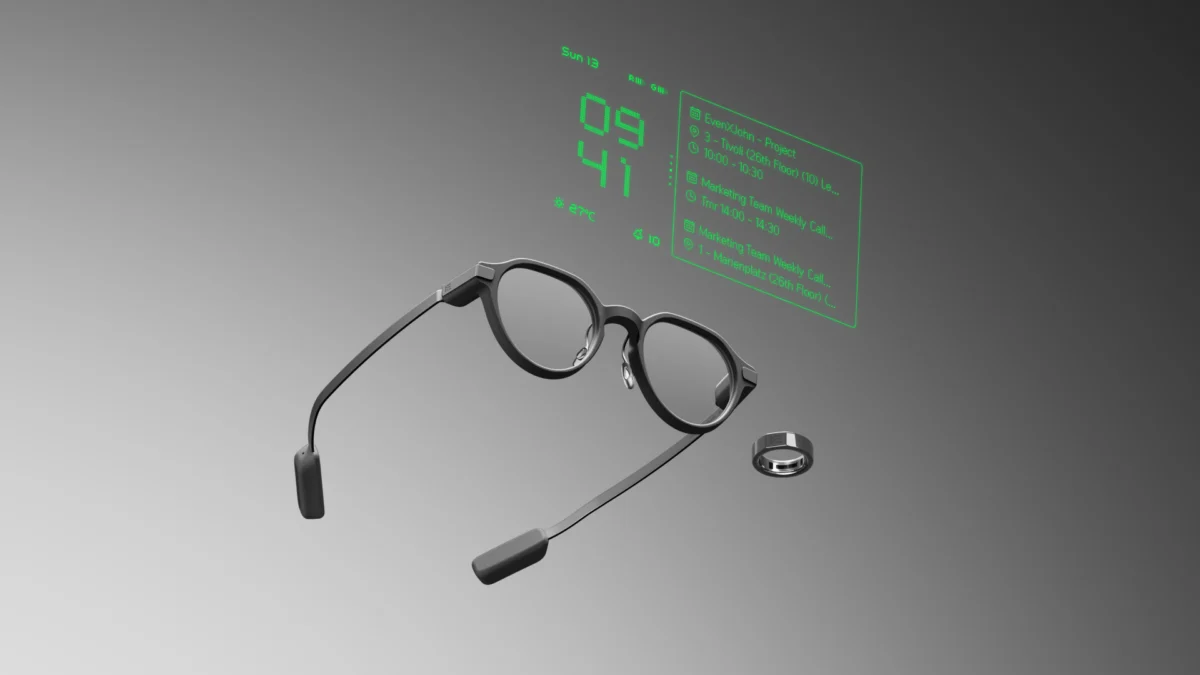
- Late 2024: The Even G2, the company’s current flagship, hits the market. It introduces a refined heads-up display (HUD) paired with the "Even R1" smart ring, allowing for gesture-based control.
- 2025 (Present): The company grows from a small team of 30–40 employees to a robust organization of 300–400. A massive $150 million funding round cements its status as a "unicorn" with a $1 billion valuation.
The Technological Moat: Why Optics Matter
While many consumer electronics companies focus on the processing power or the software stack, Will Wang argues that the real barrier to entry in this sector is the physics of light.
"With a phone or a watch, the display is just a conventional OLED or LCD screen," Wang explains. "Smart glasses are the first product category to rely on optical displays, which require an entirely different technology stack. You have to design the microchip, the optics, and the waveguide together. That is where we have invested the most."
This commitment manifested in the development of "Even HAO" (Holistic Adaptive Optics). Rather than utilizing off-the-shelf components, the company designs its microchips to communicate directly with the waveguide and prescription lens architecture. This end-to-end integration ensures that the projected text is crisp, stable, and minimizes the eye strain that has plagued early-generation AR hardware.
The "Conversate" Copilot
At the heart of the user experience is "Conversate," an AI copilot that functions as an intelligent layer over reality. Instead of recording video, the glasses process audio to provide real-time transcriptions and explanations. If a wearer is in a high-stakes meeting, the system can clarify jargon, provide background on participants, or feed follow-up questions directly into the line of sight. Data privacy is maintained through encryption, with the infrastructure specifically engineered to comply with Europe’s stringent data protection standards.
Market Dynamics and Supporting Data
Despite being headquartered in Shenzhen, China, Even Realities has opted to ignore the domestic market for the time being, focusing instead on the United States, Japan, South Korea, the Middle East, and Europe.
The U.S. currently serves as the company’s largest and fastest-growing market, accounting for more than 50% of its user base. This geographical focus is strategic; the company is building its reputation in markets with high purchasing power before tackling the complex regulatory and competitive landscape of China.
The pricing strategy reflects this premium positioning. With a retail price of $599 for the frames, and an additional $200–$300 for prescription lenses and the R1 ring, the average order value sits at approximately $1,000. This is a high barrier for a consumer product, yet the company remains profitable.
"Our customers are primarily male professionals between 30 and 50 years old," Wang notes. "We ran a survey, and about a third of our users are company executives." This data points to a crucial trend: smart glasses are evolving into a "prosumer" tool, similar to the early days of the BlackBerry or the iPad, where high-end functionality justifies the premium price tag.
Implications for the Future of Wearables
The success of Even Realities poses an existential question for the smart glasses industry: is the camera a necessity or a liability?
If Meta and Snap are positioning smart glasses as the successor to the smartphone for social media and content creation, Even Realities is positioning them as the successor to the wristwatch and the laptop for productivity. The implication is that there will be a bifurcation in the market. One segment will favor the "social/camera" experience, likely driven by younger, more casual users. The other will favor the "private/HUD" experience, driven by the professional class that values efficiency over documentation.
The "Wearability" Challenge
Perhaps the greatest achievement of the Even G2 is its form factor. By focusing on the weight and aesthetics of the frame, the company has tackled the "social stigma" problem. Most people are uncomfortable interacting with someone wearing bulky, tech-heavy headsets. If a device looks like a pair of standard designer frames, it changes the nature of the human interaction.
What Lies Ahead
As the company scales to 400 employees, the challenges will shift from engineering to distribution and ecosystem development. With the bulk of its developer community also residing in the U.S., the company must now foster an ecosystem of third-party applications that can run on its proprietary OS.
If the current momentum continues, Even Realities may well prove that the "killer app" for AR isn’t the ability to record the world, but the ability to see it more clearly—without the rest of the world watching you back. For a company that has moved this fast, in this short a time, the trajectory suggests that the "display-first" era of smart glasses has only just begun.