As What Hi-Fi? celebrates its 50th anniversary, industry retrospectives naturally gravitate toward the "golden eras" of high-fidelity audio. Audiophiles and historians frequently romanticize the warm wood-paneled stereos of the 1970s, the emergence of the compact disc in the 1980s, and the towering stacks of separate amplifiers, heavy-platter turntables, and monolithic floorstanding speakers that defined the traditional domestic listening room.
Yet, in focusing solely on these analog and early digital milestones, we often overlook a highly volatile, creative, and transformative era: the mid-2000s. It was a decade defined by a single, pocket-sized catalyst—the Apple iPod—and the sprawling, eccentric ecosystem of hardware it inspired.
The iPod speaker dock, a product category that was once ubiquitous in millions of households worldwide, is now functionally extinct. Its proprietary physical connectors have vanished, and its legacy has been absorbed by the modern wireless and smart speakers we use today. However, the rise and fall of the iPod dock represents one of the most critical bridge eras in audio history. It forced traditional, conservative hi-fi brands to adapt to compressed digital audio and portable media, rewriting the rules of industrial design and acoustic engineering in the process.
Main Facts: The MP3 Boom and the Birth of the Accessory Ecosystem
When Apple launched the original iPod in October 2001, its primary objective was to redefine personal, on-the-go music. However, as the device evolved from a niche luxury for Mac users into a global cultural phenomenon, consumers increasingly sought ways to liberate their digital music libraries from white plastic earbuds.
Traditional home stereo systems of the early 2000s were poorly equipped to handle MP3 players. Connecting an iPod required cumbersome RCA-to-3.5mm auxiliary cables draped across living room floors, offering no way to charge the device or control playback from a distance.
The turning point came in 2003 with the release of the third-generation iPod, which introduced Apple’s proprietary 30-pin dock connector. This single, wide interface did more than just charge the device and transfer data; it allowed external hardware to extract line-level analog audio, receive digital control signals, and eventually—with later firmware updates—output digital audio directly to external digital-to-analog converters (DACs).
   [ iPod (Digital Files: MP3/AAC) ]
                 |
                 v  (30-Pin Proprietary Connection)
   [ Speaker Dock (Internal DAC & Amplification) ]
                 |
                 v
   [ Room-Filling Acoustic Output ]
This hardware masterstroke birthed a multi-billion-dollar accessory market. For nearly a decade, audio manufacturers—ranging from budget electronics brands to elite, high-end loudspeaker designers—scrambled to build the ultimate physical cradle for Apple’s music player. The resulting products spanned a bizarre and beautiful spectrum of design philosophies: from sterile, Apple-white plastic blocks to high-end, valve-amplified stereos and aerodynamic, aerodynamic cabinet enclosures.
Chronology: The Evolution of the Desktop Cradle (2001–2012)
The trajectory of the iPod speaker dock reveals a rapid evolution from rudimentary charging cradles to highly sophisticated, single-box acoustic systems.
- 2001–2003: The Auxiliary Era. Early MP3 players are connected to home audio systems via simple analog headphone jacks. Sound quality is heavily bottlenecked by the iPod’s modest internal headphone amplifier.
- 2003: The 30-Pin Catalyst. Apple introduces the 30-pin connector, giving accessory manufacturers a unified, stable platform to design dedicated physical docking ports.
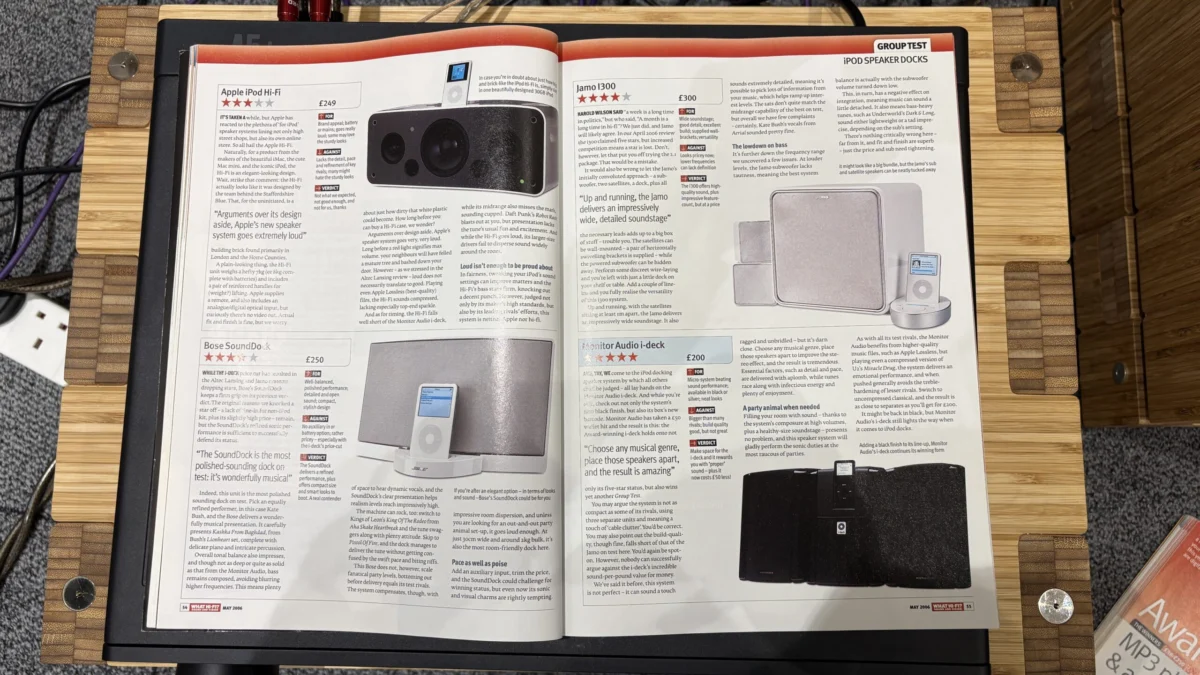
- 2004: Mass Market Adoption. Bose enters the fray with the SoundDock, proving that consumers are willing to pay premium prices for compact, integrated speaker systems designed exclusively for the iPod.
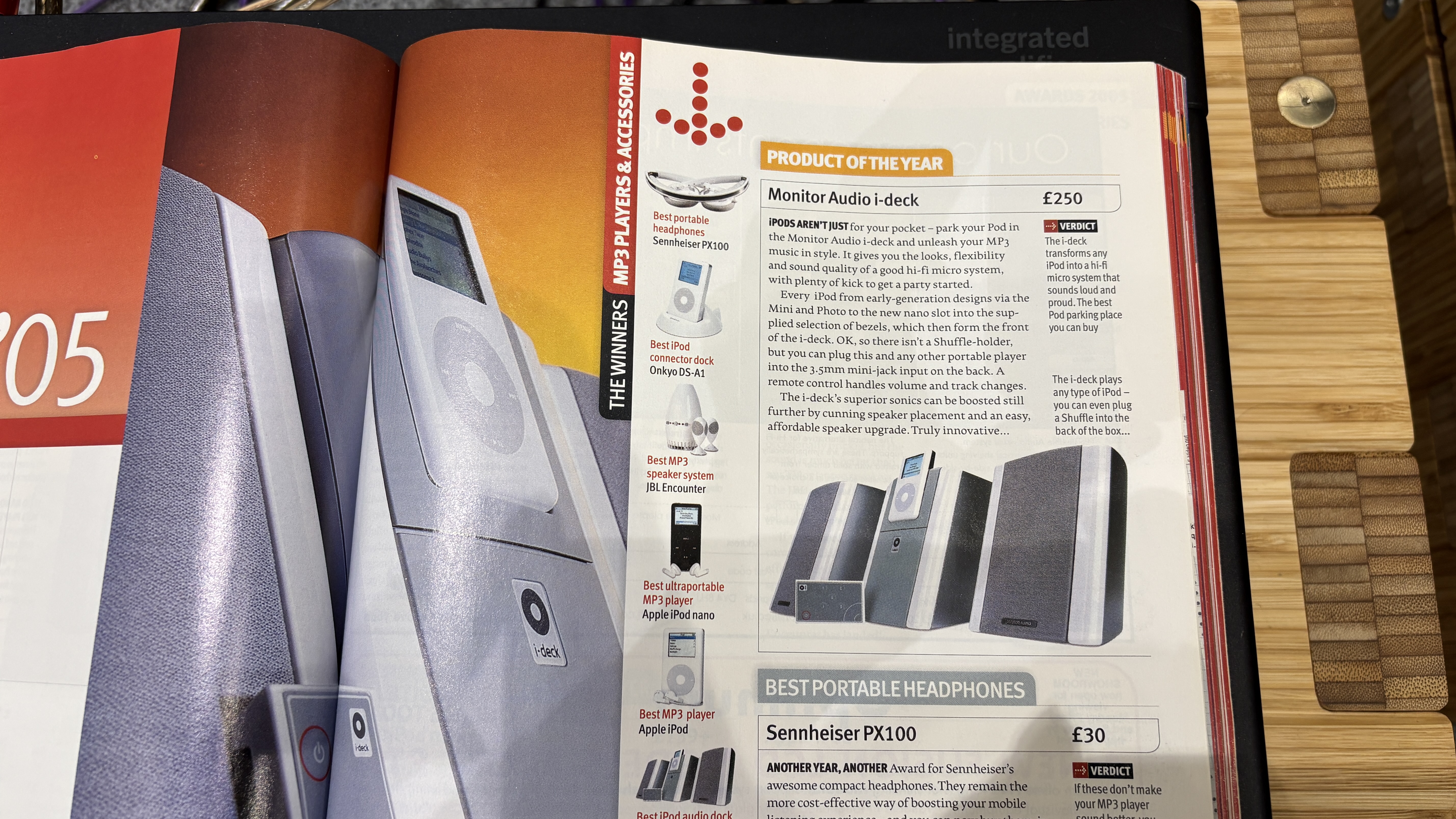
- 2005–2006: Hi-Fi Brands Respond. Traditional British and European hi-fi brands, realizing the iPod is not a passing fad, begin engineering high-performance docks. Monitor Audio launches the award-winning i-deck, treating the iPod as a legitimate high-fidelity source.
- 2007–2008: The Premium Boom. The category reaches its aesthetic and acoustic peak. Bowers & Wilkins launches the iconic Zeppelin, elevating the dock from a convenient gadget to a luxury lifestyle statement. Concurrently, boutique brands like Fatman Audio introduce vacuum tube amplification to smooth out the harshness of low-bitrate MP3s.
- 2011–2012: The Hybrid and the End. Docks begin integrating early Bluetooth and AirPlay protocols alongside physical connectors to accommodate wireless streaming. In September 2012, Apple introduces the iPhone 5 and a new generation of iPods featuring the compact, digital-only Lightning connector. The 30-pin standard is instantly legacy tech, rendering millions of existing docks obsolete overnight and accelerating the transition to pure wireless audio.
Supporting Data: Five Legendary Docks That Defined an Era
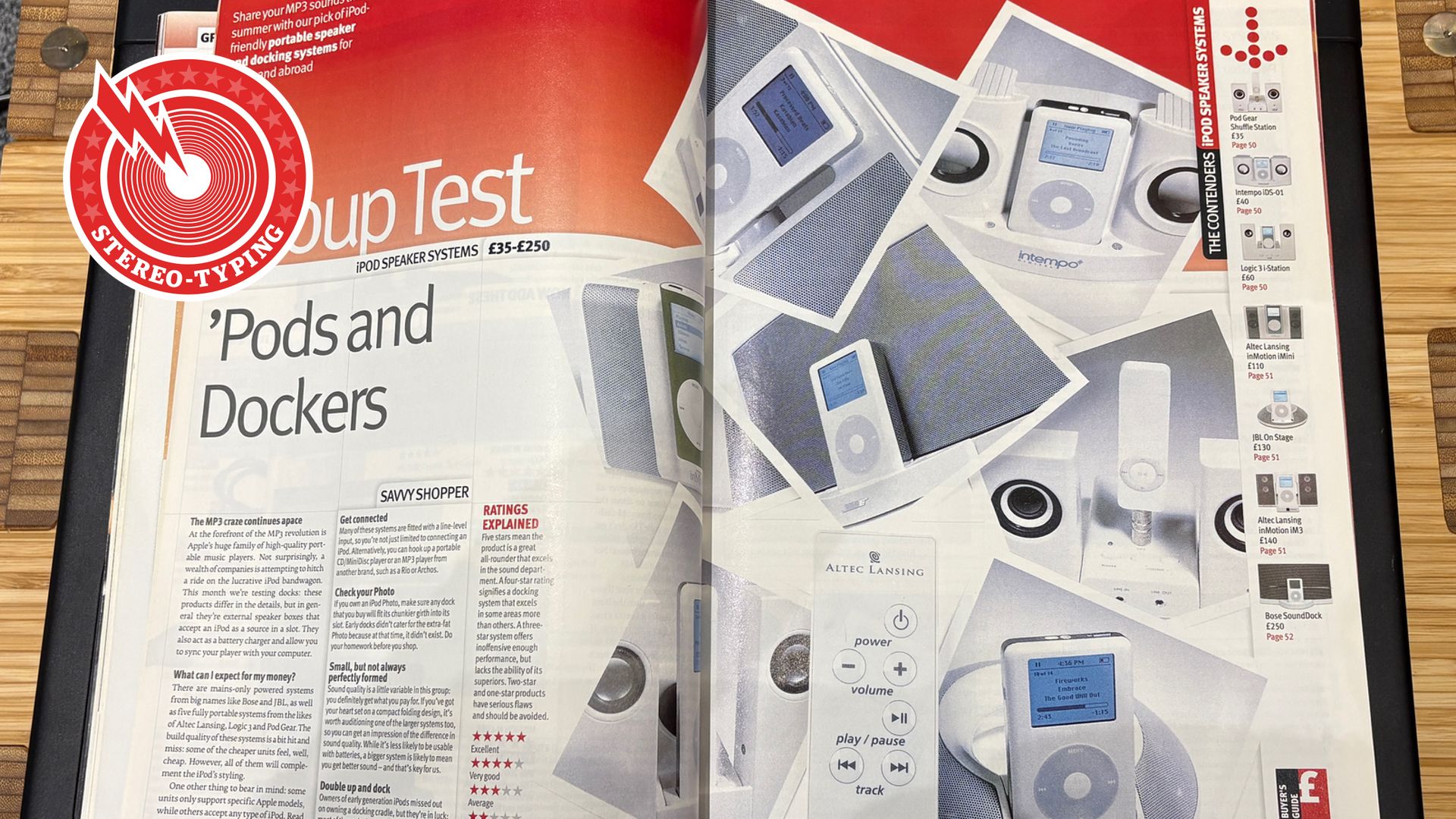
To understand the sheer variety and engineering ambition of this period, we look back at five standout speaker systems that earned critical acclaim in the pages of What Hi-Fi? during the height of the docking boom.
1. Bose SoundDock (2004)
- Launch Price: £249
- Critical Rating: 4 Stars
+------------------------------------------+
|                 [ iPod ]                 |
|                    ||                    |
|             +--------------+             |
|             | Bose Cradle  |             |
|  +----------+--------------+----------+  |
|  | [Left Driver]        [Right Driver] |  |
|  +------------------------------------+  |
+------------------------------------------+
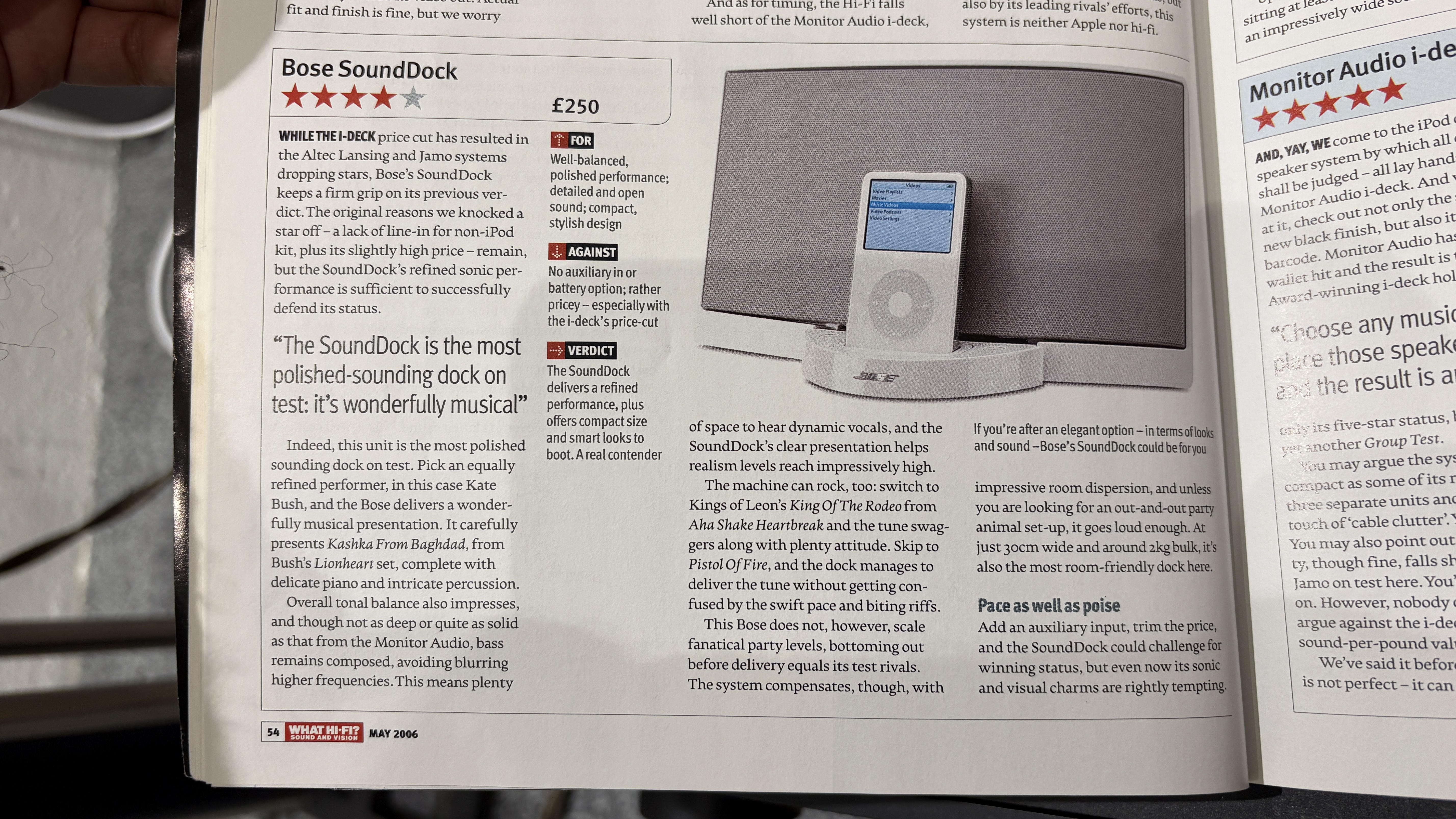
The original Bose SoundDock was the catalyst that transformed the iPod dock from a novelty accessory into a mainstream living room staple. Released in 2004, it was remarkably simple: a sleek, curved plastic wedge with a central, protruding 30-pin cradle and a minimalist, credit-card-sized remote control.
- Acoustic Philosophy: Bose utilized its proprietary acoustic waveguide technology to extract surprisingly deep, room-filling bass from a highly compact footprint.
- Performance: In contemporary reviews, the SoundDock was praised for its rich, warm vocal reproduction and a complete absence of the thin, tinny sound that plagued cheaper contemporary alternatives.
- Limitations: True to Bose’s closed-ecosystem philosophy of the era, the original SoundDock lacked an auxiliary input, meaning non-Apple MP3 players were entirely locked out. The physical fit of the cradle was also notoriously loose, requiring plastic spacer inserts to keep different iPod models upright.
2. Monitor Audio i-deck (2005)
- Launch Price: £250
- Critical Rating: 5 Stars (What Hi-Fi? Product of the Year)
Essex-based Monitor Audio, renowned for its audiophile-grade cabinet speakers, took a radically different approach with the i-deck. Rather than housing everything in a single chassis, the i-deck was a modular, three-box system comprising a central docking control unit and two independent, two-way bookshelf speakers.
- Engineering Specs: The speakers featured Monitor Audio’s signature Metal Matrix Polymer (MMP II) bass/mid drivers and Gold Dome C-CAM tweeters, driven by dedicated internal amplification.
- Performance: The i-deck was the first system to prove that an iPod could deliver a genuine stereo soundstage. Reviewers praised its "infectious energy," composure at high volumes, and punchy rhythm.
- Versatility: Unlike the Bose, the i-deck featured swappable bezels to accommodate various iPod physical profiles and included a 3.5mm auxiliary input. Crucially, the speaker cables were detachable, allowing users to upgrade to higher-quality speaker wire to eke out even better performance.
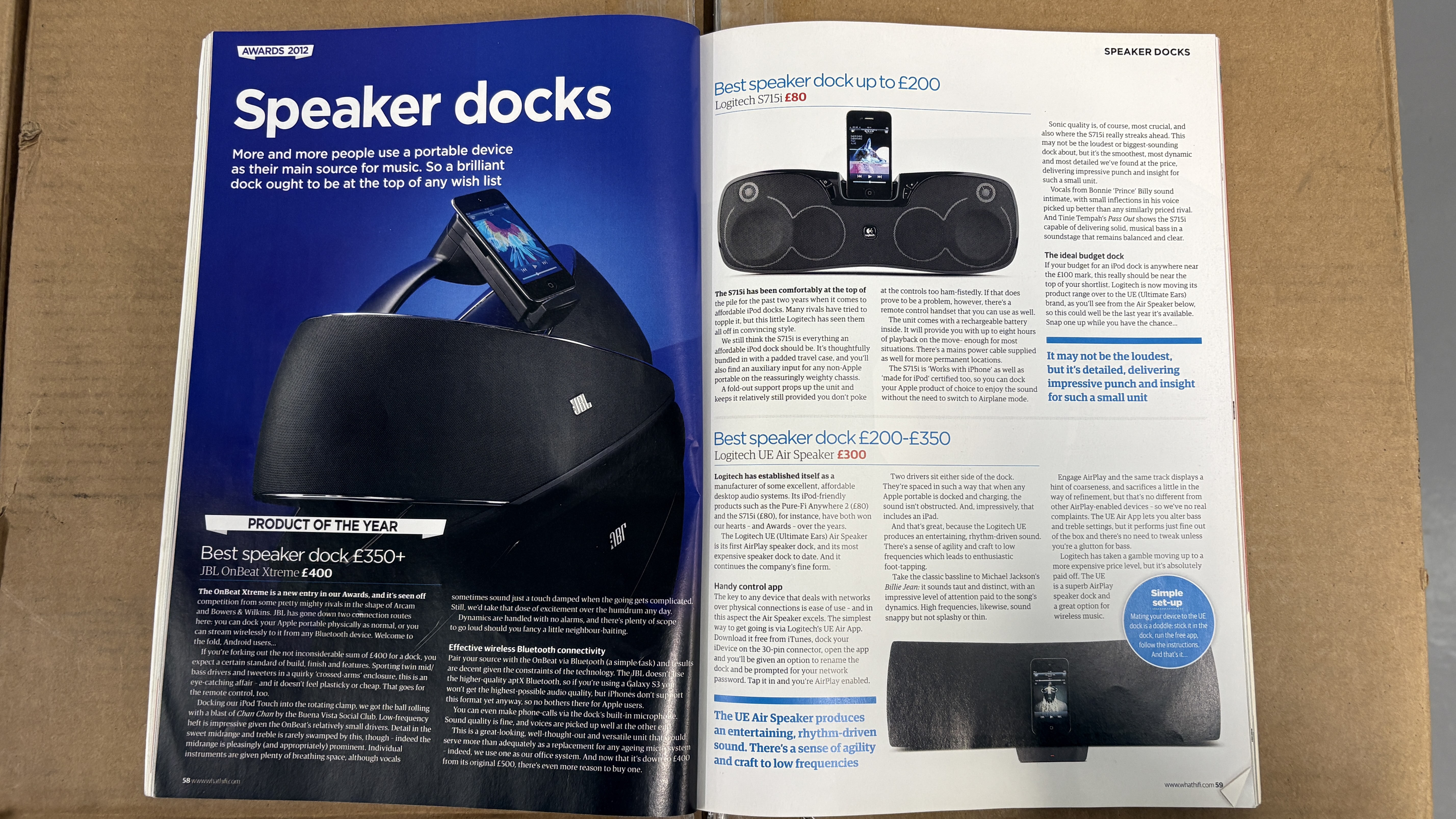
3. Bowers & Wilkins Zeppelin (2007)
- Launch Price: £400
- Critical Rating: 5 Stars
If there is one product that epitomizes the artistic zenith of the iPod dock era, it is the Bowers & Wilkins Zeppelin. Launched in late 2007, this striking, 64cm-wide blimp-shaped speaker shattered the industry expectation of what a desktop speaker dock could be, both visually and acoustically.
                      _________________
                 .-'""                 ""'-.
               .'  __                   __  '.
              /   /                   /
             |   | Mid|    [Woofer]   | Mid|   |
             |   |____|     (50W)     |____|   |
                 __/                 __/   /
               '.                           .'
                 '-._______  iPod  _______.-'
                             ||  /
`----`- Acoustic Design: The Zeppelin’s elongated, tapered shape was dictated by acoustic engineering, not just aesthetics. By tapering the cabinet toward the edges, B&W minimized baffle area around the tweeters, drastically improving sound dispersion and reducing diffraction.
- Driver Array: Under the hood, the Zeppelin was a true active 2.1 system. A central 13cm Kevlar bass driver (powered by a 50W amplifier) was flanked by two 9cm glass-fiber midrange drivers and two 25mm metal dome tweeters (each driven by individual 25W amplifiers).
- Impact: The Zeppelin was so premium that What Hi-Fi? bypassed its standard review sections, placing the product in its high-end "Temptation" showcase. Its massive scale, thunderous yet controlled bass, and crystalline high-frequency detail set a benchmark that redefined the luxury wireless speaker market for the next decade.
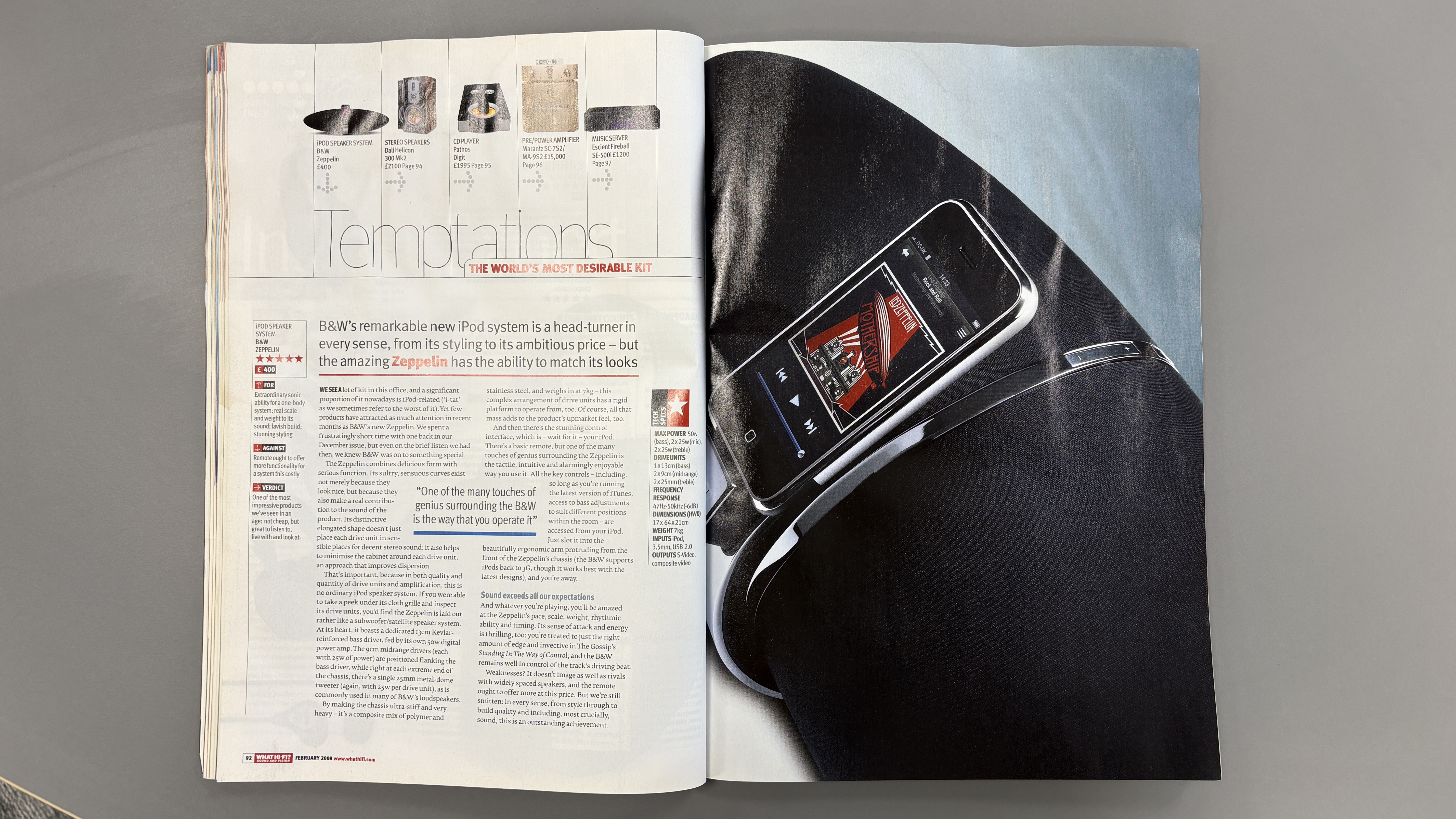
4. Fatman iTube Carbon v2.0 (2008)
- Launch Price: £350
- Critical Rating: 5 Stars
At the height of the digital music boom, purists lamented the "cold," "sterile" nature of highly compressed 128kbps MP3 files. Fatman Audio, a subsidiary of tube-amplifier specialists TL Audio, responded with a brilliantly eccentric solution: a hybrid vacuum tube amplifier system mated to an iPod dock.
- The System: The iTube Carbon v2.0 consisted of a high-gloss black amplifier base featuring exposed, glowing thermionic valves (tubes) alongside a separate, matching physical iPod dock. The system was sold with a pair of compact, two-way monitor speakers, though audiophiles often purchased the amplifier alone to drive their own high-end cabinets.
- Acoustic Alchemy: The vacuum tubes introduced even-order harmonic distortion, which naturally softened the harsh, digital glare of compressed audio, giving vocals and acoustic instruments a lush, organic warmth.
- Legacy: In head-to-head comparisons, the Fatman defeated the Bowers & Wilkins Zeppelin in raw musicality and stereo imaging, proving that vintage analog technology and modern digital files could coexist in harmony.
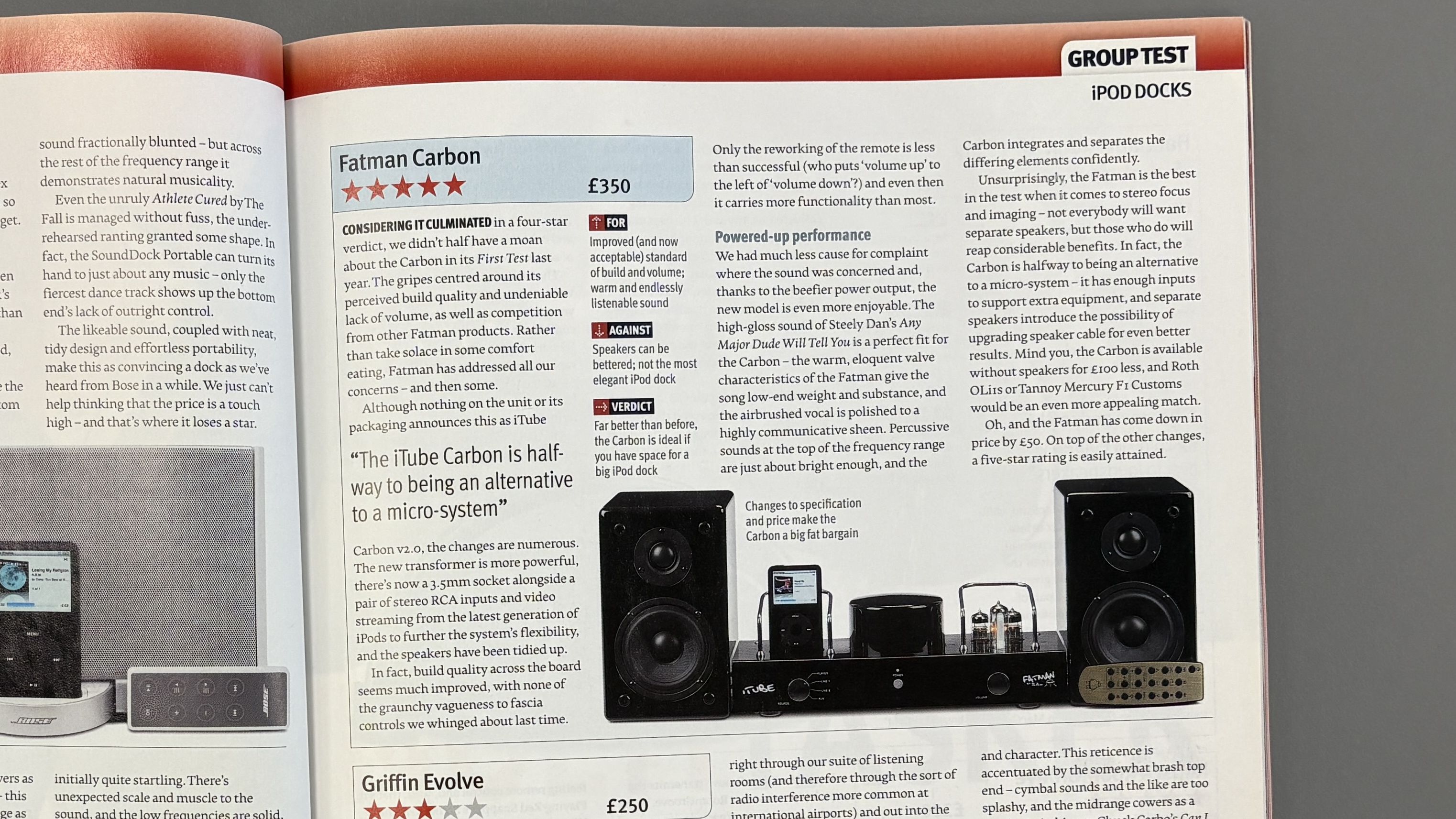
5. JBL OnBeat Xtreme (2012)
- Launch Price: £400
- Critical Rating: 5 Stars
As the 2010s dawned, the writing was on the wall for pure physical docking. Consumers wanted to use their phones while playing music. The JBL OnBeat Xtreme arrived as a highly advanced hybrid, featuring a dramatic "crossed-arms" physical cradle that could rotate an iPod or iPad into landscape mode for video viewing, alongside integrated high-fidelity Bluetooth streaming.
- Acoustic Performance: JBL engineered the OnBeat Xtreme with proprietary JBL Ridge tweeters and Hercules woofers. It delivered a highly dynamic, aggressive, and party-friendly sound with immense low-frequency authority.
- The Transition Point: The OnBeat Xtreme represented the bridge between two worlds. It served as a high-performance physical dock for charging and critical listening, while its high-bandwidth Bluetooth connection (utilizing early high-quality codecs) paved the way for the wireless future.
Official Responses and Industry Philosophy
The rise of the iPod dock forced a profound philosophical shift within the consumer electronics industry. Initially, traditional hi-fi manufacturers viewed the MP3 format and portable players with skepticism, if not outright hostility. Digital audio compression (specifically MP3 and AAC) discarded up to 90% of the original audio data to keep file sizes small—a practice that ran completely counter to the audiophile pursuit of absolute fidelity.
However, as consumer demand skyrocketed, brands had to adapt. This led to several key industry developments:
- The "Made for iPod" (MFi) Program: Launched by Apple in 2005, this licensing program forced manufacturers to pay a royalty (often rumored to be as high as 10% of the product’s retail price) to display the official logo and use proprietary Apple hardware. Despite the steep "Apple tax," brands gladly paid it to gain access to the lucrative market.
- Engineering for Compression: Engineers could no longer design speakers assuming they would be fed pristine, uncompressed signals from high-end CD players. DSP (Digital Signal Processing) became a vital tool. Brands like Bose and B&W developed complex, real-time algorithms to dynamically restore lost high-frequency detail and synthesize low-end punch from compressed digital streams.
- The Shift to Digital Extraction: Early docks simply received the analog output from the iPod’s internal, cost-engineered headphone DAC. By 2007, advanced docks began utilizing specialized authentication chips to extract the raw digital bitstream directly from the iPod, bypassing Apple’s internal audio hardware entirely and routing it through high-performance, internal audiophile-grade DACs.
Implications: The Legacy of the Dock and the Modern Wireless Era
The sudden death of the 30-pin dock in 2012 was a harsh lesson in the dangers of building an ecosystem around a single company’s proprietary hardware. When Apple transitioned to the Lightning connector, and eventually to USB-C, millions of premium speaker docks were rendered physically obsolete, destined for electronic waste or relegated to using clunky, unreliable plastic adapters.
Yet, the DNA of the iPod dock lives on in every modern wireless and smart speaker.
[ Evolution of Domestic Audio Ecosystems ]

   The Past (2000s)                 The Present/Future (2020s)
+------------------------+       +------------------------------------+
|  Physical Docking      |       |  Wireless Ecosystems               |
|  - 30-pin connector    | ----> |  - Bluetooth (aptX, LDAC)          |
|  - Closed ecosystem    |       |  - Wi-Fi (AirPlay 2, Chromecast)   |
|  - Manual control      |       |  - Voice Assistant / Cloud Streams |
+------------------------+       +------------------------------------+
The Transition to Wireless Freedom
The engineering breakthroughs made during the dock era—such as squeezing high-output, multi-driver active arrays into compact, single-box enclosures—directly enabled the development of modern premium wireless speakers. The current generation of the Bowers & Wilkins Zeppelin, for example, has completely discarded the physical arm and cradle of its predecessor, reborn as a high-resolution, Wi-Fi-enabled streaming hub utilizing AirPlay 2, Spotify Connect, and Bluetooth.
Furthermore, the consumer desire for convenience, which originally drove the popularity of the desktop dock, has now been fully realized through wireless multi-room ecosystems like Sonos, Apple HomePod, and Naim Mu-so. We no longer need to physically tether our phones to a plastic cradle to charge them while playing music; cloud streaming and high-bandwidth home Wi-Fi networks have permanently decoupled our media controllers from our acoustic transducers.
Ultimately, the era of the iPod speaker dock was a beautiful, chaotic, and highly creative stepping stone. It was a time when audio brands took risks, experimenting with valves, bold industrial curves, and innovative acoustics to accommodate a pocket-sized digital revolution. While the physical docks themselves may have vanished from our living rooms, they successfully dragged the high-fidelity audio industry into the digital age, forever changing how we experience music in our homes.