On a stiflingly hot Monday morning in East London, a small workshop tucked away on a Walthamstow side street becomes a battleground against the global tide of electronic waste. Inside, a group of dedicated volunteers is huddled around a workbench, squinting at circuit boards and chasing electrical signals through decades-old copper wiring.
This is the headquarters of the Forest Recycling Project (FRP), an independent environmental charity. On this particular day, the space—normally packed with tins of reclaimed paint and donated fabrics—has been handed over to the Forest Fixers. The Forest Fixers are a grassroots network of volunteer repairers who organize community repair events across the London Borough of Waltham Forest. While their typical weekend sessions are open to any household item, from malfunctioning toasters to jammed coffee makers, today is different. Today is a specialized, closed-shop "audio day," dedicated entirely to resurrecting vintage amplifiers, temperamental mixing desks, and aging smart speakers.
The initiative represents a growing global movement of community-led circular economies. As manufacturers make consumer electronics increasingly difficult to repair, grassroots groups are stepping into the breach. They rely on collective expertise, vintage schematics, and sheer persistence to keep functional technology out of landfills.
Chronology of a Closed-Shop Audio Day: From Oscilloscopes to Perished Belts
10:00 AM — The Diagnostic Battle Begins
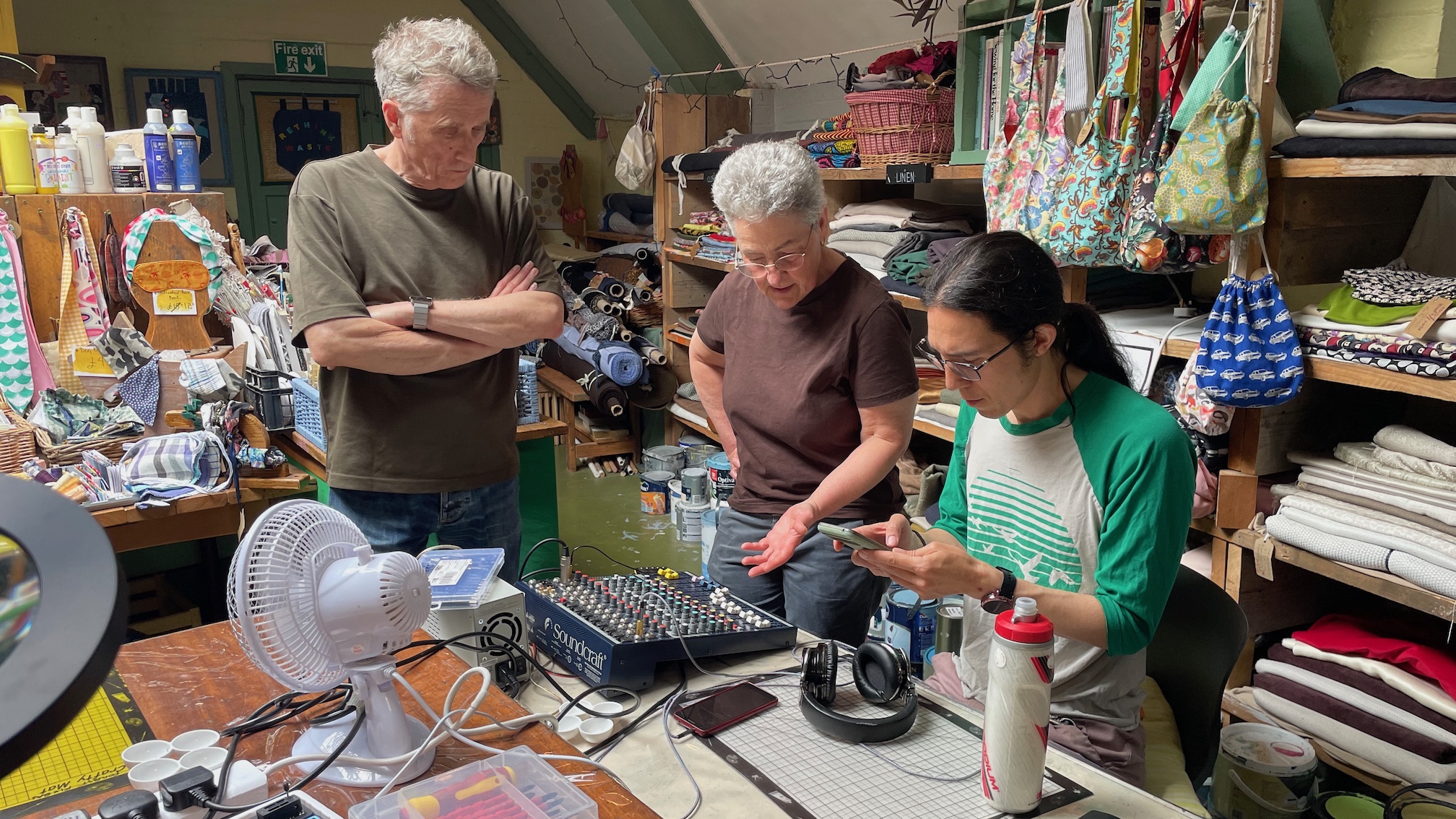
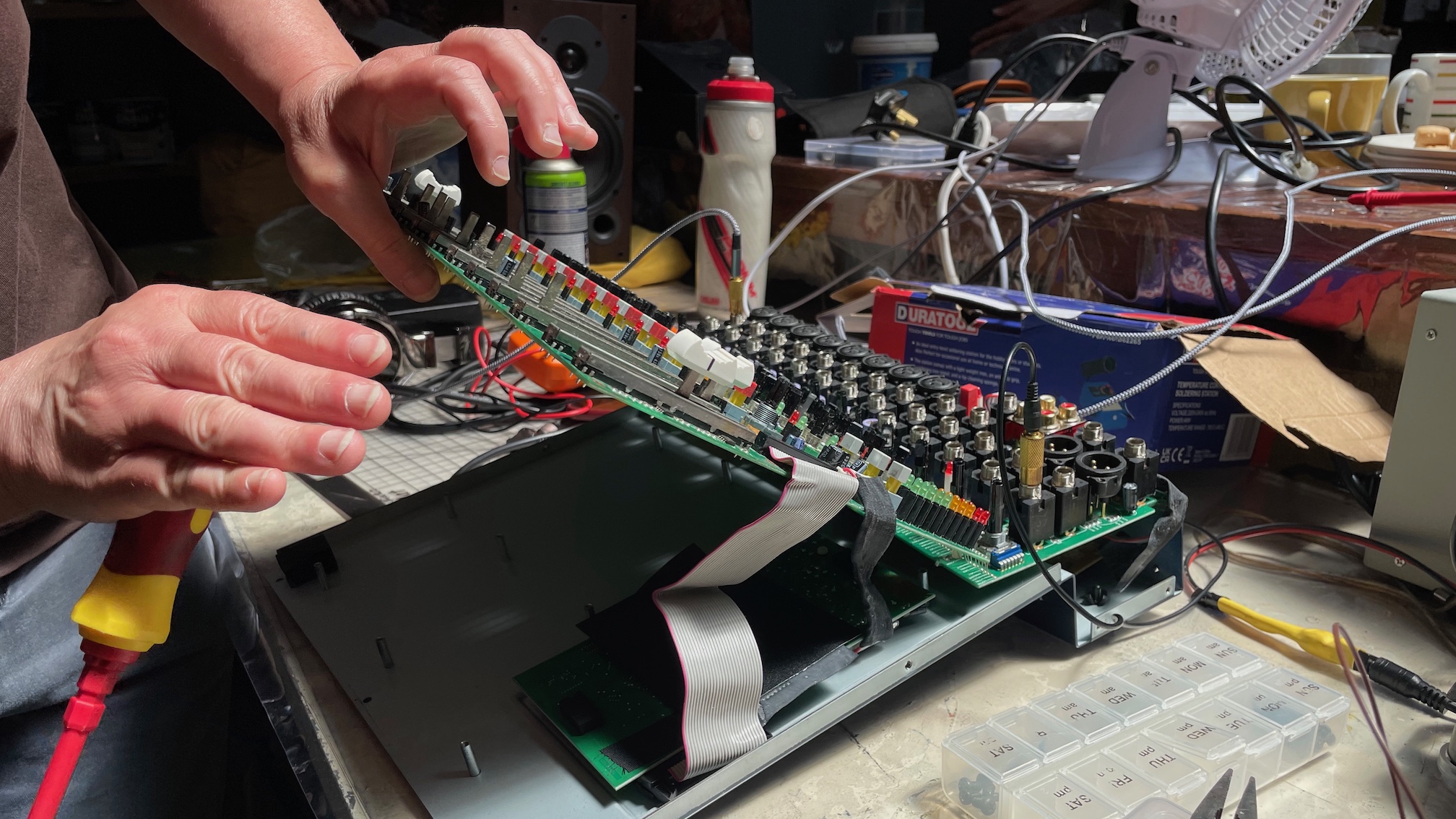
The session begins under the glare of fluorescent lights as volunteer Adrian Nettleship confronts a stubborn Soundcraft mixing console. The device, belonging to a friend, is suffering from a classic failure: audio is only outputting through a single channel. Initial suspicions pointed to a faulty XLR port, but diagnostic testing reveals the connector is functioning perfectly.
To trace the root cause, Adrian and his fellow repairers connect an oscilloscope to the mixer’s internal circuitry. By injecting a test signal and tracking its path across the board, they hope to locate where the audio signal degrades or disappears entirely. After an hour of inconclusive readings, the sheer complexity of the multi-channel board takes its toll. "I need a KitKat," Adrian mutters, stepping back to let his colleagues take a turn at the diagnostic bench.
[Audio Signal Source] ──> [Input Stage (XLR)] ──> [Fader/EQ Circuit] ──> [OP-Amp / Output Stage]
                                                        │
                                               (Signal Lost Here)
11:15 AM — The Smart Speaker Obsolescence Dilemma
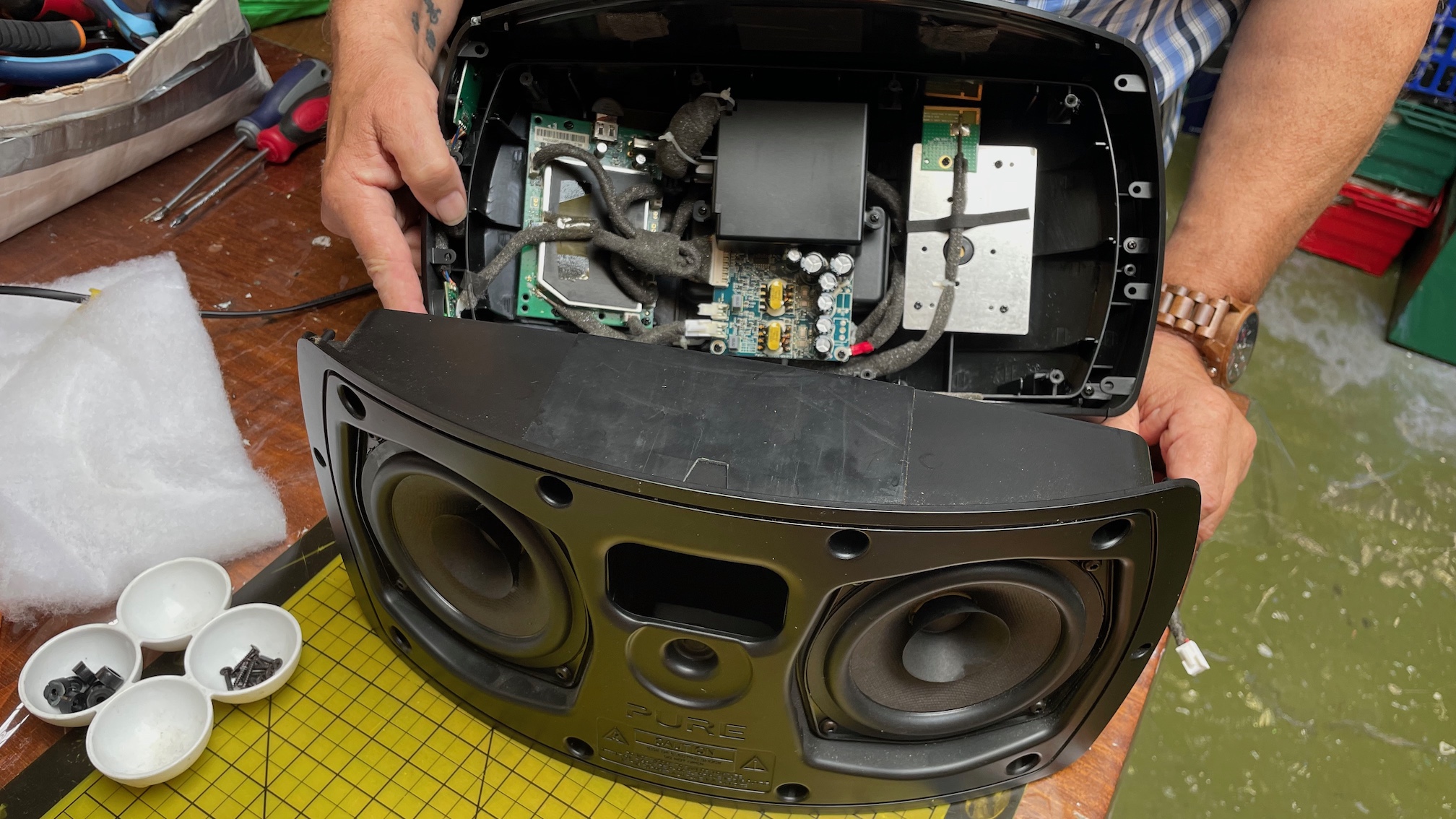
Stymied by the mixer, Adrian shifts his focus to his own faulty Pure Jongo T6X Bluetooth speaker. Originally launched in 2014, the Jongo was a well-regarded wireless speaker in its day, but it now exhibits heavy distortion and bass clipping.
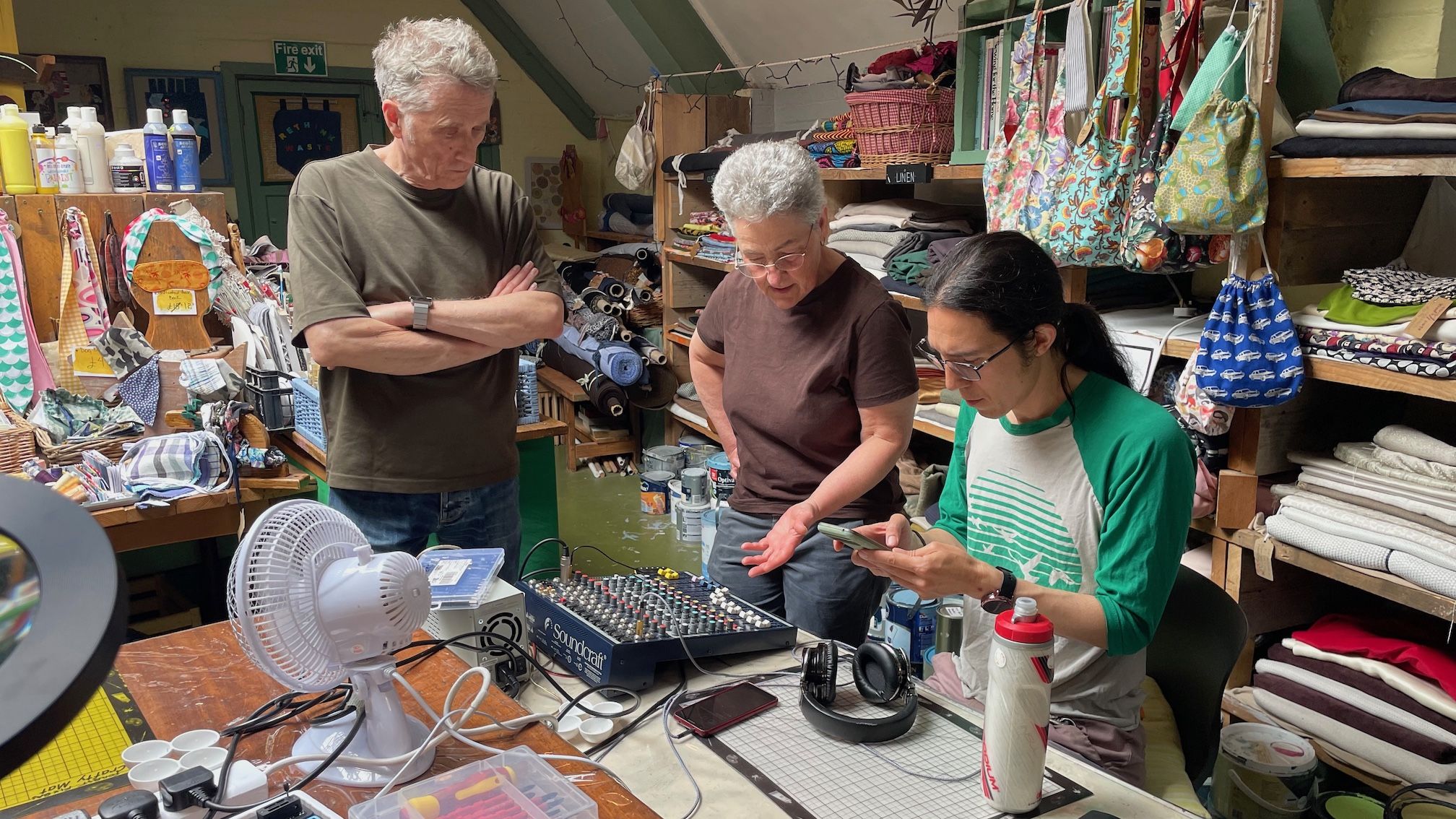
To diagnose the issue, Adrian plays a pure sine wave from a signal generator application on his mobile phone into the speaker. By systematically isolating the left and right audio channels, he identifies the culprit: one channel produces a clean tone, while the other emits a heavily distorted, "squelching" sound.
This repair highlights a broader issue in modern consumer electronics: software obsolescence. The official mobile application for the Pure Jongo is no longer supported on modern operating systems. To control the speaker, Adrian must use an obsolete smartphone that he keeps solely for this purpose. Despite the software hurdles, the hardware remains worth saving.
Volunteer Stefania Fantini assists by testing the speaker’s circuit board with a Yukiloon inductance detector, targeting a warm capacitor that suggests an electrical fault. When the reading remains inconclusive, Adrian searches online for a manufacturer datasheet. Finding none, he discovers that a replacement printed circuit board (PCB) costs £150—far exceeding the market value of the speaker itself. For the Forest Fixers, buying a pricey replacement board defeats the purpose of repair; the goal is to fix the component, not swap the module.
12:30 PM — The Legend of the NAD 3020i
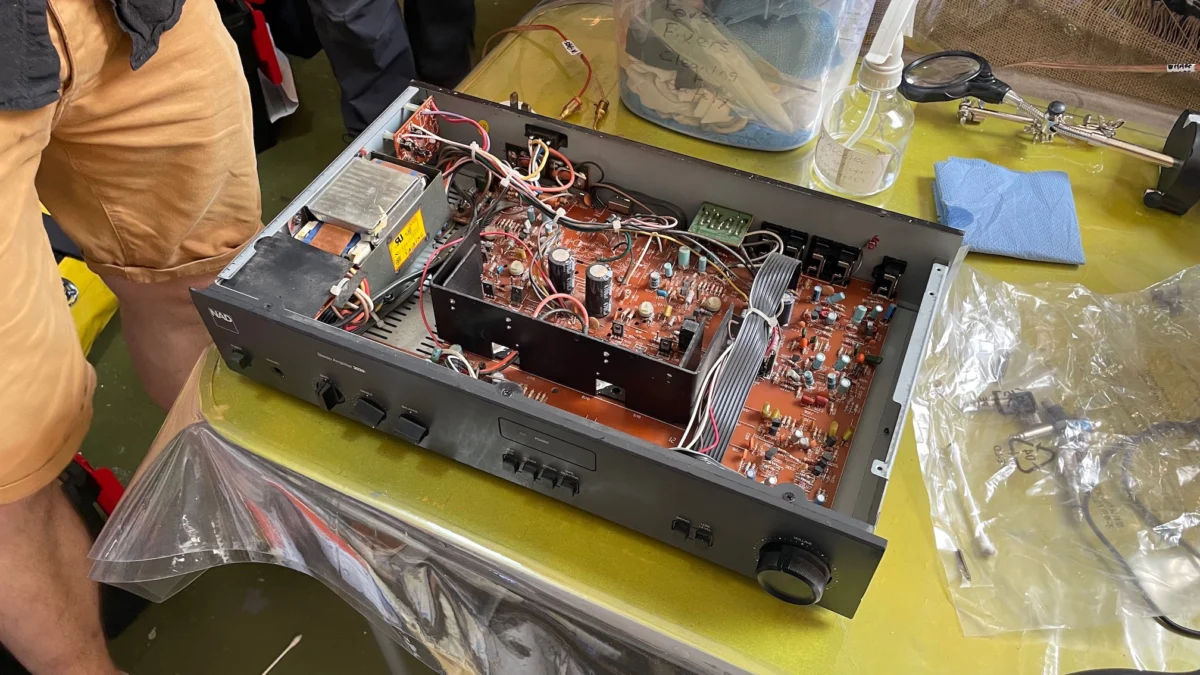
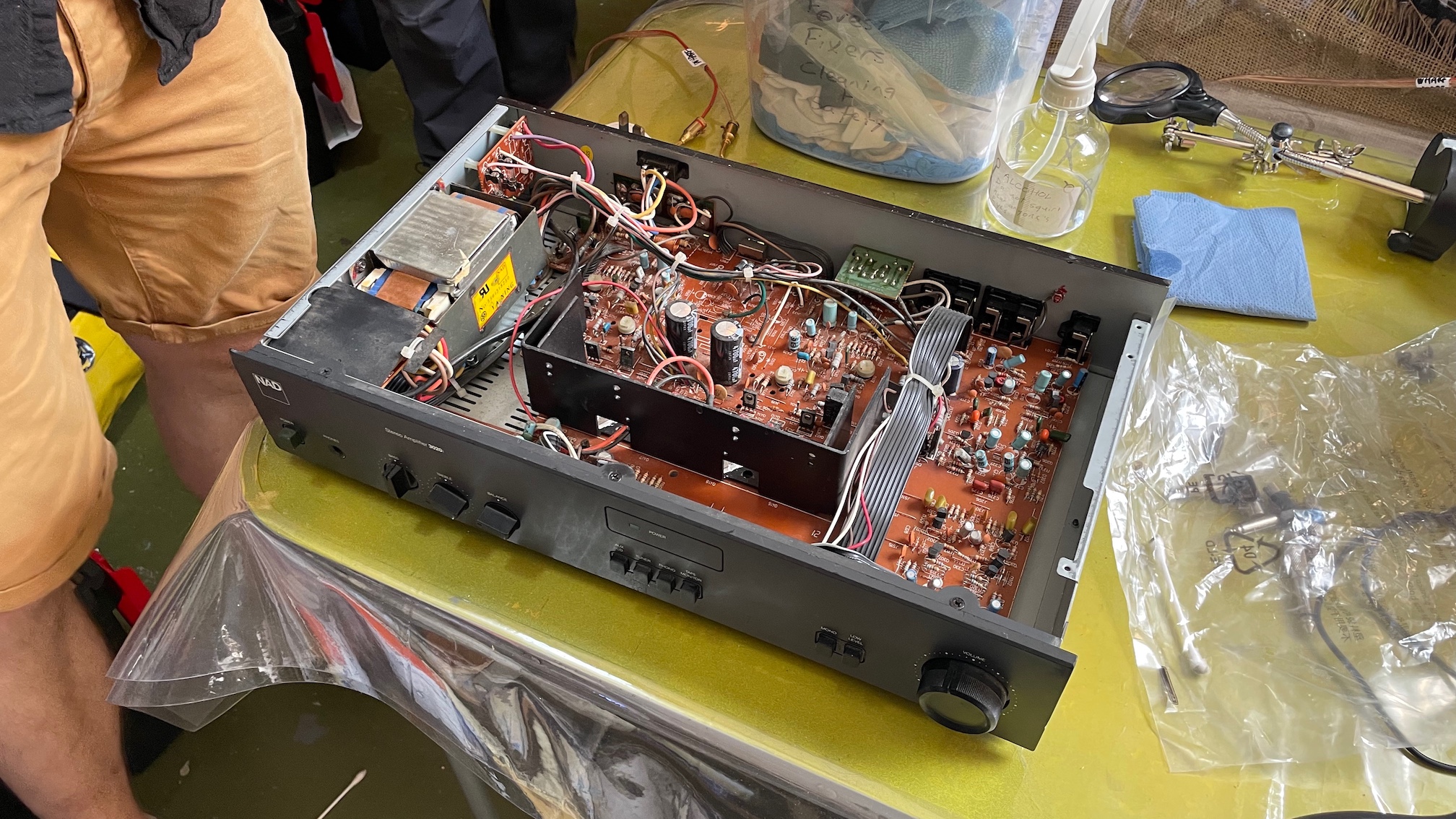
Meanwhile, visitor Lukas Kuhn arrives with a legendary piece of hi-fi history: a NAD 3020i integrated amplifier. Manufactured in 1991, the 3020 series is celebrated among audiophiles as one of the most important budget amplifiers ever made, credited with bringing high-fidelity sound to the masses.
Lukas’s unit, however, has seen better days. It outputs audio only at whisper-thin volumes, accompanied by a muffled, muddy tone. Opening the chassis reveals a time capsule of domestic wear:
- A thick layer of accumulated household dust.
- Multiple blown fuses.
- Several leaking electrolytic capacitors, which have spilled corrosive electrolyte onto the PCB.
Despite its dilapidated state, the NAD 3020i is highly repairable compared to modern equivalents. Its spacious layout, through-hole components, and widely available service manuals make it an ideal candidate for restoration, even if today’s efforts will serve as merely the first step in a long-term overhaul.
1:15 PM — Disassembling the Soundcraft Mixer
Back at the main bench, the team makes a breakthrough with the Soundcraft mixer. "We were having trouble getting the signal to pass through the fader and come out of the output, and that’s because we didn’t understand how the board worked," Adrian explains. After locating a misaligned routing button on the effects section, they successfully replicate the reported fault: the right channel is active, but the left channel remains entirely dead.
To access the physical components causing the drop-out, the mixer must be completely disassembled. This is no simple task. Unlike modern devices held together by clips or proprietary glue, the Soundcraft mixer uses traditional mechanical fasteners. However, the sheer volume of them is daunting. To remove the top metal plate, the team must systematically remove:
- Dozens of individual plastic fader knobs.
- Dozens of hexagonal nuts.
- Corresponding metal washers securing each potentiometer to the chassis.
Taking on this tedious task is Karl, a volunteer with 40 years of experience as a BBC sound engineer. "Now this is a job that AI can’t do," Karl jokes as he unscrews the hardware. "I’ve got to go soon, so it won’t be me who has to put it back together."
1:45 PM — The Serendipitous Turntable Success
Though today’s workshop is a closed session, the doorbell rings. A local family—a mother, father, and their teenage son—stand on the threshold carrying a vintage turntable. The son had recently been gifted the record player by an older relative, but the platter refused to spin. Despite the closed-door policy, organizer Lisa Percival welcomes them inside.
The device is a Pioneer PL-112D, a classic belt-drive turntable dating back to 1974. Once placed on the operating table, the diagnosis takes less than two minutes. Upon lifting the heavy aluminum platter, the team discovers that the original rubber drive belt has completely perished, turning into a brittle, sticky residue over fifty years of storage.
The motor itself is in perfect working order, spinning silently when powered on. Within minutes, the family uses a smartphone to order a replacement drive belt online for just £5. With the new belt installed, this piece of mid-70s engineering will easily provide another decade of service, introducing a new generation to vinyl. The family departs elated, illustrating the immediate, tangible value of community repair spaces.
Supporting Data: The Global E-Waste Crisis and the Rise of Repair Cafes
The activities of the Forest Fixers are part of a rapidly expanding global movement. According to the Open Repair Alliance’s 2024 Global Report, there are now more than 4,000 active community repair groups operating worldwide. These groups are driven by a combination of economic necessity, environmental awareness, and a desire to reclaim agency over the things we own.
Global Community Repair Groups (Active)
=======================================
2014: ── Approx. 500
2019: ──── Approx. 1,800
2024: ───────────────────────────────── Over 4,000 (Source: Open Repair Alliance)
The environmental stakes could not be higher. The United Nations’ Global E-waste Monitor reports that the world generates over 62 million metric tonnes of electronic waste annually, a figure that is rising five times faster than documented recycling efforts. E-waste is the fastest-growing domestic waste stream in the world, laden with hazardous materials like lead, mercury, and cadmium, which can leach into soil and water supplies when sent to landfills.
| Metric | Details |
|---|---|
| Annual Global E-Waste | 62 Million Metric Tonnes |
| Growth Rate | Rising 5x faster than documented recycling |
| Average Success Rate of Repair Cafes | Approximately 50% to 65% |
| Primary Drivers for Visitors | Cost-of-living crisis, environmental concerns, sentimental value |
Community repair cafes directly address this crisis. Data collected by the Open Repair Alliance indicates that volunteer-led repair groups maintain an average success rate of 50% to 65% across all attempted repairs. By extending the lifespans of household goods, these groups prevent thousands of tonnes of manufacturing-related carbon dioxide emissions and divert invaluable raw materials from waste streams.
Official Perspectives: Inside the Operations of a Volunteer-Led Initiative
Running a community repair group is an ongoing struggle against financial and logistical hurdles. Lisa Percival, who has organized the Forest Fixers for the past three years, emphasizes that the group relies entirely on volunteer goodwill.
"These devices are more involved than what people usually bring into our repair cafes," Percival notes, referring to the complex audio equipment on the benches. She explains that the group’s overall success rate hovers around 50%, which is highly respectable given the lack of specialized industrial tools.
The group’s challenges have been compounded by a loss of local government funding. "Since we lost our council funding, we’re all doing this unpaid," Percival says. The loss of financial support means the group must rely on donated spaces, like the Forest Recycling Project HQ, and voluntary contributions from the public to purchase essential safety equipment and consumables, such as solder, heat-shrink tubing, and cleaning solvents.
Despite these hurdles, the educational value of the space remains immense. The workshops encourage intergenerational mentoring. Younger hobbyists learn the fundamentals of analog electronics from veterans like Karl, whose four decades of BBC engineering experience provide an invaluable repository of practical troubleshooting knowledge.
Implications: The Circular Economy and Practical DIY Lessons
The work of the Forest Fixers highlights a critical shift in consumer culture: the transition from passive consumers to active custodians of technology.
Modern consumer electronics are frequently designed for the landfill. Thin chassis are glued shut rather than screwed together, components are soldered directly to mainboards to prevent modular upgrades, and proprietary security chips block third-party replacement parts. This practice, known as planned obsolescence, forces consumers into expensive replacement cycles.
In contrast, older audio equipment, like the Pioneer PL-112D turntable or the NAD 3020i amplifier, was designed with serviceability in mind. These devices feature physical switches, discrete components, and generous interior spacing, proving that sustainable product design is not a futuristic concept, but a historical standard we have abandoned.
For those inspired to attempt their own repairs at home, the Forest Fixers offer several crucial pieces of advice to ensure safety and success:
1. Perform Software and Factory Resets First
Before opening any device, perform a hard factory reset. Many apparent hardware failures, particularly in smart speakers and modern AV receivers, are actually software lockups or corrupted firmware.
2. Document the Disassembly Process
When taking a complex device apart, use small containers (such as egg cups or ice cube trays) to organize screws and small parts. Take high-resolution digital photographs at every stage of disassembly. These photos serve as an invaluable roadmap when trying to reassemble the device weeks later.
3. Seek Out Technical Documentation and Community Forums
For popular consumer electronics, search online for service manuals, schematics, or "data sheets." For devices with common failure modes—such as the notorious capacitor plagues in Apple HomePods—online forums often feature step-by-step repair guides written by users who have already solved the exact issue.
4. Prioritize Safety and PAT Testing
Safety must always come first. Working on devices that plug directly into mains voltage (110V–240V AC) carries a real risk of lethal electric shock. Capacitors inside amplifiers and power supplies can hold dangerous charges long after the device is unplugged. The Forest Fixers subject all repaired items to Portable Appliance Testing (PAT) to ensure they are electrically safe before they leave the workshop. Amateur repairers should never attempt to work on live high-voltage circuits without appropriate training and safety equipment.
Ultimately, the philosophy of the repair cafe is as much about community resilience as it is about environmental preservation. It is about slowing down, sharing tea and biscuits, and working together to solve difficult problems. Whether it is a quick fix like a five-pound turntable belt or a month-long diagnostic puzzle, every successful repair is a small victory against waste. And when the troubleshooting gets tough, there is always Adrian’s ultimate piece of advice: "Have a KitKat."